SMBC vs. MUFG! How to Maximize Rewards by Carrying Both Cards in the Battle for Point-Earning Supremacy


“With credit card services continuing to be downgraded and the trend toward lower point-reward rates for mobile payments showing no sign of stopping, the point-hacking scene is shrouded in a gloomy mood. However, there is one area where a fierce local battle is being waged. It is the retail (consumer) banking sector of the megabanks.
Mitsui Sumitomo Bank, which was quick to enter the race for dominance among financial ecosystems, and Mitsubishi UFJ Bank, which is rebuilding its retail strategy in response, are competing to lock in customers at convenience stores, supermarkets, restaurants and other establishments by offering reward rates of 20%, an exceptionally high rate by today’s standards.
This local battle is certain to affect the future competition among financial ecosystems, but simply sitting back and watching would be a waste. Along with the megabanks’ strategies, we asked experts for tips on how to take advantage of this battle to save money.”
It all started with a major overhaul of the Mitsui Sumitomo Card
Let’s briefly look back at how we got here.
It all began in February 2020, when Mitsui Sumitomo Card underwent its first major overhaul in 30 years. The card design and other elements were revamped, and as part of a campaign, customers could earn up to 5% cashback at participating convenience stores and McDonald’s. Although the number of participating stores was limited, a 5% reward rate was exceptional even compared with the mobile QR-code payment services (the so-called “○○ Pay” services) that were booming at the time.
In March 2023, the “V Point Up Program” was launched. By meeting certain conditions, customers could earn up to 18%. Then, in July of the same year, the reward rate at participating stores was raised from 5% to 7%, and combining this with the V Point Up Program made a maximum reward rate of 20% possible.
In April 2024, T-Point was integrated into the program, dramatically increasing awareness of V Points. Since then, the stores eligible for the 7% reward have expanded to convenience stores, fast-food restaurants, family restaurants and café chains, greatly improving convenience.
Mitsubishi UFJ card suddenly steps up its game
Meanwhile, Mitsubishi UFJ Card underwent a revamp in July 2021, including a name change from MUFG Card. Although it initially showed some enthusiasm with membership campaigns and the like, it lacked any major selling point and remained largely unremarkable. Then, in July 2022, it launched a service offering up to 5.5% rewards for purchases at participating convenience stores.
This was clearly intended to compete with the 5% offered by Mitsui Sumitomo Card at the time, adding 0.5 percentage points to highlight its advantage. However, the initiative attracted little attention. In addition to being limited to two convenience store chains, Mitsui Sumitomo Card responded by introducing the V Point Up Program and, as mentioned above, a 7% reward rate exceeding 5.5%.
After that, Mitsubishi UFJ Card continued expanding its list of participating stores, but it still struggled to attract much attention.
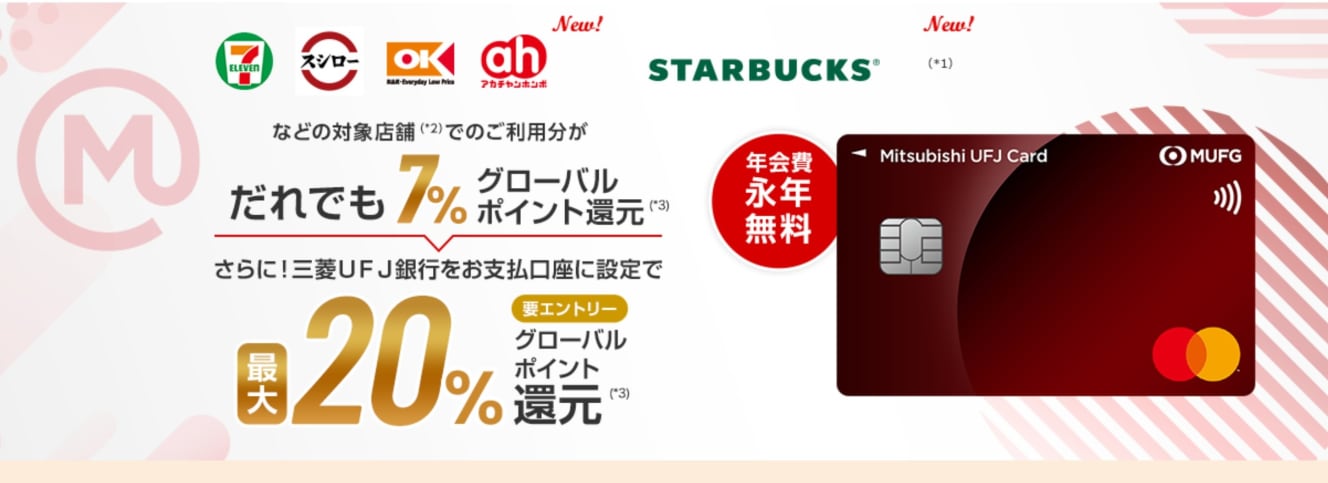
Then, in June 2025, it launched a major comeback. It raised the standard reward rate at participating stores from 5.5% to 7% while updating its point-up program to offer a maximum reward rate of 20%. At that point, on the surface, it had almost caught up with Mitsui Sumitomo Card.
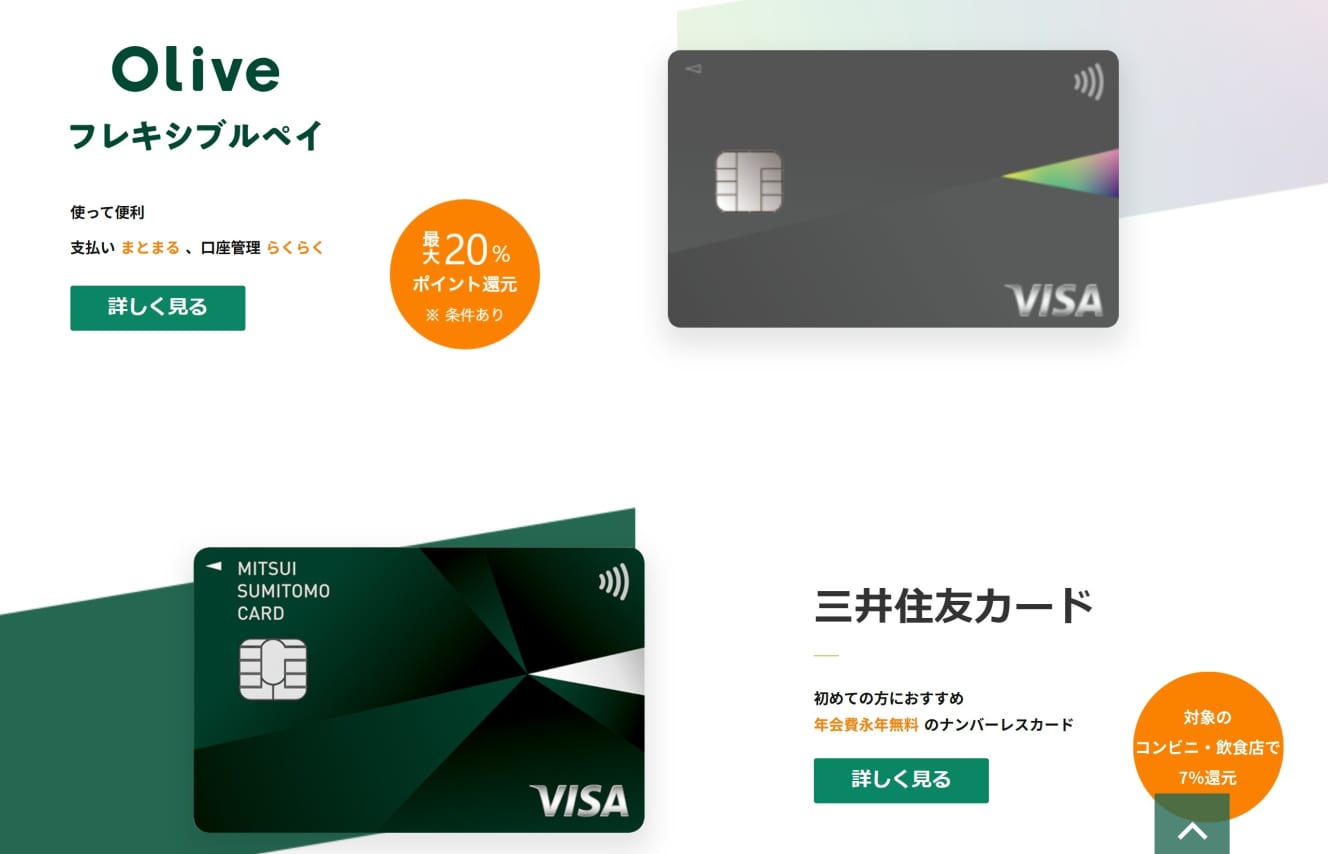
But the story does not end there. In February 2026, Mitsui Sumitomo Card revised its point service, offering 8% rewards for contactless payments with the “Olive Flexible Pay,” and as much as 11% specifically at 7-Eleven. This move effectively restored its advantage over Mitsubishi UFJ Card. This back-and-forth is likely to continue.
Mitsui Sumitomo for dining, UFJ for supermarkets
For reference, let’s look at the participating stores for each card. The only overlap is 7-Eleven and Lawson. Mitsui Sumitomo Card is particularly strong at fast-food restaurants and other dining establishments, while Mitsubishi UFJ Card has an advantage at supermarkets. However, Mitsui Sumitomo Card has more nationwide chains, giving it an edge in terms of ease of use.
Requirements for the maximum 20% reward
The maximum reward rate for Mitsui Sumitomo Card is 20%, but the full 20% is available only when paying with the “Olive Flexible Pay.” Olive Flexible Pay is a card issued when you register for an “Olive Account.” It combines the functions of a cash card with those of a credit card, debit card and other payment functions.
After setting this card to credit mode in the Mitsui Sumitomo Bank app, registering it with Apple Pay or Google Pay on your smartphone, and using smartphone contactless payment at participating stores, you can earn 8% rewards.
Even if you make payments in the same way with a Mitsui Sumitomo Card (NL), you will receive only 7%, and even after meeting the conditions of the V Point Up Program, the maximum reward rate is limited to 18.5%. With either card, if you use the physical credit card for contactless payment instead of your smartphone, you will receive only 0.5%.
In other words, within the Mitsui Sumitomo Card lineup, the Olive Flexible Pay receives preferential treatment. There are still quite a few explanatory videos and websites with outdated information about these details, so be sure to exercise caution.

The mysterious Olive
Launched in March 2023 alongside the V Point Up Program, “Olive” is described by Mitsui Sumitomo Bank as an all-in-one financial service for individuals. Specifically, it is embedded as a mini-app within the bank’s app, allowing users to apply to open an SBI Securities account and use Money Forward ME’s asset-management functions, among other features. It certainly offers impressive functionality, but to be honest, it can be difficult for ordinary users to grasp the overall picture.
An Olive Account, in the end, is simply an online bank account for which no passbook is issued. The basic structure to remember is: Olive Account = multifunctional online account; Olive Flexible Pay = the cash card issued when you open an Olive Account.
Meanwhile, in June 2025, when Mitsubishi UFJ Bank raised its credit card reward rate to 7%, it also launched a mini-app called “emutto,” offering functions and services similar to Olive. Unlike Olive, users do not need to create a separate account and existing customers who already hold an account can start using it immediately, making its design easier to understand.
Major retail players join the V point ecosystem
Let’s take a look at the rivalry between the megabanks’ credit cards, as well as the strategies of each side and what may lie ahead.
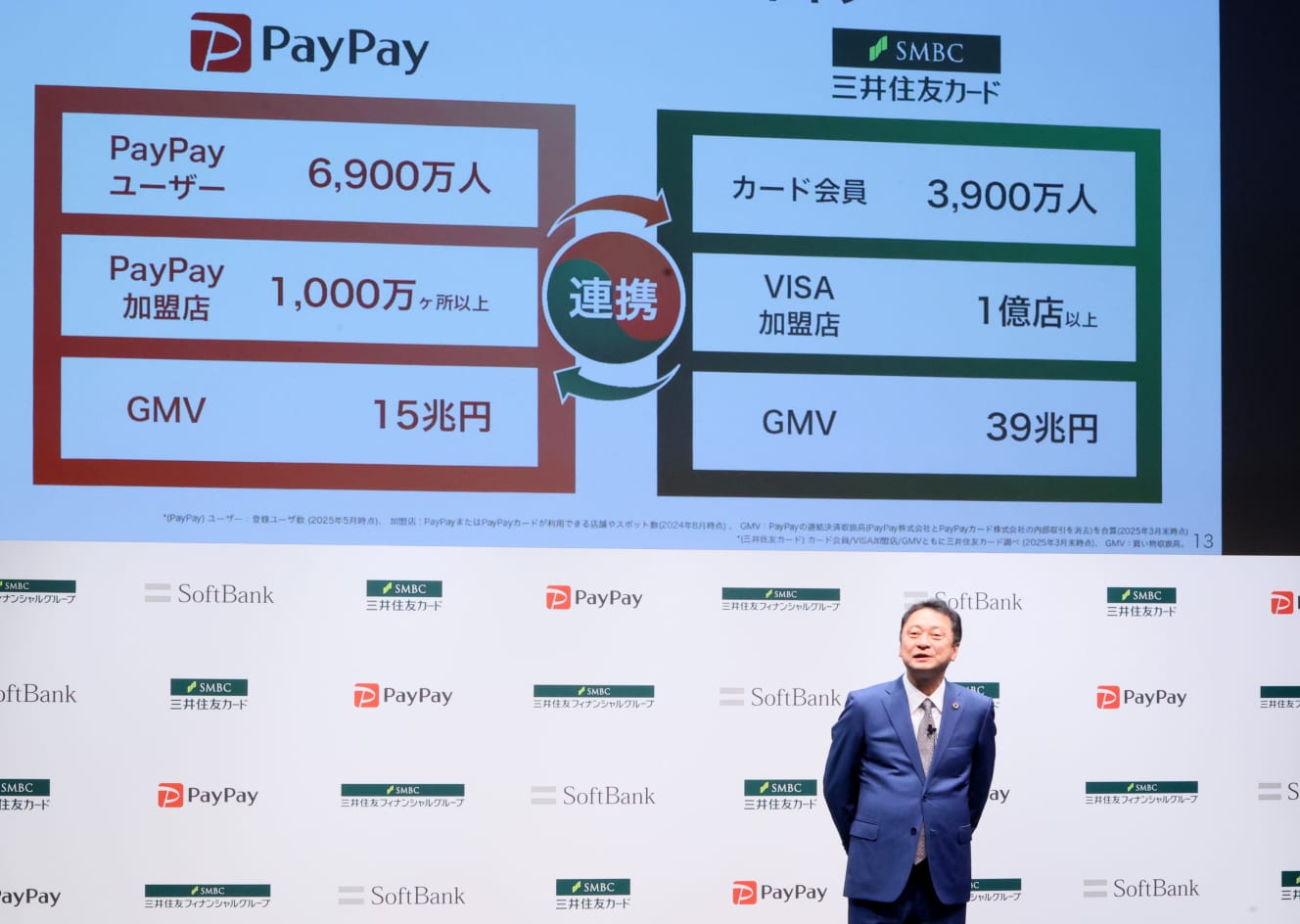
First, Mitsui Sumitomo is seriously aiming to establish dominance with its “V Point ecosystem.” In June 2026, reciprocal exchanges between PayPay Points and V Points began. Partnering with PayPay Points, which has an overwhelming share of smartphone code payments and is also easy to use for online shopping, significantly improves the convenience of V Points.
What’s more, at the end of the following July, Seven & i Holdings and Seven-Eleven Japan announced that they had entered into a capital and business alliance with Mitsui Sumitomo Card, in addition to SoftBank Group companies SoftBank, PayPay and LY Corporation.
This is a full-scale initiative that will integrate “7iD,” Seven & i Holdings’ common customer-membership platform, with “PayPay ID.” Since 7iD also includes Ito-Yokado customers, the ripple effect on V Point membership could be substantial. A major piece is being added to the retail sector, which had been a weakness.
8% rewards when you ride! Targeting the transportation sector
The Mitsui Sumitomo camp also has a powerful weapon: stera. stera is a next-generation payment platform developed by Mitsui Sumitomo Card in collaboration with Visa Worldwide Japan and others, offering various services to businesses.
One of those services, stera transit, is a public transportation payment system that allows passengers to ride trains and buses by using credit card contactless payments at railway station ticket gates and bus boarding points. It has already become widespread among private railway operators in the Tokyo metropolitan area, so quite a few people are likely already using it.
When it comes to transportation-related points, Suica has long dominated the field. But stera transit is arguably the only system capable of challenging that stronghold, given its better cost-effectiveness than Suica in terms of system maintenance and renewal costs. The accumulation of individual transportation data could also lead to new marketing initiatives and services, giving it a major advantage that other camps do not have.
Since April 2026, a campaign has been offering up to 8% rewards when users ride eligible railways and buses using smartphone contactless payments. In the Kanto region, major private railway operators, Tokyo Metro and the Toei Subway are among those covered. As with other offers, earning the full 8% requires smartphone contactless payment using a device with Olive Flexible Pay registered on it.
stera transit has been criticized for lacking a service equivalent to a commuter pass, which has been seen as a weakness. However, something resembling a commuter pass is scheduled to launch sometime in 2027, which could give adoption another boost.
What is Mitsubishi UFJ’s biggest weakness?
The Mitsubishi UFJ camp, on the other hand, gives the impression that it has yet to fully commit. The reason is that its points, which form the foundation of its ecosystem, are difficult to understand. The “Global Points” earned through Mitsubishi UFJ Card can be exchanged for other points through the website, but there are no points that can be used interchangeably within the ecosystem.
For example, in the “Rakuten ecosystem” and “Docomo ecosystem,” the points associated with those ecosystems circulate as a form of “money” within them. The greater the volume of points in circulation, the larger the ecosystem can be considered to be.
That is why the name recognition and convenience of points are important, and why different point systems have been made interoperable. When points are easy to accumulate and convenient to use, users are naturally encouraged to actively collect them.
Global Points were carried over unchanged from the former “MUFG Card” when it was revamped and renamed Mitsubishi UFJ Card. Although they have been awarded to users for a considerable period of time, their name recognition has never really increased, and there has been little sign of any serious effort to popularize them.
Why did Mitsubishi UFJ leaves out Ponta?
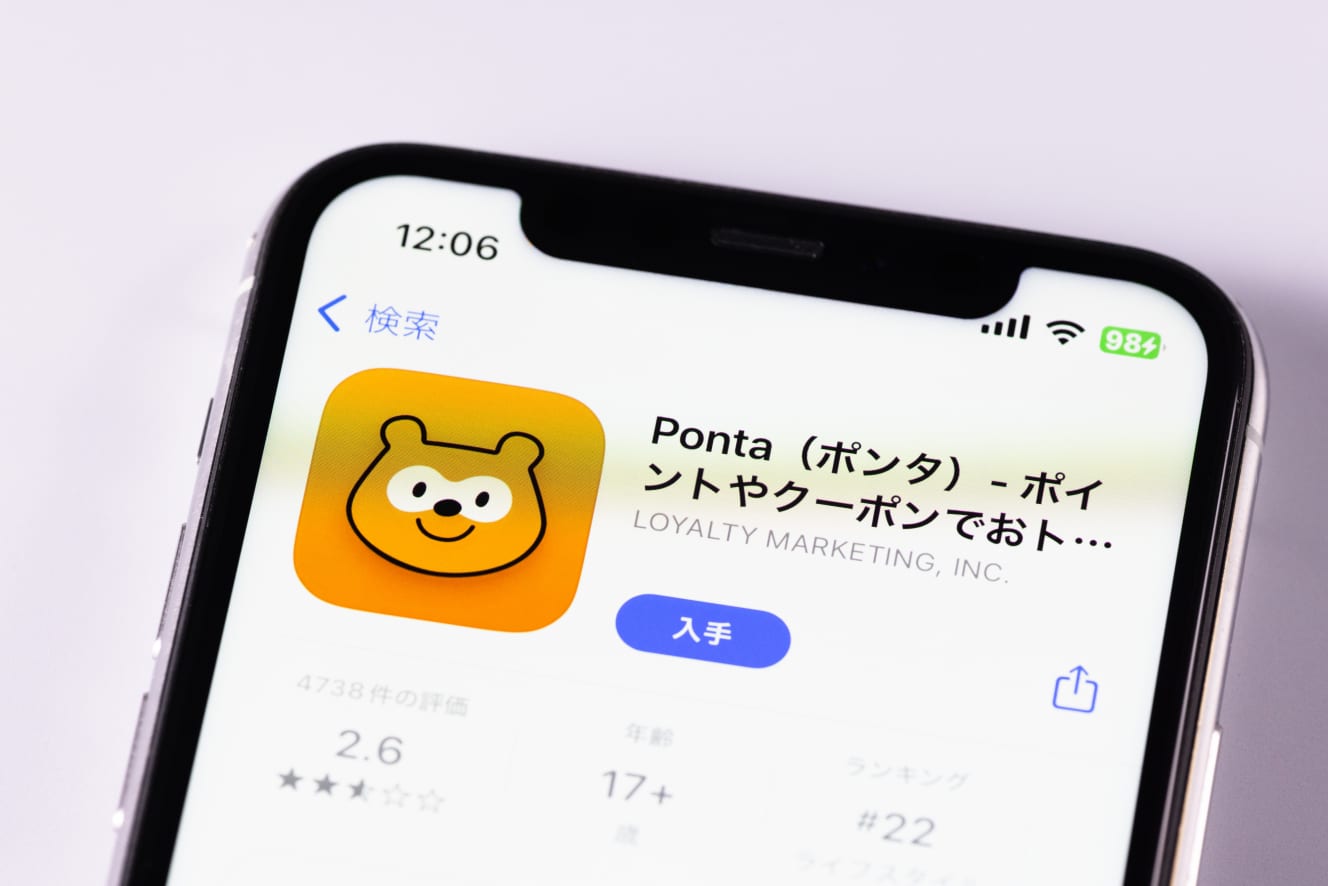
Mitsubishi UFJ could have chosen to offer “Ponta Points” as rewards. Ponta’s business is operated by Loyalty Marketing, which Mitsubishi Corporation established in August 2008. Mitsubishi Corporation remains its largest shareholder, while Mitsubishi UFJ Bank is also one of its major shareholders, albeit with a smaller stake.
KDDI is the second-largest shareholder after Mitsubishi Corporation, and under a scenario in which Ponta Points would become a common-point system and Mitsubishi UFJ would join forces with au (KDDI) to seek dominance, Ponta Points are being offered as a benefit of Mitsubishi UFJ Bank’s services.
Why, then, did this scenario fail to materialize? One possibility is that Mitsubishi UFJ revised the course of its retail strategy. In November 2024, it announced that it would purchase all of KDDI’s shares in what was then au Kabucom Securities, which had been jointly owned and operated with au, making the company a wholly owned subsidiary of Mitsubishi UFJ Bank. After the acquisition was completed, its name was changed to Mitsubishi UFJ e Smart Securities.
At the same time, Mitsubishi UFJ said it would transfer all of its stake in au Jibun Bank to KDDI. In effect, this brought an end, at least for the time being, to its partnership with KDDI dating back to the former “Jibun Bank,” established in 2008. KDDI probably wanted to continue the partnership, but perhaps in the process of making this decision, Mitsubishi UFJ reviewed its retail strategy and chose to pursue an independent path.
Mitsubishi UFJ’s strategy to dominate payments
Rather than seeking to build a conventional financial ecosystem, Mitsubishi UFJ’s strategy appears to be to specialize in financial and payment services in the retail sector and establish dominance there. Let us examine the clues one by one.
As mentioned earlier, the “emutto” mini-app embedded in Mitsubishi UFJ Bank’s online-banking app serves as an entrance to the group’s various companies. From there, users can access Mitsubishi UFJ Card, Mitsubishi UFJ e Smart Securities, and the code-payment service “COIN+,” while also being able to apply for card issuance or account opening and check their usage status.
What deserves particular attention is COIN+. It is a payment brand operated by Recruit MUFG Business, which was established through joint investment by Mitsubishi UFJ Bank and Recruit, and is expected to become the centerpiece of a comeback in the point-services area, currently a weakness for Mitsubishi UFJ.
In fact, there are plans to launch a point program called “emutto Points” during fiscal 2026 (by March 2027). emutto Points are expected to become the common points for the Mitsubishi UFJ Group, with the current Global Points expected to be migrated to the new system, although the details have yet to be determined.
What is important is that it has been announced that emutto Points will be transferable to COIN+. If this becomes a reality, users will be able to convert their points into cash and withdraw them, as well as use them for transfers and remittances. That is because COIN+ is treated almost like cash. If credit-card spending also earns emutto Points, users should have no trouble finding ways to use them.
There are other ways to convert various points into cash, but they take time and, above all, the procedures are complicated and cumbersome. COIN+ was established as part of a plan to transfer Mitsubishi UFJ Bank’s digital-currency business, and it also supports digital salary payments, in which salaries are paid through COIN+.
There may be some legal hurdles that need to be cleared, but they do not appear to be particularly high.
The future of stablecoin integration
Integration with stablecoin is another possibility. Stablecoins are a type of crypto asset designed to maintain a value linked to fiat currencies such as the Japanese yen or U.S. dollar. In Japan, the first yen-pegged stablecoin, “JPYC,” was issued in October 2025. Among the megabanks, Mitsubishi UFJ Bank has been the most proactive in pursuing stablecoins.
In recent years, Mitsubishi UFJ Bank has been promoting collaborations on digital money with major overseas financial institutions. Just recently, it announced the establishment of a new company jointly with 21 major financial institutions to support the issuance of stablecoins. Mitsubishi UFJ is the only Japanese bank participating.
A consortium of Japan’s three megabanks has now been established with the goal of jointly issuing a yen-denominated stablecoin during fiscal 2026, but I believe there is also a possibility that Mitsubishi UFJ Bank could get ahead of the others and move forward on its own.
The Mitsubishi UFJ Financial Group also plans to launch a new digital bank during fiscal 2026. Details remain unclear, but it is conceivable that this digital bank could handle stablecoins as well. If emutto Points could be exchanged for stablecoins, Mitsubishi UFJ could establish a significant presence in the payments sector.
I have gone on at length, but as end users, we should focus on how to benefit from the competition between these megabanks. Neither side is likely to back down easily, so this is expected to become a long-term battle.
Both Olive Flexible Pay and Mitsubishi UFJ Card have no annual fee for their standard cards. Of the maximum 20% reward rate, earning an additional 10% or so in points can be achieved relatively easily through measures such as logging into the app and configuring your credit card.
By all means, I recommend having two cards and making full use of them.
Reporting and Text: Kenji Matsuoka
Money writer and financial planner. After working as a market analyst at a securities firm, he became independent in 1996. He writes articles on finance and asset management, primarily for business and economic magazines.His books include *The First-Year Guide to Robo-Advisor Investing* and *Easy to Understand with Plenty of Illustrations! The Definitive Guide to Maximizing Benefits from Cashless Payments*. ■X (formerly Twitter) → @1847mattsuu
PHOTO: Afro