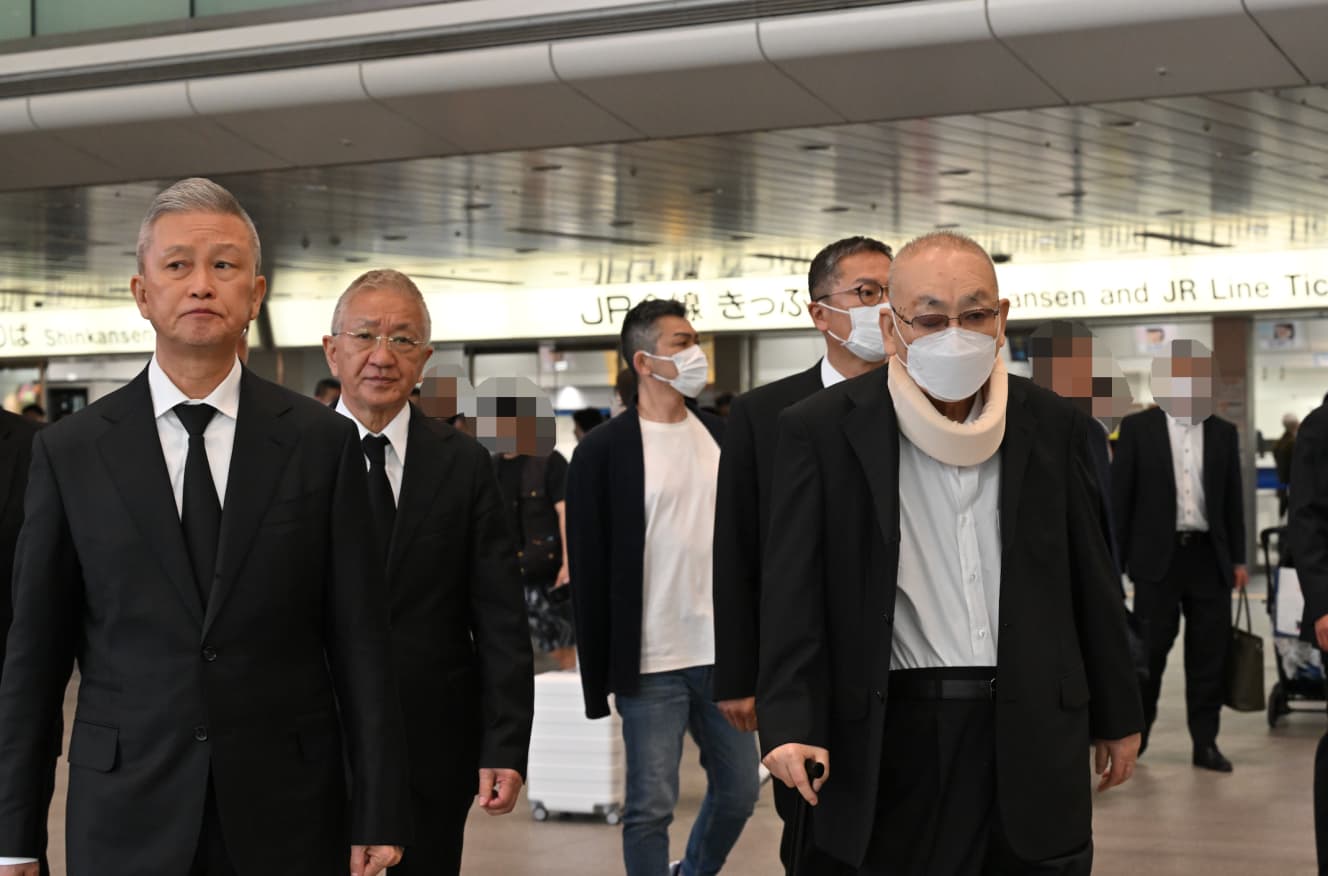
Takayama Kiyoshi (right), who was appointed advisor this April. He handed over the wakagashira position to Teruaki Takeuchi (left) of Kodo-kai, the organization from which he himself originates. Lifting the Specified Violent Conflict designation will take time A senior investigative official from the police authorities mentioned earlier emphasizes: “Even if the Sixth Yamaguchi-gumi declares an end to the conflict, it’s not something we can simply accept at face value. Their objective may be to have the specified violent conflict designation lifted, but the fact that they remain in a state of confrontation has not changed. For the time being, the designation will likely continue.” The specified violent conflict designated organized crime group referred to here is an organization designated by a prefectural Public Safety Commission under the Anti-Organized Crime Law when designated crime syndicates are in a state of violent confrontation and there is a risk of serious harm to the general public. This provision was newly established in the fifth revision of the Anti-Organized Crime Law in 2012. Once designated as a specified violent conflict organized crime group, the Public Safety Commission designates alert zones, within which actions such as five or more members of the same crime syndicate gathering together are prohibited. Violations can result in immediate arrest without going through administrative orders such as cease-and-desist notices. Alert zones are set in cities such as Osaka, Kobe, and Nagoya. The Sixth Yamaguchi-gumi and the Kobe Yamaguchi-gumi were designated in January 2020 on the grounds that their confrontation had intensified since the fall of 2019. The Sixth Yamaguchi-gumi is also designated as being in violent conflict with the Ikeda-gumi and the Kizuna-kai, both of which further split off from the Kobe Yamaguchi-gumi. As a result, the group is in a triple designation state. Regarding specified violent conflict designated organized crime groups, the first case occurred in December 2012, when the Dojin-kai, based in Kyushu, split in a similar manner and repeatedly clashed with the Kyushu Seido-kai. In that conflict, more than ten people were killed on both sides, and there were civilian victims as well. Although both the Dojin-kai and the Kyushu Seido-kai declared an end to the conflict in June 2013, the restrictions under the designation were not lifted until June 2014, one year later. Given this precedent, the lifting of the designation for the Sixth Yamaguchi-gumi and the Kobe Yamaguchi-gumi remains uncertain. As the confrontation has calmed, the Sixth Yamaguchi-gumi revealed personnel changes this April, with Wakagashira Takayama Kiyoshi (78), who had served as the organization’s number two for approximately 20 years, stepping down to become an advisor. His successor as wakagashira is Wakagashira-hosa Teruaki Takeuchi (65). Once again, the top leadership pairing of Sixth Yamaguchi-gumi boss Shinobu Tsukasa (83) and Takeuchi consists entirely of members originating from the Kodo-kai. While the Sixth Yamaguchi-gumi steadily moves forward with consolidating its organization, the Kobe Yamaguchi-gumi has shown no overt activity. Organizational shrinkage is unavoidable, and the reality is that the disparity between the two sides continues to widen.(Honorifics omitted)
 Share on SNS