A Pivotal Year After the Sixth Yamaguchi Gumi Declared an End to the Feud


〈For the Sixth Yamaguchi-gumi, 2025 became a milestone year. It unilaterally put an end to the split conflict that had continued with the Kobe Yamaguchi-gumi. Nonfiction writer Masahiro Ojima, author of works such as The Truth Behind the Yamaguchi-gumi Split, looks back on this turbulent year.〉

Japan’s largest yakuza syndicate, the Sixth Yamaguchi-gumi, split in August 2015, and the confrontation and conflict with the breakaway Kobe Yamaguchi-gumi has now lasted 10 years.
During that time, murder cases involving the use of handguns occurred, and at one point there were near-daily incidents such as gunfire at rival offices, dump trucks and other large vehicles ramming into buildings, Molotov cocktail attacks, and brawls in entertainment districts, resulting in the deaths of dozens of people. However, in April of this year, the Sixth Yamaguchi-gumi unilaterally declared an end to the conflict. Perhaps because of that, no major incidents have occurred since, and things have remained relatively calm as the year draws to a close.
At the time of the split, the Sixth Yamaguchi-gumi had about 6,000 members, while the Kobe Yamaguchi-gumi had about 2,800, giving a power balance of roughly two to one. Initially, new members joined one after another, and the Kobe Yamaguchi-gumi appeared to have momentum. However, from around the fall of 2019, a series of violent incidents occurred, including the shooting deaths of senior Kobe Yamaguchi-gumi members. The Sixth Yamaguchi-gumi gained the upper hand, and according to the latest data compiled by police authorities as of the end of 2024, the Sixth Yamaguchi-gumi has about 3,000 members, while the Kobe Yamaguchi-gumi has declined sharply to about 120.
Conflict incidents that also occurred in 2025
Over the 10 years since the split, 95 percent of the Kobe Yamaguchi-gumi’s members have left the organization. A senior police official in charge of organized crime countermeasures commented, “Based on membership data as of the end of this year, it is possible that the Kobe (Yamaguchi-gumi) side is down to double digits,” suggesting that the gap between the two sides will widen even further.
The final conflict-related incident this year is said to have been an arson attack in January on the Kobe residence of Kobe Yamaguchi-gumi leader Kunio Inoue (77). A former senior member affiliated with the Sixth Yamaguchi-gumi entered Inoue’s property carrying a handgun, poured gasoline, and set two vehicles on fire. He was arrested on suspicion of arson of structures and other property, as well as violation of the Firearm and Sword Possession Control Law.
As the confrontation has calmed, the groups are entering the year-end and New Year period. A designated organized crime gang executive active in the Tokyo metropolitan area, who has closely watched the split, offered the following view:
“In yakuza society, there is an unwritten rule known as giri-goto—during celebratory events such as a boss’s succession ceremony, or solemn occasions like the funeral of a senior member, fighting is avoided. During the auspicious New Year period, people generally lie low, but there is absolutely no guarantee that nothing will happen.”
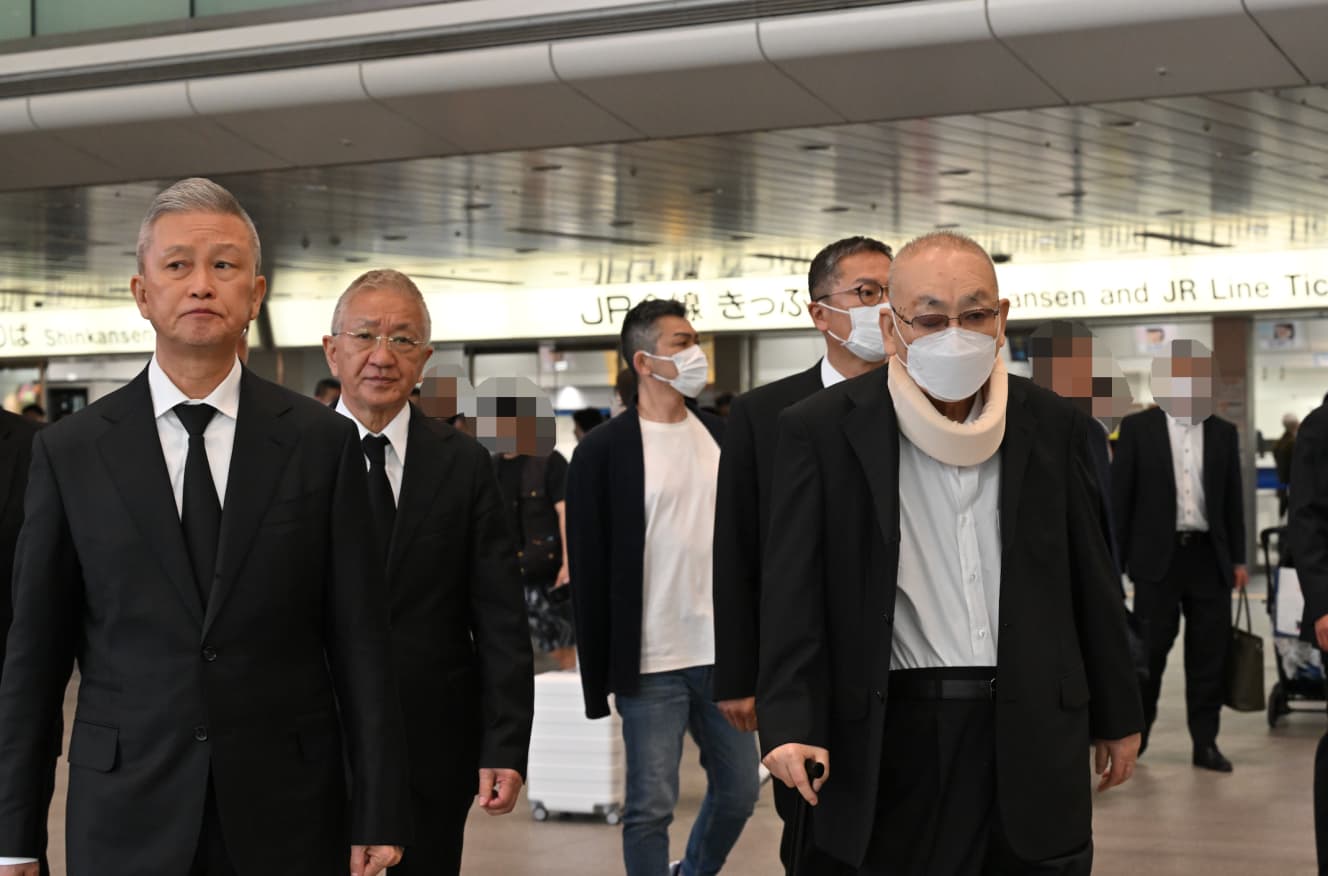 Takayama Kiyoshi (right), who was appointed advisor this April. He handed over the wakagashira position to Teruaki Takeuchi (left) of Kodo-kai, the organization from which he himself originates.
Lifting the Specified Violent Conflict designation will take time
A senior investigative official from the police authorities mentioned earlier emphasizes: “Even if the Sixth Yamaguchi-gumi declares an end to the conflict, it’s not something we can simply accept at face value. Their objective may be to have the specified violent conflict designation lifted, but the fact that they remain in a state of confrontation has not changed. For the time being, the designation will likely continue.”
The specified violent conflict designated organized crime group referred to here is an organization designated by a prefectural Public Safety Commission under the Anti-Organized Crime Law when designated crime syndicates are in a state of violent confrontation and there is a risk of serious harm to the general public. This provision was newly established in the fifth revision of the Anti-Organized Crime Law in 2012.
Once designated as a specified violent conflict organized crime group, the Public Safety Commission designates alert zones, within which actions such as five or more members of the same crime syndicate gathering together are prohibited. Violations can result in immediate arrest without going through administrative orders such as cease-and-desist notices. Alert zones are set in cities such as Osaka, Kobe, and Nagoya.
The Sixth Yamaguchi-gumi and the Kobe Yamaguchi-gumi were designated in January 2020 on the grounds that their confrontation had intensified since the fall of 2019. The Sixth Yamaguchi-gumi is also designated as being in violent conflict with the Ikeda-gumi and the Kizuna-kai, both of which further split off from the Kobe Yamaguchi-gumi. As a result, the group is in a triple designation state.
Regarding specified violent conflict designated organized crime groups, the first case occurred in December 2012, when the Dojin-kai, based in Kyushu, split in a similar manner and repeatedly clashed with the Kyushu Seido-kai. In that conflict, more than ten people were killed on both sides, and there were civilian victims as well. Although both the Dojin-kai and the Kyushu Seido-kai declared an end to the conflict in June 2013, the restrictions under the designation were not lifted until June 2014, one year later. Given this precedent, the lifting of the designation for the Sixth Yamaguchi-gumi and the Kobe Yamaguchi-gumi remains uncertain.
As the confrontation has calmed, the Sixth Yamaguchi-gumi revealed personnel changes this April, with Wakagashira Takayama Kiyoshi (78), who had served as the organization’s number two for approximately 20 years, stepping down to become an advisor. His successor as wakagashira is Wakagashira-hosa Teruaki Takeuchi (65). Once again, the top leadership pairing of Sixth Yamaguchi-gumi boss Shinobu Tsukasa (83) and Takeuchi consists entirely of members originating from the Kodo-kai.
While the Sixth Yamaguchi-gumi steadily moves forward with consolidating its organization, the Kobe Yamaguchi-gumi has shown no overt activity. Organizational shrinkage is unavoidable, and the reality is that the disparity between the two sides continues to widen.
(Honorifics omitted)
PHOTO: Takero Shintai