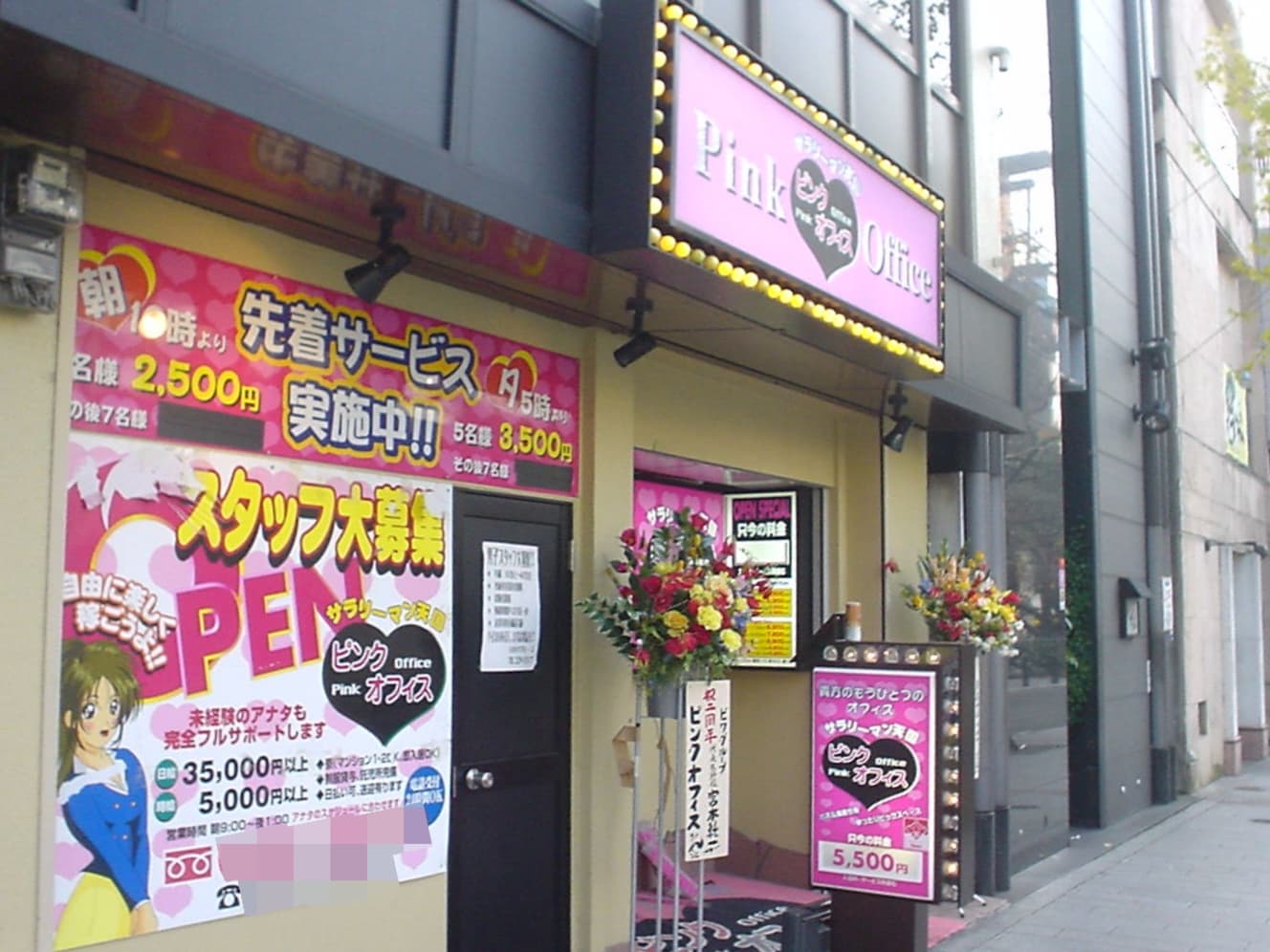
OL cosplay pink salons. Office-play has always maintained strong popularity (Kyoto, 2002) Cosplay started with pink salons Image play in Japan already appeared in Meiji-era pleasure districts. In 1885 (Meiji 18), Shizuoka City’s Ni-chome red-light district had a place called Horairo that featured a “Western-dress parlor,” where prostitutes dressed in Western-style clothing were employed. They were given stage names like “Hubble,” “Crystal,” “Pink,” “East,” and “Spring,” though they apparently did not gain much popularity. Additionally, during the Russo-Japanese War, when over 2,000 female nurses served in the military for the first time, prostitute cosplay as nurses became popular nationwide. The prototypes of costume play in postwar Japanese sex work can be traced to pink salons, Turkish baths (today’s soaplands), and SM-oriented establishments. It is said that cosplay started with pink salons. One well-known example after the full enforcement of the Anti-Prostitution Law in 1958 (Showa 33) was the Tokyo “Negligee Salon,” where hostesses wore negligees. Cosplay was introduced to Turkish baths in 1971 (Showa 46). The following year, anticipating the Winter Olympics, Sapporo’s Susukino district, then riding a tourism boom, creatively began uniform Turkish services—featuring flight attendants, nurses, and schoolgirls—pioneering this nationwide. In 1976 (Showa 51), two ultra-luxury Turkish baths opened in Kawasaki’s Horinouchi district: the Chinese-style Kinpeibai and Persian-style Arabian Night. These establishments mainly catered to official and private entertainment and flourished. Both now operate as soaplands. In Tokyo’s Yoshiwara, realistic nun Turkish-bath girls with shaved heads appeared. Previously, Turkish baths modeled after nunneries existed across Japan, but women simply wore white head coverings and robes to act the part. In 1982 (Showa 57), however, a nun at Ama Goten had her head fully shaved, making headlines in weekly magazines and newspapers, and reservations surged.
 Share on SNS