Five Months, 56,000 km at Sea – JMSDF’s Young Elite Under the Spotlight
After crossing the Pacific Ocean, they followed the long voyage from North America to South America.


Five Months at Sea for Officer Trainees
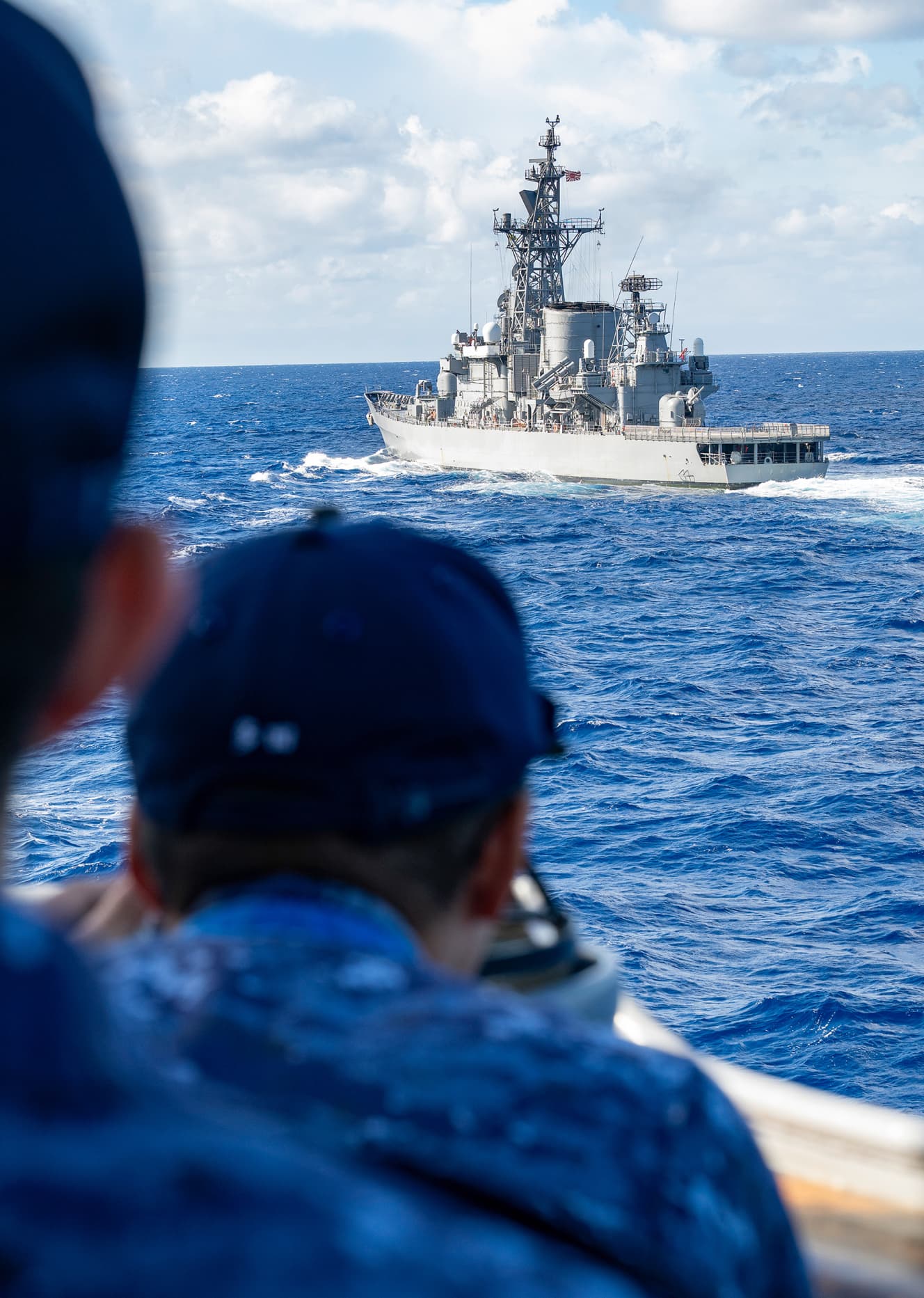
Two gray ships cut through the Atlantic Ocean, leaving white wakes behind them under an endless expanse of blue sky and sea. They are the Japan Maritime Self-Defense Force (JMSDF) training vessels Kashima and Shimakaze.
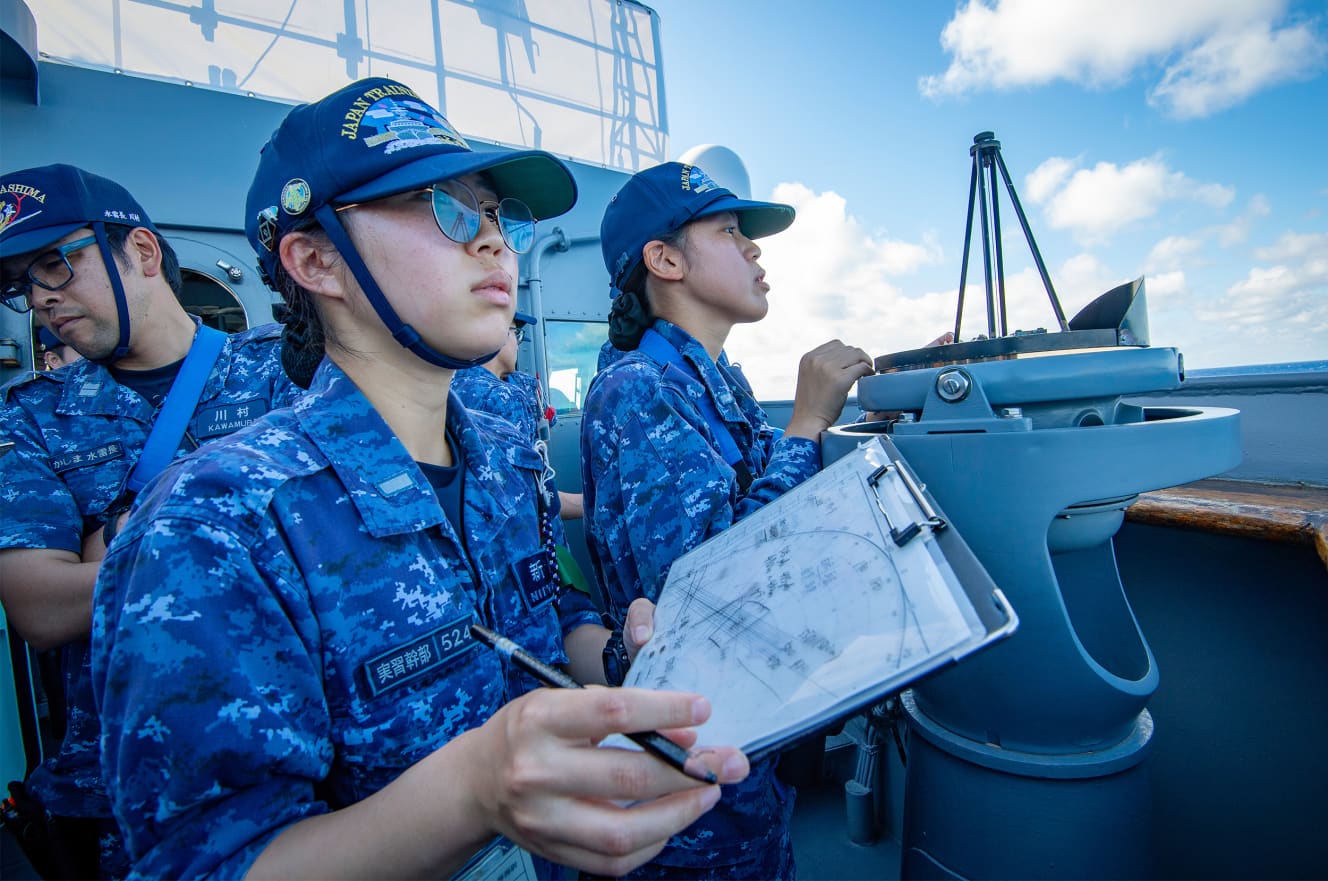
“What is the distance and bearing to Shimakaze?”
The officer on watch hesitates to answer a question that should be responded to immediately.
“You don’t even know your own position? An officer cannot just wait around.”
On the balcony-like area jutting out next to the bridge of Kashima, called the wing. a group of young men and women in their early twenties fumble nervously. These are the JMSDF’s trainee officers, known as practical officers.
Every year, the JMSDF conducts a training voyage called the Distant Sea Training Cruise. Participants are young elite officers, called A-Kan, who have joined after graduating from the National Defense Academy or regular universities as general officer candidates.
Before joining their assigned units, they spend about a year at the Officer Candidate School in Etajima, Hiroshima Prefecture, learning the fundamental knowledge and skills necessary to serve as officers. Upon graduation, they are commissioned as third-class ensigns (3rd Lieutenant equivalent), but they still lack practical experience.
To gain this, they undertake a distant sea training cruise, putting into practice the knowledge they acquired in the classroom on the open ocean.
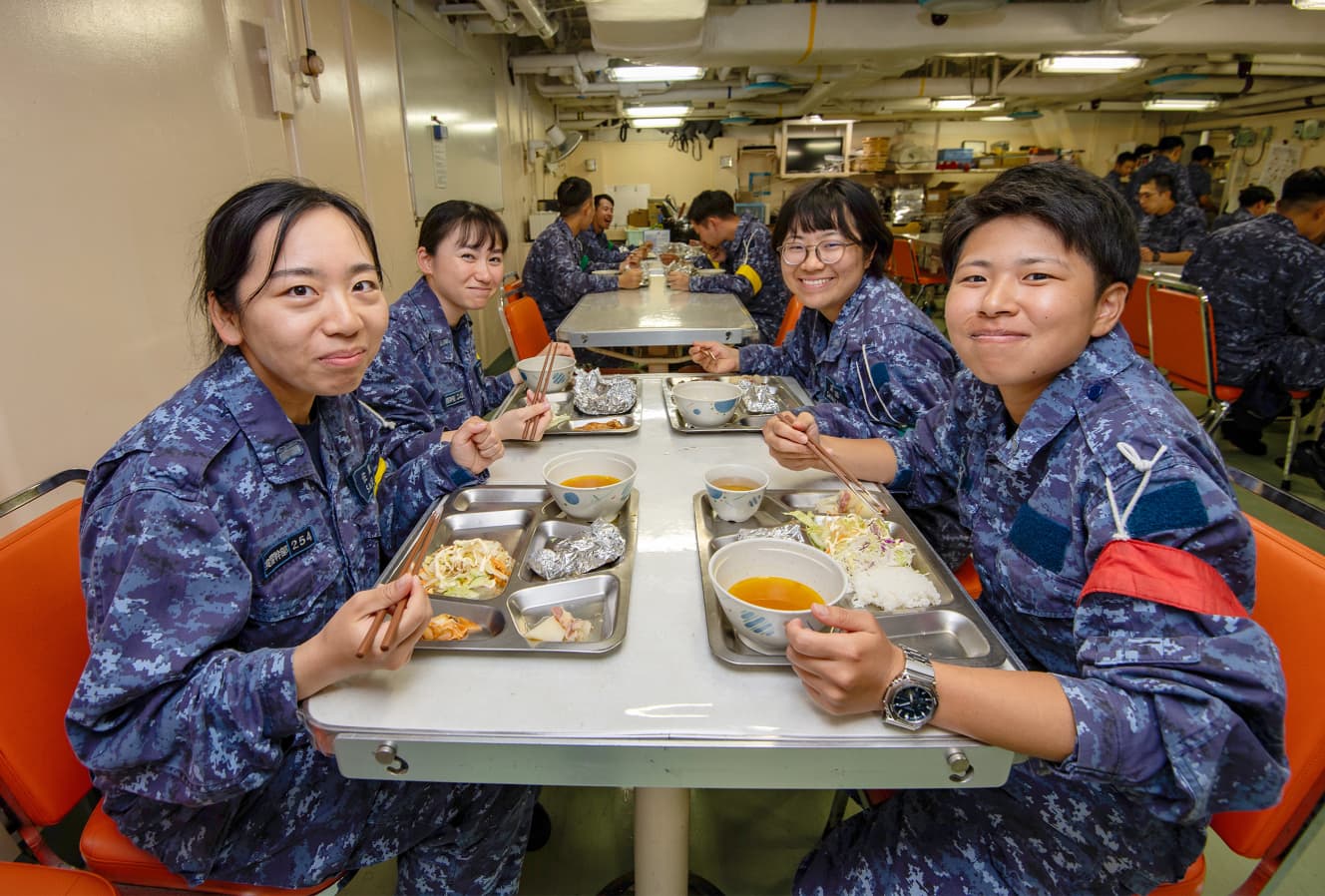
This year, after departing Japan, they visited Pearl Harbor, crossed the Pacific, and sailed along the southern edge of North America down to South America. The voyage lasted about five months, from June 13 to November 12, covering over 56,000 km. Participants included 192 graduates of the 75th class of the general officer candidate course, of whom 29 were women.
The trainee officers’ schedules are nearly fixed. They rise at 6 a.m.; the morning is spent on navigation and ship-handling training, while the afternoon is devoted to drills in departments responsible for firefighting and flood damage control, as well as classroom study. They also conduct self-study sessions called research duty in preparation for the next day’s training, before finally going to bed. Although there is always one day off per week, most of that time is spent studying.
One trainee officer, Third-Class Ensign Teruaki Nozawa, decided to attend the National Defense Academy while still in his second year of high school.
“I hope to become a patrol aircraft pilot. Pilots, whether military or civilian, must ensure they return safely. On top of that, patrol aircraft involve dangerous missions, and I wanted to challenge myself in that environment.”
Continuing to Learn for Japan’s National Defense
Third-Class Ensign Sorami Furuya says, “I once gave up on joining the JMSDF.”
“It’s embarrassing to say it wasn’t for lofty ideals like national defense, but when I was in middle school, I read a novel by Hiro Arikawa and dreamed of serving on a submarine (a whale). However, at that time, female personnel were not allowed on board, so I went on to a regular university.
Then, in 2018, I learned from the news that deployment restrictions had been lifted, and I thought, ‘Now I can make my middle school dream come true!’ During the training cruise, trainee officers are given duties such as firefighting station assignments, but it’s up to them to figure out what to do and constantly think ahead. They need to actively ask questions and learn on their own.”
Lieutenant Akiyoshi, the ship’s navigator in charge of guiding the trainee officers, smiles wryly.
“For navigation, you need to memorize distances and speeds and apply your own experience to make calculations. Some of the trainee officers act as if they’re doing everything on the fly, and you really wonder, ‘Did they study at all?’”
Commander Katsuhara, a training staff officer at the training fleet headquarters, regards the trainees warmly.
“There’s a saying that rank shapes a person. Once they finish the distant sea training cruise and are assigned to a unit, they all grow tougher immediately. Here, what we hope they learn is shipboard life and how to interact with peers and subordinates.”
The results will appear five or ten years later. The future of the JMSDF—and Japan’s national defense—rests on these young men and women.
Photography and text by: KIKUCHI Masayuki