Drastic Changes in a “World with Interest Rates”! Why Online Banks Have Disappeared from Mortgage Rankings… A Return to the Era of One Dominant Player


〈During the era of ultra-low interest rates, online banks swept the mortgage market by leveraging “unbeatable low rates.” However, with the arrival of a “world with interest rates”—triggered by the Bank of Japan’s rate hikes—they have been disappearing one after another from the top of the popularity rankings.
Among borrowers with variable-rate loans, there has been a sharp increase in the number of people falling into a state of panic after being hit with unreasonable interest rate hikes that exceed the policy rate. “ Why has the Reiwa-era conventional wisdom that “online banks are safe” collapsed? Financial journalist Kenji Matsuoka explains the rapidly changing business realities of online banks and the future trajectory of loan interest rates.”〉
The Shock of a “0.5% Increase” in Variable Interest Rates
Even after the Bank of Japan’s rate hike ushered in a “world with interest rates,” the impact on mortgages remained minimal for some time. This was because interest rates were already abnormally low to begin with, and there was a time lag before the changes were reflected in actual loan rates.
The situation changed dramatically in late September of this year. “Sony Bank” announced a 0.5% increase in its variable interest rate, while “au Jibun Bank” raised its rate by 0.6%. Social media platforms like X were flooded with comments expressing surprise and dismay.
During the era of negative interest rates, “au Jibun Bank” was a regular at the top of mortgage rankings, offering variable-rate loans with interest rates below 0.3%. The bank has a large customer base, which is why the reaction has been so strong.
Mega-banks “postpone” rate hikes
Personally, I wasn’t surprised by the 0.5% or 0.6% increase. This is simply the result of the bank reflecting the cumulative 0.5% increase from the rate hikes in June and September of ’26 all at once.
“au Jibun Bank” reviews its variable interest rates twice a year, in April and October. This is the most common practice adopted by nearly all banks, including the megabanks. Therefore, if interest rate hikes occur in June and September, reflecting the combined total in the interest rate can be considered “business as usual.”
However, many banks following this pattern limited their increases to 0.25%.It is likely that they wanted to avoid the negative perception that a “0.5% increase” might create due to its strong impact. To balance this out, many banks raised the short-term prime rate (commonly known as “short-term prime”), to which variable interest rates are linked, by 0.25% in November.
On the other hand, among online banks , PayPay Bank reflected the June rate hike in July, and Docomo SMTB Net Bank did so in August; by spreading out the increases in small increments, they effectively softened the impact. “Aeon Bank” held off on raising rates until October, when it increased them by 0.5%. This level of discretion is closely tied to each bank’s mortgage sales strategy.
The Trap of Online Banks’ “Unique Rules”
Based on the explanation so far, some readers may be wondering: “Why is the rate increase at ‘au Jibun Bank’ 0.6%, which is 0.1% higher than the total policy rate hike of 0.5%?”
The bank reportedly responded that this decision was made “after comprehensively considering market interest rate trends, funding costs, and operating expenses.” In other words, the level of variable interest rates is influenced not only by the policy interest rate but also by the bank’s own factors. Even among actual borrowers, few are aware of these circumstances.
Many online banks do not link their variable interest rates to short-term rates but instead base them on “market interest rate conditions.”Market interest rates generally refer to short-term rates with maturities of less than one year, which directly reflect the Bank of Japan’s policy rate. If there is a 0.25% rate hike, short-term interest rates across the board rise by about 0.25%, and banks raise their variable rates by 0.25%.
Therefore, under current conditions—where the short-term money market anticipates that the policy rate will be raised to 2% by 2027—market interest rates will also rise in line with that scenario.Short-term interest rate futures for 2027 have already risen and are trading at those levels. Consequently, since the funding costs for online banks will also rise, they will have no choice but to raise variable interest rates once those costs exceed a certain threshold. This can be seen as the reason why the interest rate at “au Jibun Bank” exceeded the policy rate by 0.1%.
Widening “Interest Rate Gap” Among Banks
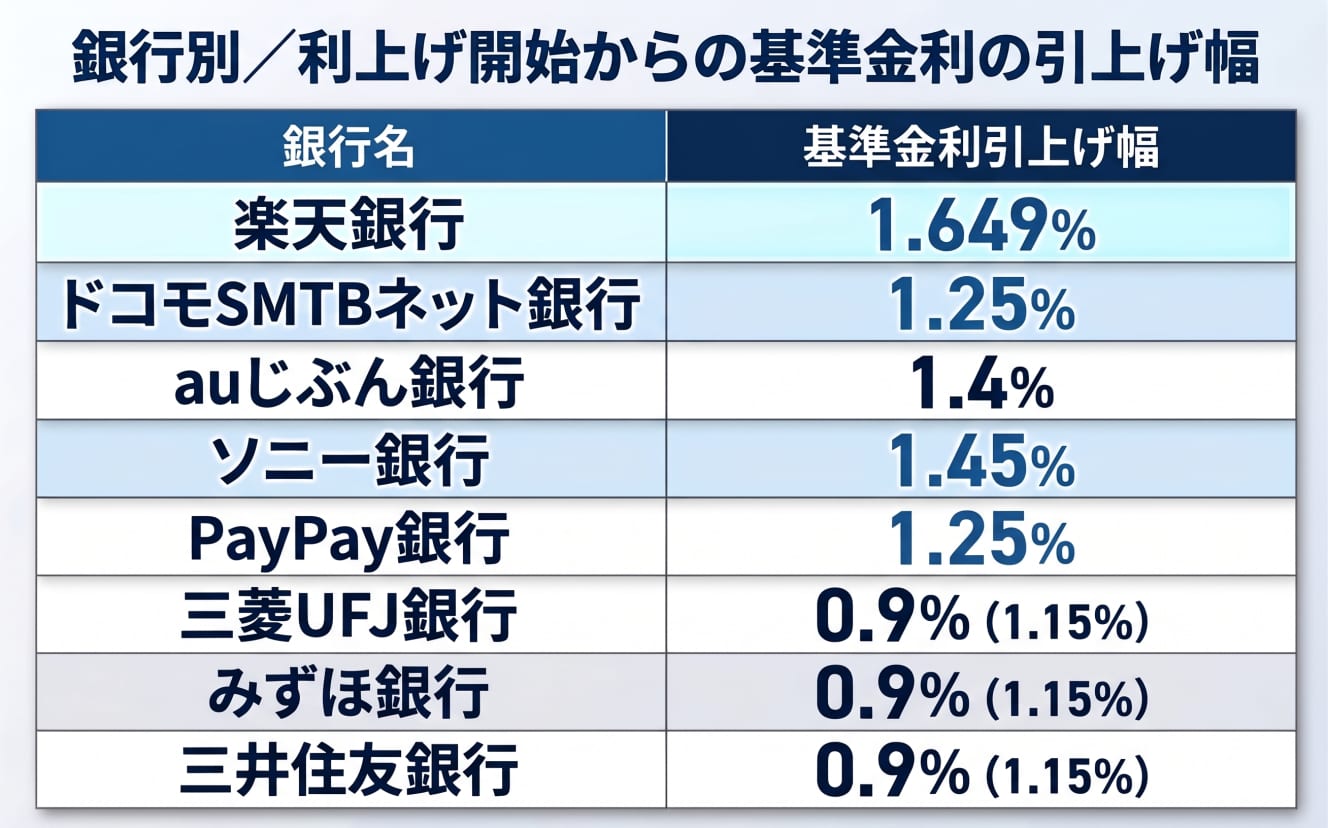
Since the Bank of Japan began raising interest rates, the extent to which variable interest rates have increased has varied among banks. Interest rate hikes began in March ’24. Let’s compare the increases in benchmark rates from then until November ’26. The benchmark rate serves as the basis for variable interest rates; when the benchmark rate rises, variable rates rise by the same amount.
The Bank of Japan has raised rates from negative territory to 1.25%. A quick glance at the table reveals that while the megabanks are deferring the burden of these rate hikes, even after reflecting the 0.25% increase from September, their rates are likely to remain at 1.15%.
Although the September rate hike is reflected in the November short-term fixed-rate loans, the corresponding adjustment to variable interest rates will not take effect until April 2027, and it will not be reflected in actual repayment amounts until July—three months later.Needless to say, the repayment burden is lighter than at online banks, which have lower interest rates and where rate hikes are immediately reflected in repayment amounts (however, the variable-rate loans currently offered by “Mitsubishi UFJ Bank” have shifted to a “monthly review” system, where interest rates are adjusted every month).
Furthermore, “Rakuten Bank” has long distanced itself from the low-interest-rate competition and has adopted its own unique strategy, such as setting loan fees at a flat rate (with a flat fee, costs decrease as the loan amount increases).
Rakuten Bank links its base rate to the “TIBOR (Tokyo Interbank Offered Rate),” one of the benchmarks for short-term interest rates, and revises it monthly. Since interest rate hikes began, the bank has revised the rate almost every month, and the base rate has been on a steady upward trend.This serves as a clear example of a bank adjusting its variable interest rates in response to trends in short-term interest rates. It is presumed that the funding costs for other online banks have risen by a similar margin.
Why Major Banks Are Showing “Leeway”
Why have major banks, such as the megabanks, been able to postpone raising their benchmark rates and maintain them at 1.15%? The reason is that interest rate hikes have significantly improved their core net interest margins.
The interest margin refers to the profit a bank earns by raising funds from depositors at low interest rates and lending those funds to businesses and individuals at higher rates. A review of financial statements reveals that the interest margin has widened with each interest rate hike.
For example, in the case of Mitsubishi UFJ Bank, the net interest margin rose by 0.1% over the full fiscal year FY25, and in the first quarter (Q1) of FY26 alone, it rose by 0.11% (“Domestic Deposit-to-Loan Yield Spread”).While the percentage figures alone may not seem particularly impressive, the retail (individual) division’s net interest income for the first quarter of fiscal year ’26 increased by 29 billion yen compared to the previous year.
On the other hand, online banks have not seen an improvement in their net interest margins; in fact, some have even seen them worsen. Until now, online banks have focused on the mortgage business, relying primarily on loan growth as their main source of revenue. However, rising short-term interest rates have increased their funding costs, preventing them from reaping the benefits of interest rate hikes.
Seniors’ Checking Accounts Are a “Treasure Trove”
Where does the disparity in interest rate spreads among banks stem from? It comes down to the “quantity” and “quality” of liquid deposits.
Liquid deposits are those with no restrictions on the deposit term, allowing for deposits and withdrawals at any time; they refer to savings accounts and checking accounts.
Major banks and regional banks have a large proportion of elderly customers, and for many years, massive amounts of ordinary savings—as solid as bedrock—have remained stagnant in these accounts. Although interest rates on ordinary savings have risen, the net interest margin has improved due to an even greater increase in lending rates.
On the other hand, funds in online banks’ checking accounts are deposited and withdrawn relatively frequently, making it difficult for them to contribute to an improvement in the net interest margin.
After all, banks can earn interest at the policy rate simply by depositing funds in the Bank of Japan’s current account (a system known as “interest on deposits”). Assuming an interest rate of 1.25% on deposits and 0.5% on savings accounts, the net interest margin is 0.75%.Among major city banks —Mizuho, Mitsubishi UFJ, Sumitomo Mitsui, Resona, and Saitama Resona— alone, the funds eligible for interest on current account deposits total approximately 144 trillion yen.
If the current interest margin persists, interest income from this system will exceed 1 trillion yen annually for these five banks. They can earn this profit risk-free simply by keeping the funds in the Bank of Japan’s demand deposit accounts. This, too, is thanks to the existence of massive amounts of liquid deposits.
Are “Major Banks” the Only Option for Mortgages?
The short-term money market anticipates that the policy interest rate will rise to 2% by 2027. If that happens, the gap in profitability between online banks and major banks is highly likely to widen even further in the future.
“PayPay Bank” raised its variable interest rates for new loans and refinancing by 0.12% in November. This effectively means it kept the base rate unchanged while narrowing the preferential rate margin. These measures likely reflect rising funding costs.
For those taking out new mortgages, major banks will likely continue to hold the advantage—at least when it comes to variable-rate loans. Even for those considering refinancing with a variable-rate loan, major banks should be prioritized as an option, given the “stability” of their base rates.
The Trap of “Peace of Mind with Short-Term Prime Rate Linkage”
One final note. Major banks and regional banks state that their variable interest rates—or the underlying benchmark rates—are “linked to the short-term prime rate.” On social media, there are occasional instances where this short-term prime rate is explained as if it were equivalent to the policy interest rate, but this is clearly incorrect.
Originally, the short-term prime rate referred to the most preferential lending rate for corporations with terms of less than one year; it has since come to be applied to residential mortgages for individuals secured by real estate as well.In principle, the Short-Term Prime Rate is determined based on the short-term money market and at the discretion of each individual bank. The impression that it aligns with the policy interest rate stemmed from the fact that, historically, whenever interest rates were raised, it was “customary” for “major banks to raise the Short-Term Prime Rate by the same amount as the rate hike, with regional banks following suit.”
There is essentially no difference between major banks and regional banks linking their variable interest rates to the “short-term prime rate” and online banks basing their variable interest rates on market interest rate conditions. In fact, “Docomo SMTB Net Bank” links its variable interest rates to the “short-term prime rate, ” but sets them based on its own judgment.
As mentioned earlier, “Mitsubishi UFJ Bank” used to review its variable interest rates “twice a year,” but now reviews them “monthly” to ensure it can quickly reflect changes in the short-term prime rate.
To begin with, the structure of variable-rate mortgage products is extremely complex. How is the interest rate on the loan you currently hold—or are planning to take out—determined, and how has it been adjusted in the past? Since this is likely the most expensive purchase you’ll ever make, it’s essential above all else to fully understand the details rather than letting it remain a “black box.”
Reporting and Text: Kenji Matsuoka
Money writer and financial planner.
After working as a market analyst at a securities firm, he became independent in 1996. He writes articles on finance and asset management, primarily for business and economic magazines.His books include *The First-Year Guide to Robo-Advisor Investing* and *Easy to Understand with Plenty of Illustrations! The Book That Guarantees You’ll Save Money with Cashless Payments*. ■X (formerly Twitter) → @1847mattsuuPHOTO: Afro