The 1.9 Billion Yen Fraud Case: Why Did Dai-ichi Life’s Top Saleswoman—the “Legendary Life Insurance Lady”—Turn to a Life of Crime?
Over the course of two years, an up-and-coming nonfiction writer has uncovered the “tricks of the trade” and “unique regional social dynamics” behind this mystery-shrouded case!


The “Empress’s” Tactics
Total damages: 1.9 billion yen—there is a “legendary life insurance saleswoman” who orchestrated an unprecedented massive fraud scheme yet passed away without ever revealing her motives. Why did this woman, dubbed the “Empress” for being Dai-ichi Life’s top salesperson, tarnish her legacy in her final years?
Nonfiction writer Shinnosuke Kubota took on this mystery. He is the author of *Sinking into the Sea of Tsushima* (Shueisha), a bestseller that sold 60,000 copies, which delved into corruption within the agricultural cooperatives following the inexplicable drowning of a man known as the “God of JA.”Based on two years of extensive research, Kubota published *The Woman of Kisan* (Kodansha), which delves into the truth behind the fraud case committed by 89-year-old life insurance agent Fumiko Shoge.
Mr. Kubota has long focused his reporting on agriculture. What prompted him to expand his coverage to the life insurance industry?
“The protagonist of *Sinking into the Sea of Tsushima* embezzled 2.2 billion yen from the JA. That’s not much different from the amount Shoge defrauded. They also both reigned as top insurance salespeople—at the JA and Dai-ichi Life, respectively—which had always intrigued me.Furthermore, when the scandal came to light, Masashita was the same age as my grandmother. I was intrigued by the fact that someone the same age as my grandmother had committed such a massive fraud.”
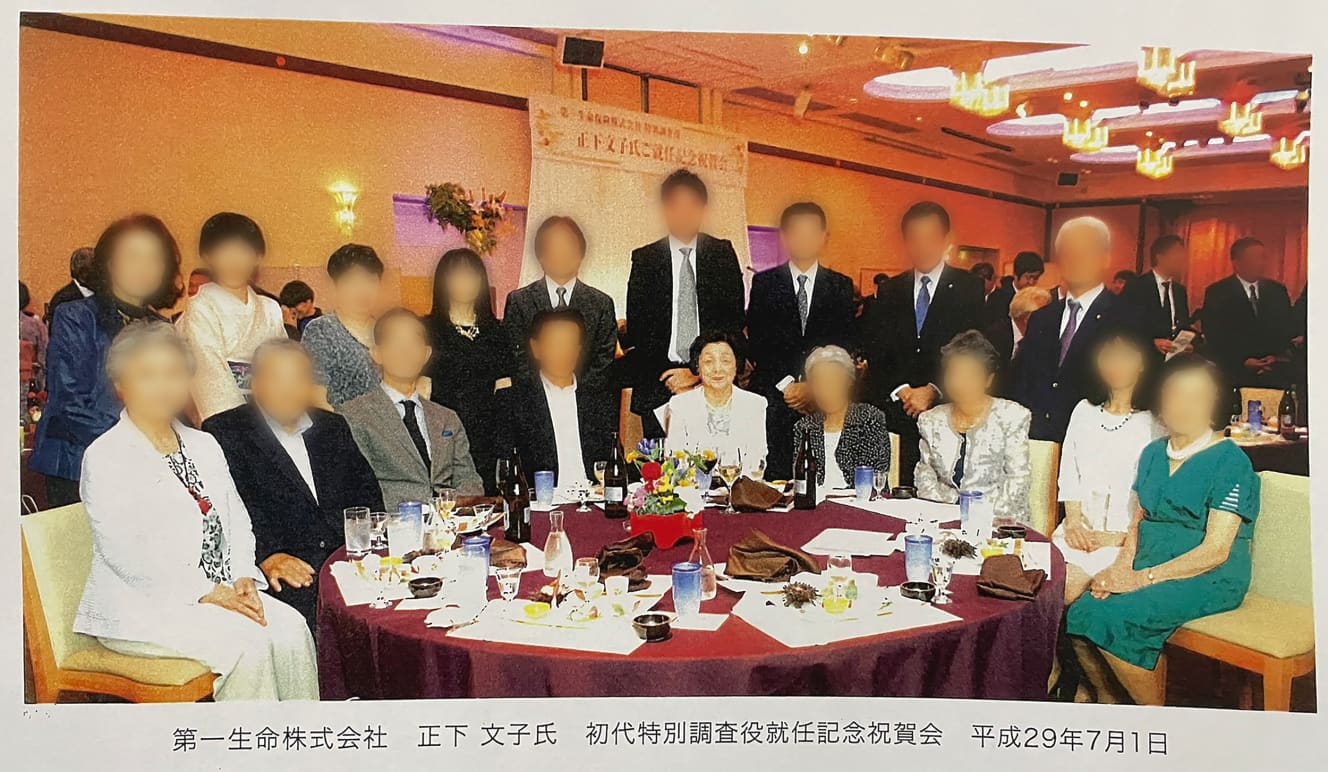
Masashita, who was assigned to the Tokuyama Branch (Yamaguchi Prefecture) of Dai-ichi Life’s West Japan Market Management Division and had worked for the company for 55 years, achieved top-tier performance within the company and made a name for himself nationwide. The source of his success was his close-knit network of personal relationships in the region.
Masushita’s greatest backer was Kozo Tanaka (died at age 95), the fourth-generation president of the local Yamaguchi Bank, who was known as the “Don.” Masushita set his sights on the Tokuyama High School clique—a prestigious local school that wielded influence in the political and business circles of Tokuyama City (now Shunan City).By tracing a male relative who was an alumnus of the school, he made his way to Tanaka and, by devoting himself to building a faction to secure Tanaka’s appointment as president, managed to gain a foothold with “Don.” From there, he was introduced to influential clients seeking loans from Yamaguchi Bank, and he successfully secured one insurance contract after another.
Masashita’s network of contacts extended to the administration and business community of Tokuyama City, where she worked, and even reached the Kurokami clan—known as the “Tokuyama Fixers.”Surrounding the Kurokami clan was the “Kurokami Circle,” a group of businesspeople who shared vested interests. She infiltrated this circle as well, leveraging the relationships she formed there to increase her number of insurance policies.
“When infiltrating the ‘Kurokami Circle,’ Masashita also made maximum use of the Tokuyama High School alumni organization known as the ‘Kiyama-kai.’Masashita leveraged her connections at Yamaguchi Bank and within the Kurokami Circle to boost her performance, and Dai-ichi Life awarded her the title of ‘Special Investigator’—a position for which she was the first appointee. Because of her overwhelming track record, the victims came to wholeheartedly believe in the fictitious investment schemes Masashita proposed.”
Was Masashita a con artist?
Mr. Kubota began interviewing victims in Yamaguchi Prefecture, but his reporting proved extremely difficult.
“In this case, there were no records documenting the flow of money from customers to Masashita. This posed a major obstacle as we proceeded with our investigation. However, we found a lead when fraud involving policyholder loans—a system where policyholders of life insurance and other policies can borrow money from insurance companies using their policy surrender value as collateral—began around 2018.Why did Masashita suddenly start using policy loans?—This was one of the keys to unraveling the case.”
As the investigation progressed, a sense of unease began to grow within Mr. Kubota.
“When a client’s husband fell ill, Masashita advised him from his hospital bed that he should change his life insurance policy from a corporate policy to an individual one in order to receive a larger death benefit. This was not an action taken to defraud people of money. Among those who entrusted their money to Masashita’s investment schemes, there were some who had been receiving dividends over the long term.Masashita likely treated clients to meals and gave them gifts out of her own pocket. There was even a client who had her arrange a marriage match for their child. Her clients weren’t all victims; some had actually benefited from her. The suspicion arose: ‘Maybe she never intended to deceive people from the start?’”
So why did this legendary life insurance agent “fall from grace”?—Mr. Kubota obtained crucial testimony.
“Through our investigation, we confirmed that due to the advancing age of Tanaka—Masashita’s greatest supporter—referrals from Yamaguchi Bank ceased in 2016. As it became difficult for Masashita to secure new contracts, she likely found it hard to pay dividends to her clients. She fell into a vicious cycle of borrowing money from other clients to cover those dividends.She must also have been reluctant to lose the trust she had built up over the years in Tokuyama. As her cash flow dried up, Masashita began resorting to fraud by misusing policyholder loans and other means. Her refusal to discuss her motives may have stemmed from a desire to avoid raising suspicions about the involvement of her daughter—a fellow insurance agent who had taken over her client base.”
Whether in *The Woman of Kiyama* or his previous work, *Sinking into the Sea of Tsushima*, Kubota does not focus on major incidents that have captured the public’s attention. Why does he turn his attention to criminals involved in “closed cases”—rather than the high-profile cases the media reports on day after day?
“I want to confront the things that resonate with my sensibilities and weave words from them. Even major incidents are over once they’ve been reported on the news for a while, aren’t they? My work as a nonfiction writer begins right where the public thinks, ‘This event is over now.’”
Beginning where it ends—behind Kubota’s pursuit of Masashita’s life lay his pride as a nonfiction writer.
(Honorifics omitted in some parts of the text)


From the November 13 & 20, 2026, combined issue of *FRIDAY*