“First Voice,” a Film Depicting Japan’s First Sexual Harassment Trial: The “Painful Solidarity” That Moved the Hearts of the Female Victims
Special Interview [Part 2]


“Professor Asahi is the person I’ve always wanted to meet in my life.”
Kaori Sakano (47), producer of the film *First Voice*, said this while looking the author straight in the eye.
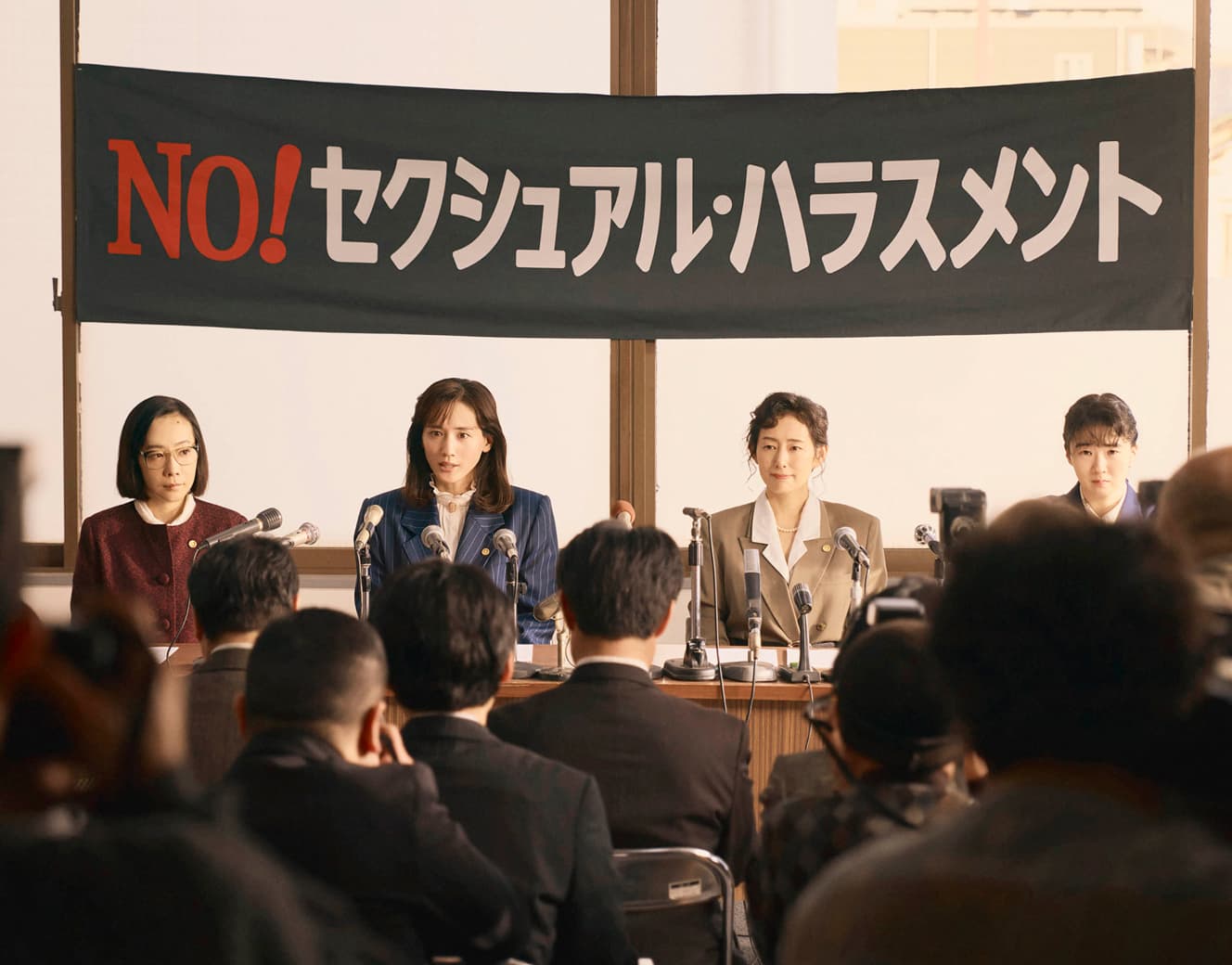
In this film, inspired by the 1989 Fukuoka sexual harassment trial, Haruka Ayase (41) plays Michiko Asahi, a good-natured lawyer who keeps taking on cases that don’t pay well.Then, Megumi Uehara (First Summer Uika, 36)—who was stripped of her beloved job after baseless rumors, such as being called a “promiscuous woman,” were spread about her at work—comes to Asahi, saying, “I want to sue my company and my boss.”
In an era when the term “harassment” had not yet taken root in society, Asahi and her fellow female lawyers take on a case that everyone else had given up on as “hopeless”—working entirely on their own dime—but…
Haruka Ayase’s “Decision”
The path to a film adaptation wasn’t clear from the start. Initially, a TV drama adaptation was considered, but various constraints—such as broadcast time slots, sponsors, and runtime—prevented it from coming to fruition. On the other hand, with a film, as long as funding could be secured, a path to realization could be found. We believed the film format was best suited to deliver this story to a wider audience.
Initially, I envisioned a film for art-house theaters, but when I showed the proposal to a producer I knew, he encouraged me, saying, “Precisely because it’s a subject like this, you should go big.”
For the screenplay, we brought in Yuji Hashimoto, who had been deeply moved by Mr. Sakano’s *Biri Gyaru: The Movie*.
“I watched *Biri Gyaru* three times, and it brought me to tears every single time. The friendship between the women and the careful characterization left a lasting impression on me and really struck a chord. I was drawn to Mr. Hashimoto’s skill in weaving together a non-fiction subject with stories of friendship and family drama to craft a single film.”
The director is Tetsu Maeda. He has a proven track record of successfully transforming social issues into entertaining films, such as *Banana at This Hour? A Beloved True Story*.
With the addition of producer Yoichi Ari Shige from Nikkatsu and producer Yumiko Miwa from TV Asahi, the project began to take shape.
“Mr. Ari Shige took very seriously the point that sexual harassment is by no means someone else’s problem for many women. He said, ‘It’s precisely because so many women have experienced this injustice and these unpleasant feelings that there’s meaning in making this into a movie.’ It was reassuring to know he thought that way.”
We approached Haruka Ayase about starring in the film quite early on. Asahi is kind-hearted, cheerful, and unwavering in her convictions. The entire team of directors and producers wrote the script while hoping, “We want Ms. Ayase to play this role.”
“Given the nature of the subject matter, I was prepared for it to take her some time to decide, but less than three days after I gave her the script, she replied, ‘I’ll do it.’ That really made me happy…”
The film depicts a tense scene where the plaintiff, Megumi, is at a loss for words in front of her supporters. Even in front of supporters, it’s not easy to speak openly and without reservation about the sexual abuse she has suffered. Deep down, she doesn’t want to tell anyone.It’s not as simple as saying, “It’ll feel better once you talk about it.” It is precisely because of this scene that I wanted to trust this film.
After I went public about the sexual violence I experienced in the film industry, there were times when I felt left behind, even as the issue gained widespread attention as a social problem.It was very painful to be praised for being “brave” or to be thanked. That doesn’t solve the problems faced by survivors. There were moments when I suffered, worrying that I might be “used as a stepping stone” in the name of solidarity among women.
At the same time, I was encouraged by the kindness of people who reached out to me and shared my anger. I was supported by those who hoped for social change and took action to bring it about. That sense of hope and the feeling of being left behind coexist.
The story might have been neater if it had portrayed everyone supporting the plaintiff with the same mindset. But in reality, even those offering support had their own experiences and values, and there were conflicts with the plaintiff. I felt relieved that this film didn’t simplify that complexity.
“The hardest part for Megumi was the feeling of being left behind, even though she was the plaintiff. Even though she appeared strong on the outside, she was suffering on the inside. First Summer Uika portrayed that contrast with great care.
After the film’s release, many people told me, ‘If those conflicts hadn’t been depicted, I would have been disappointed.’ But I was scared at first. When I first started researching the story, I was told, ‘This isn’t as good a story as you think it is!’ and there were times when I thought, ‘Maybe it’s impossible to make this into a movie…’”
He, Too, Is a Victim of a Male-Dominated Society
Mr. Sakano said he did not want to portray the male perpetrator as a straightforward “monster.”
“Back then, phrases like ‘The Frenzied Employee’ and ‘Can You Work 24 Hours?’ were everywhere, and there was a prevailing sentiment that ‘men must work harder than women.’ The presence of a woman more capable than himself must have been unwelcome to his boss; in fact, the plaintiff says, ‘He, too, was a victim of a male-dominated society.’
“That’s why I wanted to portray him not as an extreme villain, but as an ordinary person shaped by the conventional wisdom of the time. I think there were probably many people who, even though they weren’t bad people, unconsciously did similar things.”
How to present this heavy subject matter to the audience?
The answer lies in the film’s brightness. Amid the courtroom battles, we see the everyday lives of women raising children and enjoying fashion. The bright red bodycon dress worn by Asahi—played by Ayase—during her closing argument is particularly striking.
Ms. Sakano incorporated the vibrant colors of that era into the film, hoping “to lift the spirits of today’s audience.” Her goal was not to create a courtroom drama that viewers would watch with trepidation, but rather a film that would keep the audience running alongside the characters until the very end—and leave them feeling a little more energized as they walked out of the theater.
“Ms. Asahi is always there to encourage others and run alongside them. I’d be happy if people watched this film when they want to feel energized or need some encouragement. It’s easy to give up on anything. But this movie gives you the strength to keep going. It’s a film that’s very dear to me—one I’d want to rewatch whenever I hit a wall.”
Long ago, the plaintiff in the real-life case that inspired this film challenged the conventional wisdom of her time and proved the value of her work.
“It’s okay to question today’s conventional wisdom, too. Others might empathize with what you believe to be right.”
Asahi hears Megumi’s voice. Mr. Sakano captures that struggle on film. And the audience receives it. At the end of the film, a caption appears, conveying that this struggle is not just a thing of the past—it continues even now.
“I want to tell those who are still struggling somewhere out there, ‘It’s not your fault.’ I hope this film can be an ally to them.”
Mr. Sakano, speaking these words, may himself be “Teacher Asahi” to someone.
Reporting and Text: Midori Suiren / An actor and writer born in Yokohama in 1987. In addition to working in film and theater, she writes film reviews for *Kinema Junpo* and serializes film introductions and columns in *Shimbun Akahata*.In the spring of ’22, she publicly accused a film director of sexual assault using her real name


From the November 13 & 20, 2026, combined issue of *FRIDAY*
Reporting and Text: Midori Suiren Photography: Miyuki Suemitsu