LOHACO Discounts at APA Hotels, Too! 6 “Must-Have November Perks” That Could Yield Over 6%



November is often referred to as the “off-season” for shareholder benefits, as only about 50 companies offer them annually. However, compared to other months when the sheer number of options can make it hard to decide, November is actually a great opportunity to carefully identify and target truly practical “hidden gem” stocks.
Looking over the lineup, you’ll find a wealth of “must-have” benefits that directly improve your daily life—from meal vouchers for popular bars and restaurant chains that help you save significantly on daily dining expenses, to discount coupons for daily necessities that directly ease the strain on household budgets amid rising prices, and even luxury dairy product gifts and hotel stay perks that help keep travel costs down.
In this article, we’ve carefully selected and will explain six noteworthy stocks—all with rights determination dates in November—that offer an excellent balance of practicality and yield.
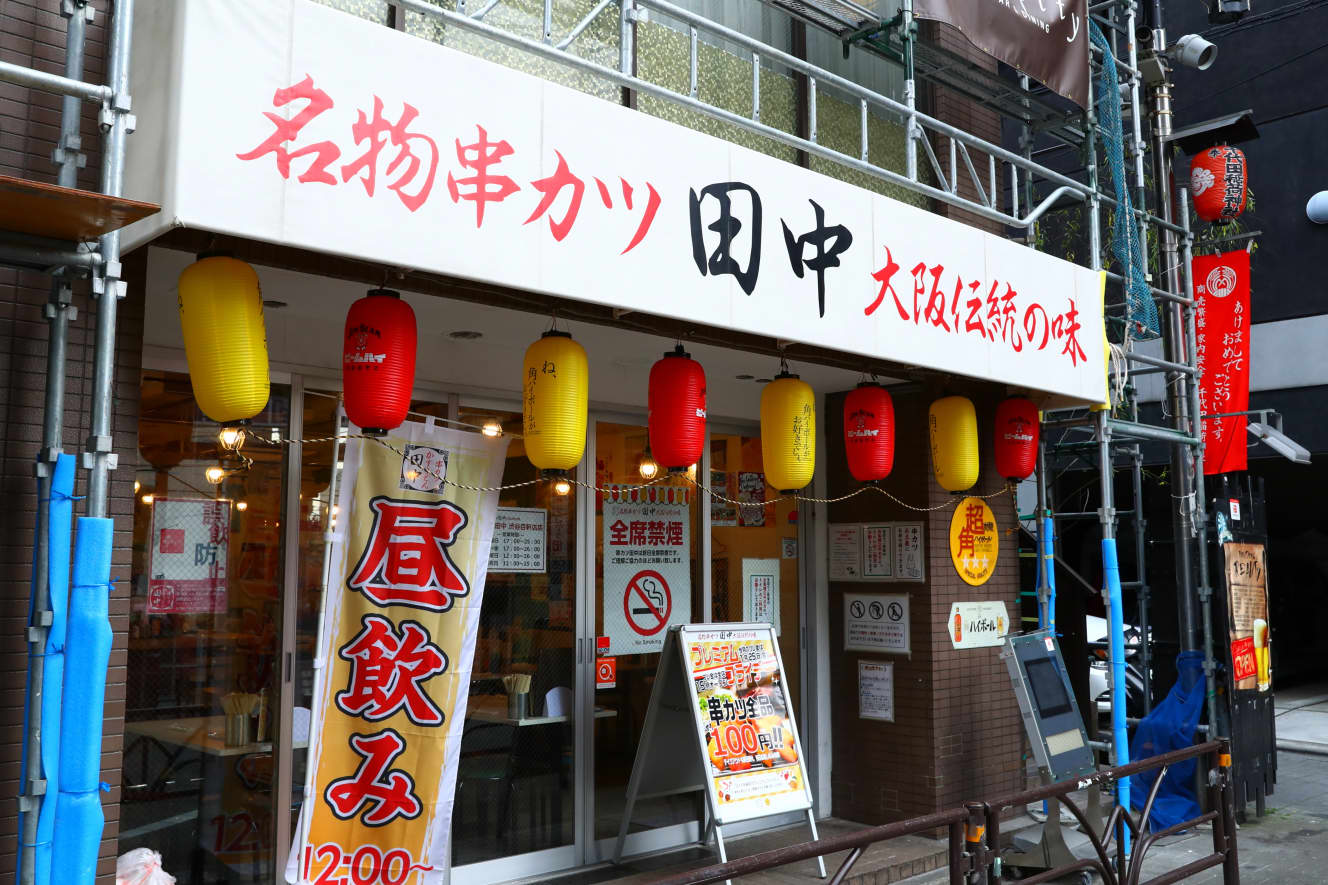
Eat Your Fill at “Kushikatsu Tanaka”! Shareholder Benefits the Whole Family Can Enjoy
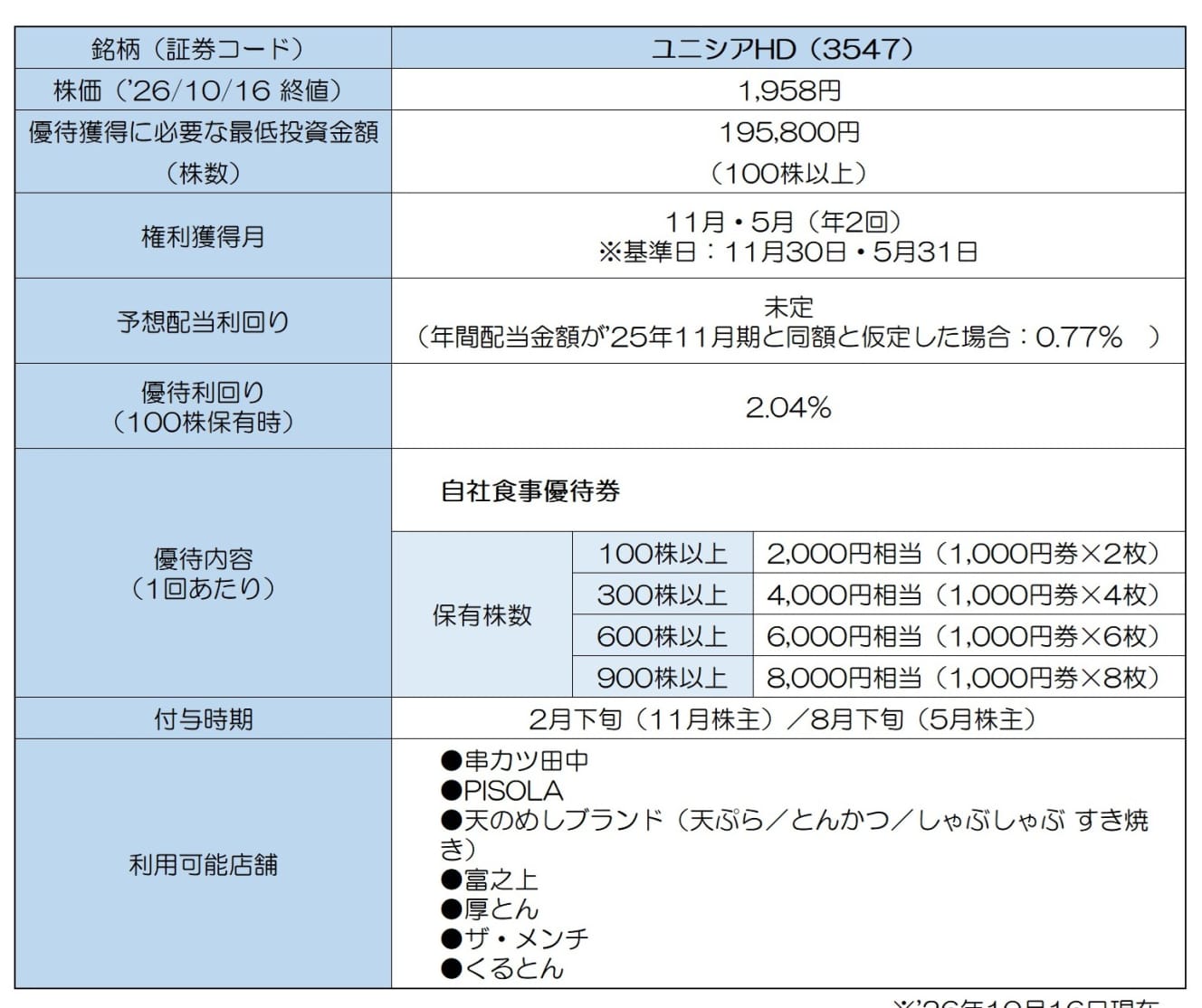
[Unisia HD (3547)] is a company that operates “Kushikatsu Tanaka” as its flagship brand, along with the Italian restaurant chain “PISOLA,” the “Ten no Meshi” brand (offering tempura, tonkatsu, shabu-shabu, and sukiyaki), “Atsuton,” and “The Menchi.”Shareholders who hold 100 shares receive 2,000 yen worth of meal vouchers twice a year, redeemable at participating company-owned restaurants. “Kushikatsu Tanaka” is not only a popular izakaya but also offers extensive services for children, making it an attractive destination for families.
4.8% Yield! A Divine Perks Program from a Famous Bar
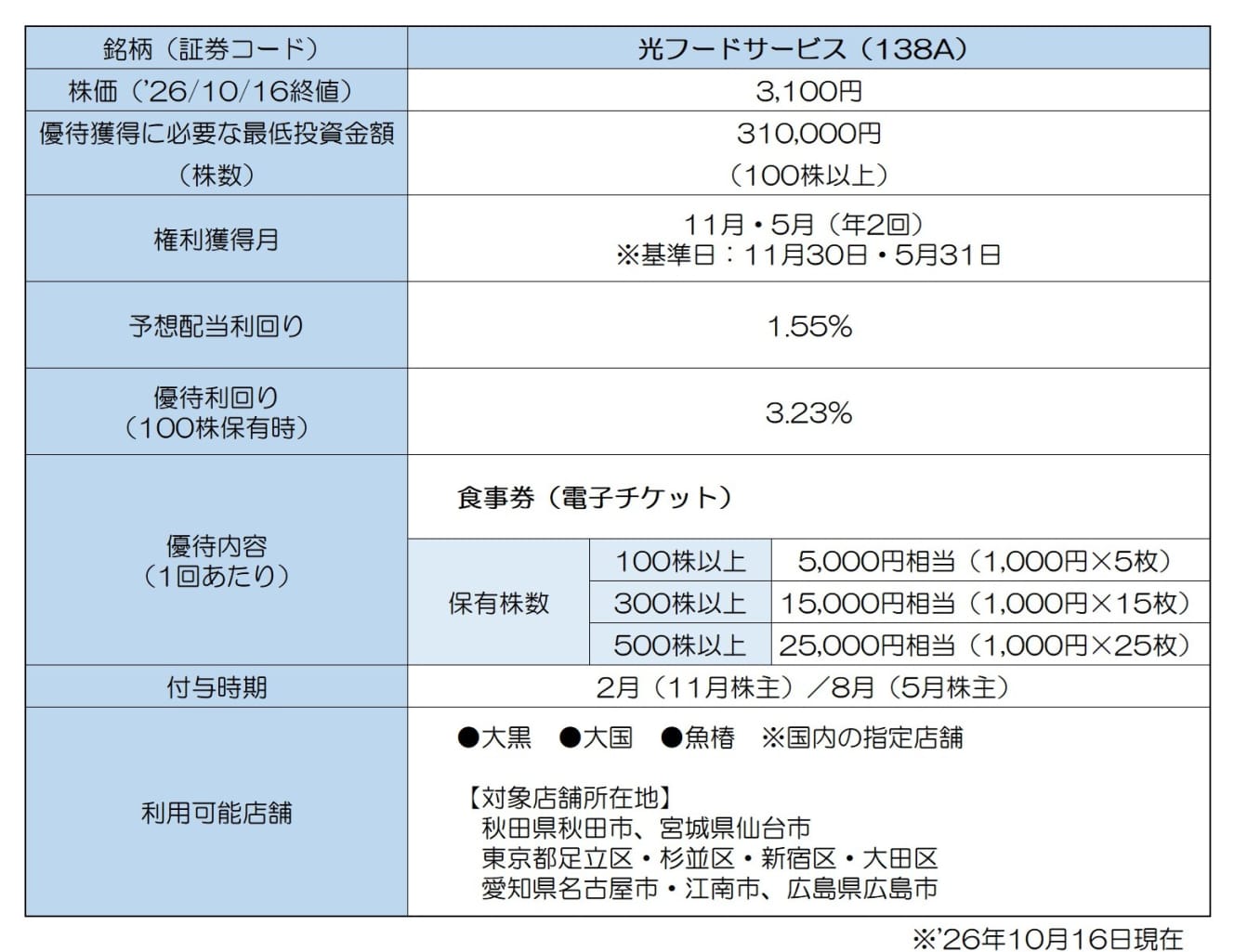
[Hikari Food Service (138A)] is a company that operates restaurants such as “Tachinomi Yakiton Daikoku,” primarily in the Nagoya area.Shareholders holding 100 shares receive 5,000 yen worth of meal vouchers (electronic tickets) twice a year, redeemable at eligible company-owned restaurants. This amounts to 10,000 yen worth of meal vouchers annually, with a shareholder benefit yield of 3.23%. Combined with the dividend (1.55%), the total yield reaches approximately 4.8%.By increasing the number of shares held, it is possible to raise the annual benefit amount to a maximum of 50,000 yen while maintaining the same yield. However, since the areas where participating stores are located are limited, be sure to check in advance whether there is a store near you.
Cheese and Butter! A Delicious Treat Worth the Two-Year Wait
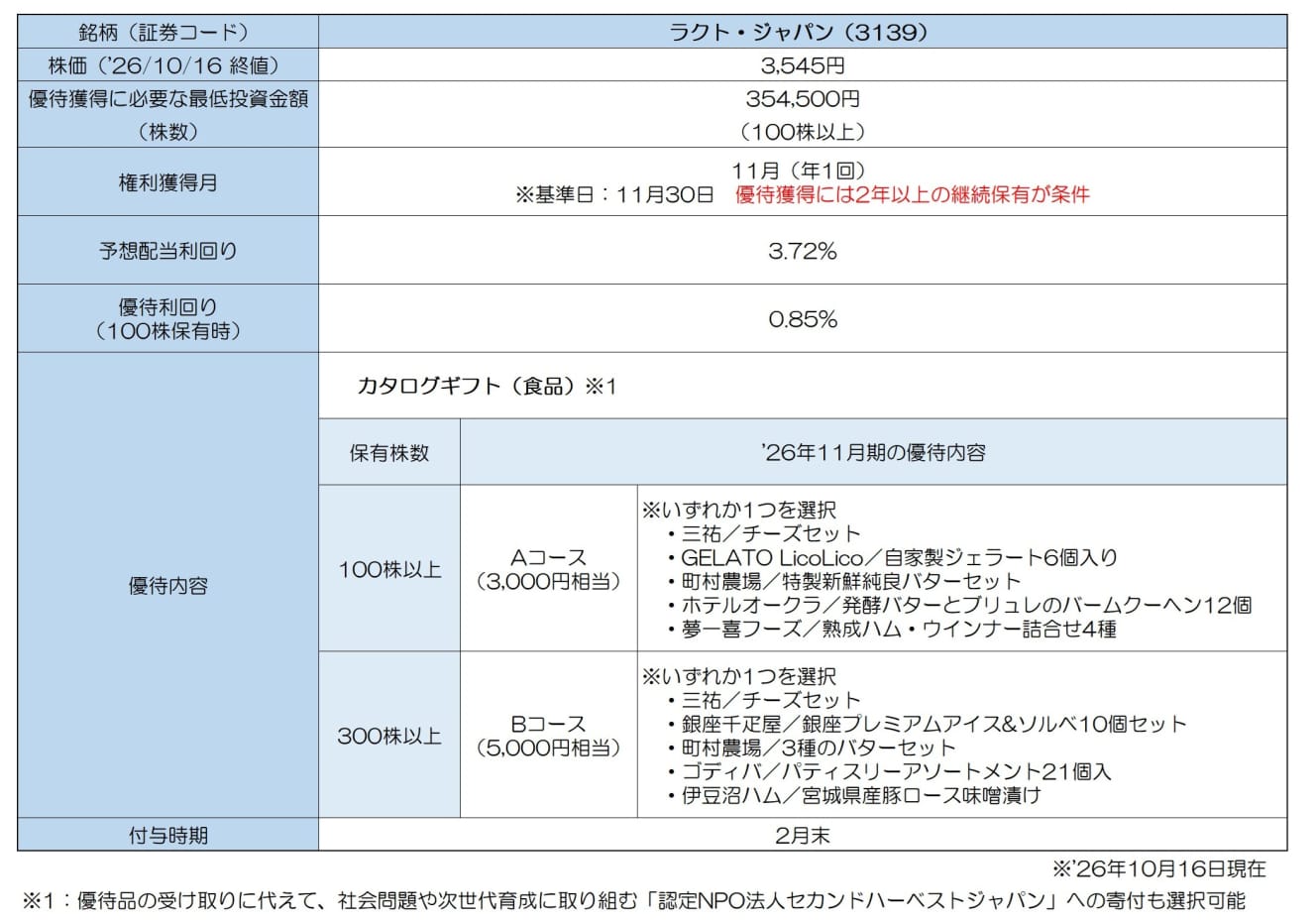
[Lacto Japan (3139)] is a specialized trading company that primarily deals in dairy ingredients. As a shareholder benefit, you’ll receive a catalog gift from which you can choose items such as cheese, butter, and gelato.The benefit value is equivalent to 3,000 yen for holdings of 100 shares or more, and 5,000 yen for 300 shares or more. The condition is continuous ownership for at least two years, so it takes time to qualify for the benefit. With a high dividend yield of 3.72%, this is a stock you’ll want to hold patiently for the long term while collecting dividends.

Daily Necessities at a Real Discount! LOHACO Coupons
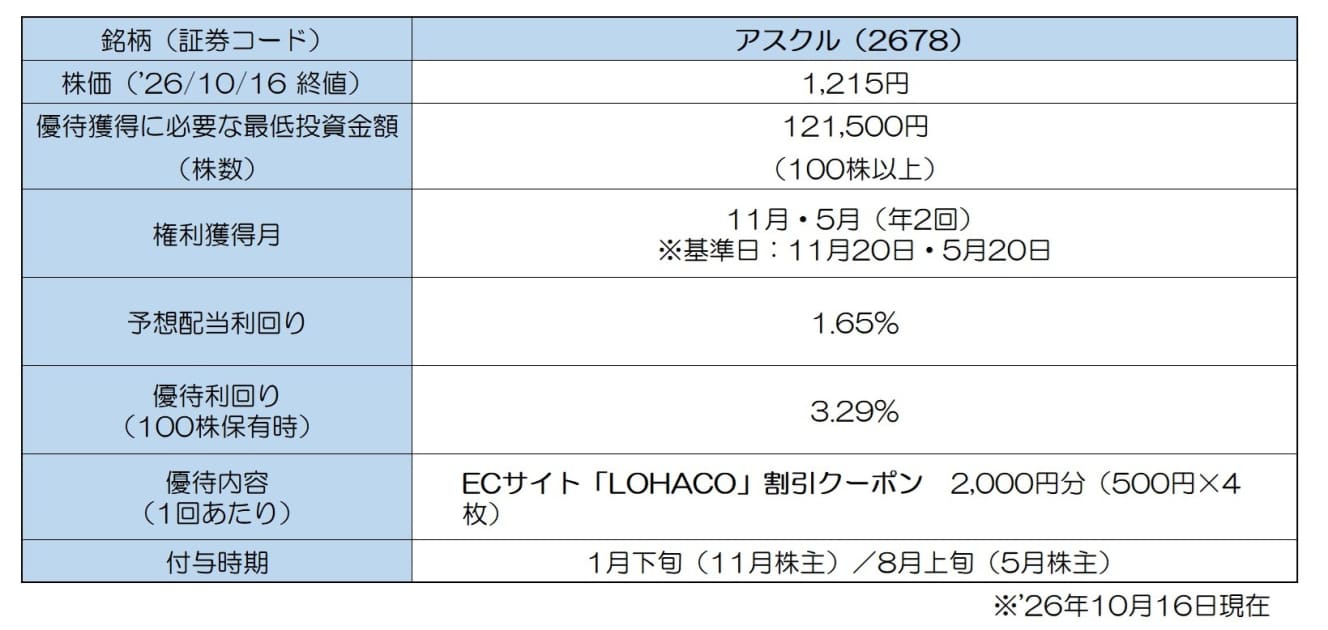
[Askul (2678)] is a company that operates e-commerce and delivery services focused primarily on office supplies. Shareholders who hold 100 or more shares receive a 2,000-yen discount coupon twice a year, redeemable on “LOHACO,” the company’s subsidiary e-commerce service for daily necessities.The coupons can be used to purchase daily necessities such as detergent and tissues, as well as cosmetics, pharmaceuticals, and food and beverages, making them extremely practical. Since an investment of approximately 120,000 yen yields 4,000 yen worth of coupons annually, the shareholder benefit yield is 3.29%.
In October 2025, Askul suffered a cyberattack involving ransomware, resulting in significant damage that caused prolonged outages of its e-commerce site and logistics systems. Although the stock price has remained weak, the company is projected to return to profitability by the fiscal year ending May 2027; investors should consider this opportunity while closely monitoring the progress of its business recovery.
Accommodation Discounts & Gift Certificates! Great Value for Long-Term Holders
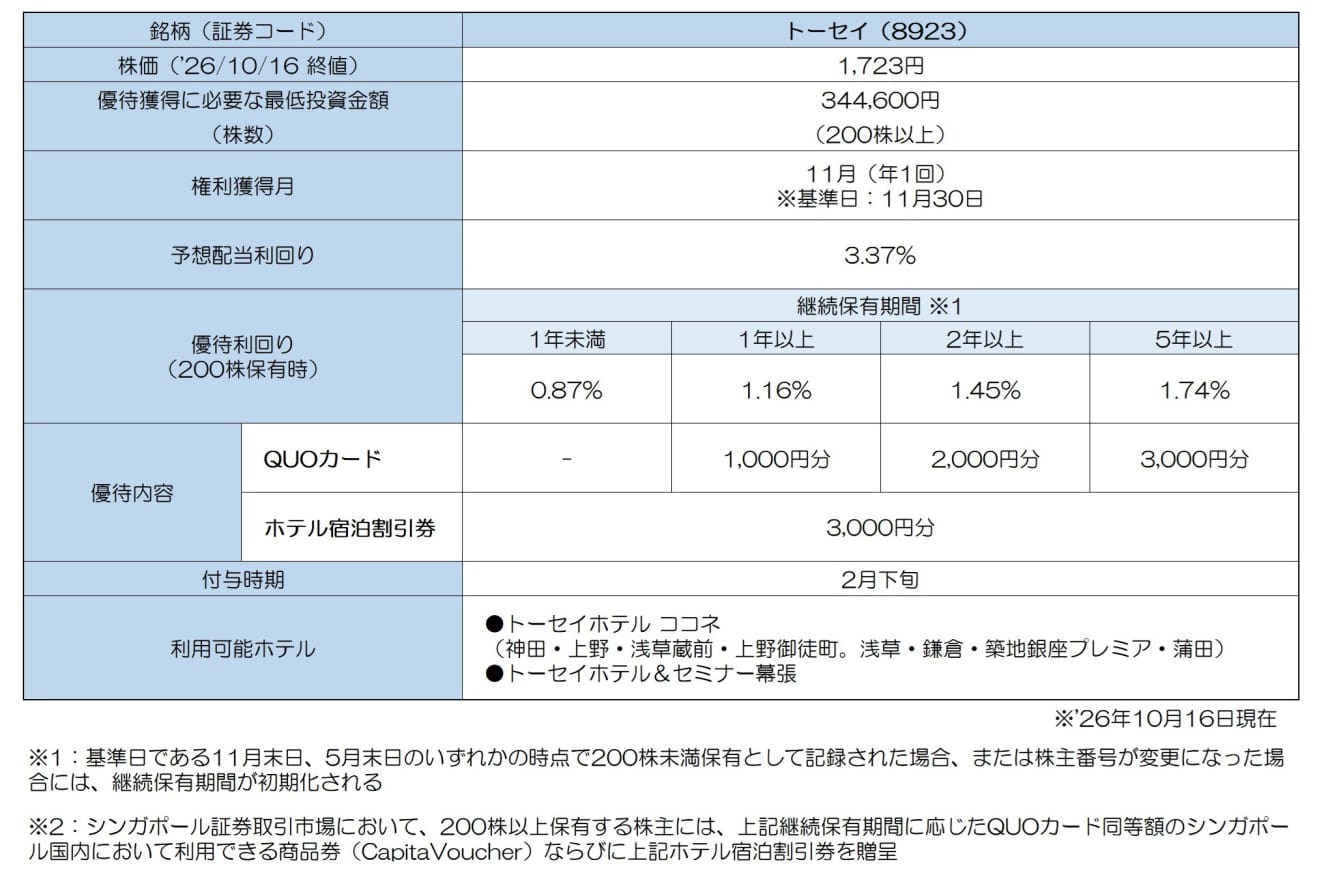
[Tosei (8923)] is a comprehensive real estate company engaged in everything from real estate revitalization and development to leasing, asset management, property management, and hotel operations.As a shareholder benefit, shareholders holding 200 shares or more receive a 3,000-yen accommodation discount voucher once a year, redeemable at properties such as the “Tosei Hotel Cocone” operated by the company. Additionally, shareholders who hold their shares continuously for one year or more receive an extra 1,000-yen QUO Card.The value of the QUO Card increases based on the length of continuous ownership: 2,000 yen for two years or more, and 3,000 yen for five years or more.

Yield Over 6%! APA Hotel Stay Points
[Japan Hotel & Residential Investment Corporation (3472)] is a listed real estate investment trust (REIT) managed by Apa Investment Advisors, a subsidiary of Apa Holdings, which operates the “Apa Hotel” chain.This REIT invests in hotels and rental housing, is listed on the Tokyo Stock Exchange, and can be bought and sold on the market just like stocks.
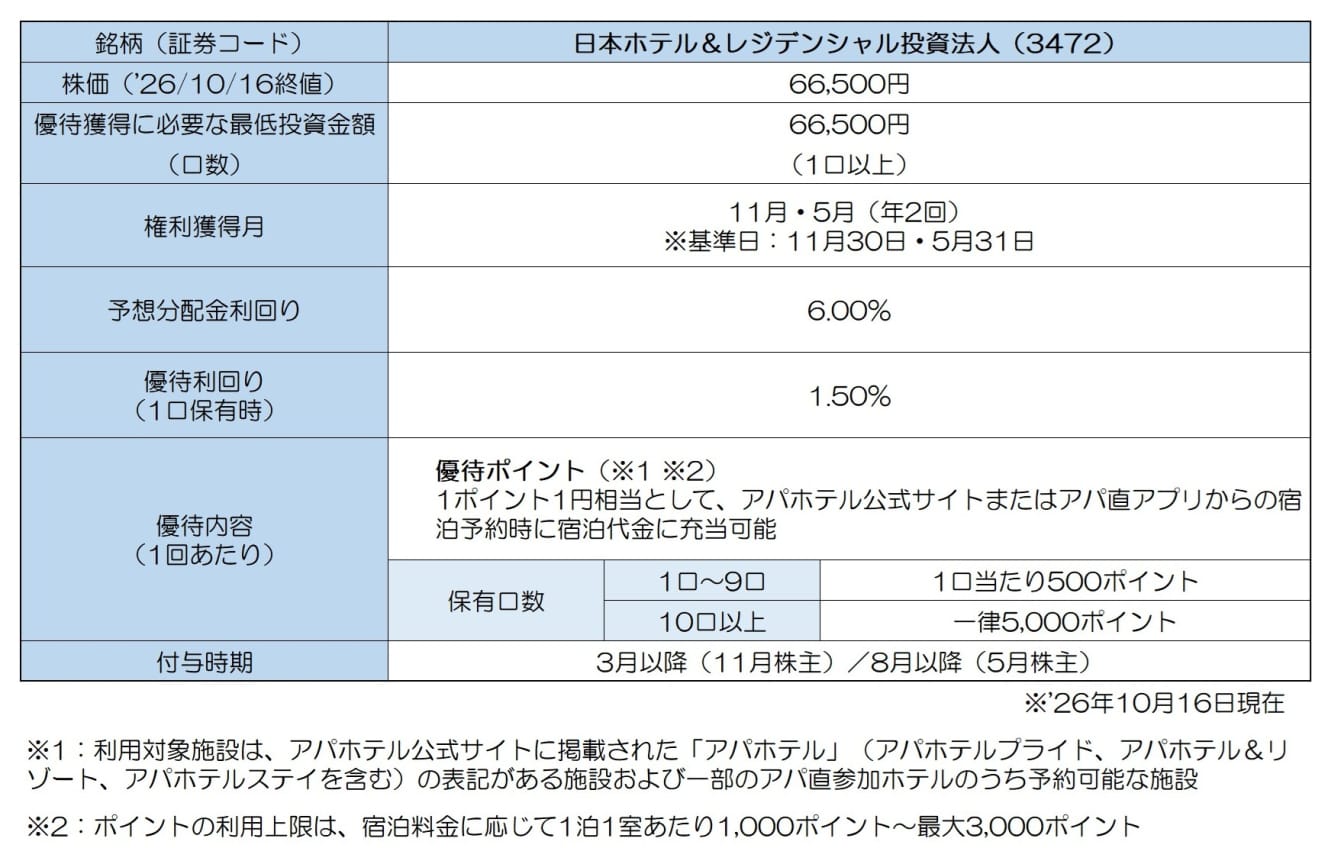
As a shareholder benefit, you receive reward points twice a year that can be used to pay for accommodations at a rate of 1 point = 1 yen when booking through the official APA Hotel website or the APA Direct app.The benefit amount is 500 points per unit (required investment of approximately 67,000 yen) per occasion, totaling 1,000 points annually. For holdings of up to 10 units, the benefit amount increases based on the number of units held (up to 5,000 points for 10 units, totaling 10,000 points annually).
Furthermore, the distribution—which is equivalent to a stock dividend—is projected to be 3,989 yen per share (estimated distribution for June ’26 through May ’27), resulting in a distribution yield of 6.0%. This is a stock worth holding for the long term, as it offers the dual benefits of distributions and loyalty rewards.
Avoid the sharp post-ex-dividend drop! Smart rules for when to buy
To receive shareholder benefits, you must be a shareholder of the company as of the record date (the date on which rights are granted).For the stocks featured here, the record date for [Askul (2678)] is November 20, while for the other stocks it is the end of November (November 30). For Askul, the ex-dividend date is Wednesday, November 18, ’26,while the others must be purchased by Thursday, November 26 of the same year.
Note that the stock price of shareholder benefit-eligible stocks tends to rise leading up to the last trading day with rights (two business days before the record date), and on the following business day (the ex-rights date), the stock price tends to fall by an amount equivalent to the value of the shareholder benefits or dividends. Therefore, it is generally advisable to avoid buying immediately before the last trading day with rights or selling immediately after the ex-rights date.If you are targeting November shareholder benefits, you should aim to purchase the shares between late October and early November. If you plan to hold the shares long-term, one strategy is to buy after the price has fallen following the ex-dividend date, with the aim of receiving future shareholder benefits and dividends.
*This article is intended solely for informational purposes and does not constitute a solicitation or recommendation to buy or sell any specific stock. Please make your own final investment decisions.The details regarding shareholder benefits, required investment amounts, projected dividend yields, and benefit yields (annual benefit amount / required investment amount) mentioned in this article are based on information available at the time of writing (October 16, ’26) and are subject to change. Please verify the latest information before considering a purchase.
Reporting & Text: Hiroki Takekuni
Financial Planner / Representative, Rapport Consulting Office.After graduating from the Faculty of Engineering at Nagoya University, he worked at a securities firm and an insurance agency before going independent. Through financial consultations and writing and supervising articles, he supports people in developing the ability to think for themselves and take action regarding their financial matters. He holds certifications as a Level 1 Financial Planning Specialist, CFP®, Real Estate Transaction Specialist, and Sauna & Spa Professional.
PHOTO: Afro