[The Tsutomu Miyazaki Case] Young Girls Disappeared One After Another… A FRIDAY Reporter Heard the “Heart-Wrenching Lamentations” of the Victims’ Parents at the Scene


A veteran crime reporter who covered the scene recounted
The “Tokyo-Saitama Serial Kidnapping and Murder Case of Young Girls,” which occurred from 1988—the end of the Showa era—through 1989, the year following the start of the Heisei era, involved four young girls aged 4 to 7 who went missing and were later found dead. It is also known as the “Tsutomu Miyazaki Case.”
The perpetrator’s bizarre behavior—such as mailing the victims’ remains to their families and sending a confession to a newspaper under the name “Yuko Imada”—drew widespread attention.Toshiyuki Kobayashi (74), who covered the case as a reporter for *FRIDAY* at the time, looks back on this case that plunged all of Japan into fear.
On August 22, 1988, the first child to go missing was “A-chan” (then 4 years old), a resident of Iruma City, Saitama Prefecture. Two months later, on October 3, “B-chan” (then 7 years old), a resident of Hannō City in the same prefecture, vanished. There were no leads, and the whereabouts of both children remained a complete mystery.
Then, on December 9, “C-chan” (age 4 at the time), a resident of Kawagoe City in the same prefecture, went missing after parting ways with a friend near her home on her way back from playing at the friend’s house.Five days later, a postcard resembling a riddle —bearing the words “C, cold, cough, throat, relief, death” —arrived at C-chan’s home.
The very next day, C’s body—stripped naked—was discovered in a wooded area in Naguri Village, Iruma District (now Hanno City). The discovery of C’s body suddenly drew attention to the disappearances of the other two young girls, and voices began to emerge in the public questioning whether the three cases were connected.
Mr. Kobayashi describes the situation at the time.
“I thought the chances of a connection between the three cases were fifty-fifty. At that point, A-chan and B-chan were still only missing.I think that once C-chan’s body was found, the police naturally re-examined the cases involving A-chan and B-chan as well. They must have suspected that the same perpetrator was responsible. However, I don’t believe they ever made any official announcement to that effect.
What I still remember vividly is that after C-chan went missing and her body was found, children suddenly stopped coming to the park altogether. It was truly an eerie sight. I don’t think the parents were letting their kids out, and the children themselves must have sensed that something was wrong.”
A claim of responsibility signed “Yuko Imada”
On February 6, 1989, as the new year began and the era name changed to Heisei, the case began to take an even more bizarre turn.
A cardboard box was placed in front of A-chan’s home. Inside were photographs of the clothes A-chan had been wearing, bones and teeth mixed with ashes and wood chips, and a sheet of copy paper with the words “A Burned Remains Appraisal” typed on it.
“When A-chan’s father went to open the door to head to work, he sensed something was there (outside the door), and when he looked, he saw a cardboard box had been placed there. He thought, ‘Maybe a neighbor’s kid left something behind,’ but when he looked inside, he immediately said, ‘I knew this was bad.’‘I can’t show this to my wife,’ he thought. So he called the police right away,” (Mr. Kobayashi; same below)
Furthermore, on February 10, a confession signed “Yuko Imada of Tokorozawa City” along with a photograph of A-chan was sent to the newspaper office and A-chan’s home. It was a lengthy text exceeding 5,000 characters, detailing everything from the motive for the crime to the method of killing.
On March 1, the Sayama Police Station announced that the human bones found in the cardboard box belonged to A-chan, confirming her death. Her funeral was held on March 11. However, even on the day of the funeral, a “confession” arrived from “Yuko Imada.”
It was filled with phrases that seemed designed to stoke the grief of the bereaved family and mock the police investigation.
“That poor girl.”
While the true identity of “Yuko Imada” was capturing the public’s attention, B-chan’s mother had been constantly worrying about her daughter’s safety, having received no information since her disappearance. In March 1989, with the investigation still at a standstill since A-chan’s funeral, Mr. Kobayashi interviewed her.
“It seems that until four years ago, B-chan’s family lived just a few hundred meters from A-chan’s house. But since they didn’t actually know each other, her mother said, ‘I don’t think my child has anything to do with A-chan’s case.’ She added, ‘I don’t think it’s the same case.’
She also shared this: Since Hanno—where B-chan was living at the time of her disappearance—is close to Iruma, where A-chan lived, there were apparently quite a few posters asking for information posted after A-chan’s disappearance.
When B-chan and her mother went out shopping or something, B-chan saw one of the posters and said, ‘That girl is so pitiful, isn’t she?’ She recalled that moment as follows:
“I said, ‘She’s so pitiful,’ too. But I never imagined that my own child, who had said those very words, would end up going missing in the same way… It’s truly heartbreaking,” she said.
She said she often had dreams in which B-chan appeared. “That child would say, ‘Whoa!’ and run toward me, and no matter how hard I tried to catch her, I couldn’t. Then I’d suddenly wake up,” she explained. “That’s why I sleep fully dressed so I can get out at any moment. I make sure I’m ready to dash out at the slightest sign of trouble,” she said.
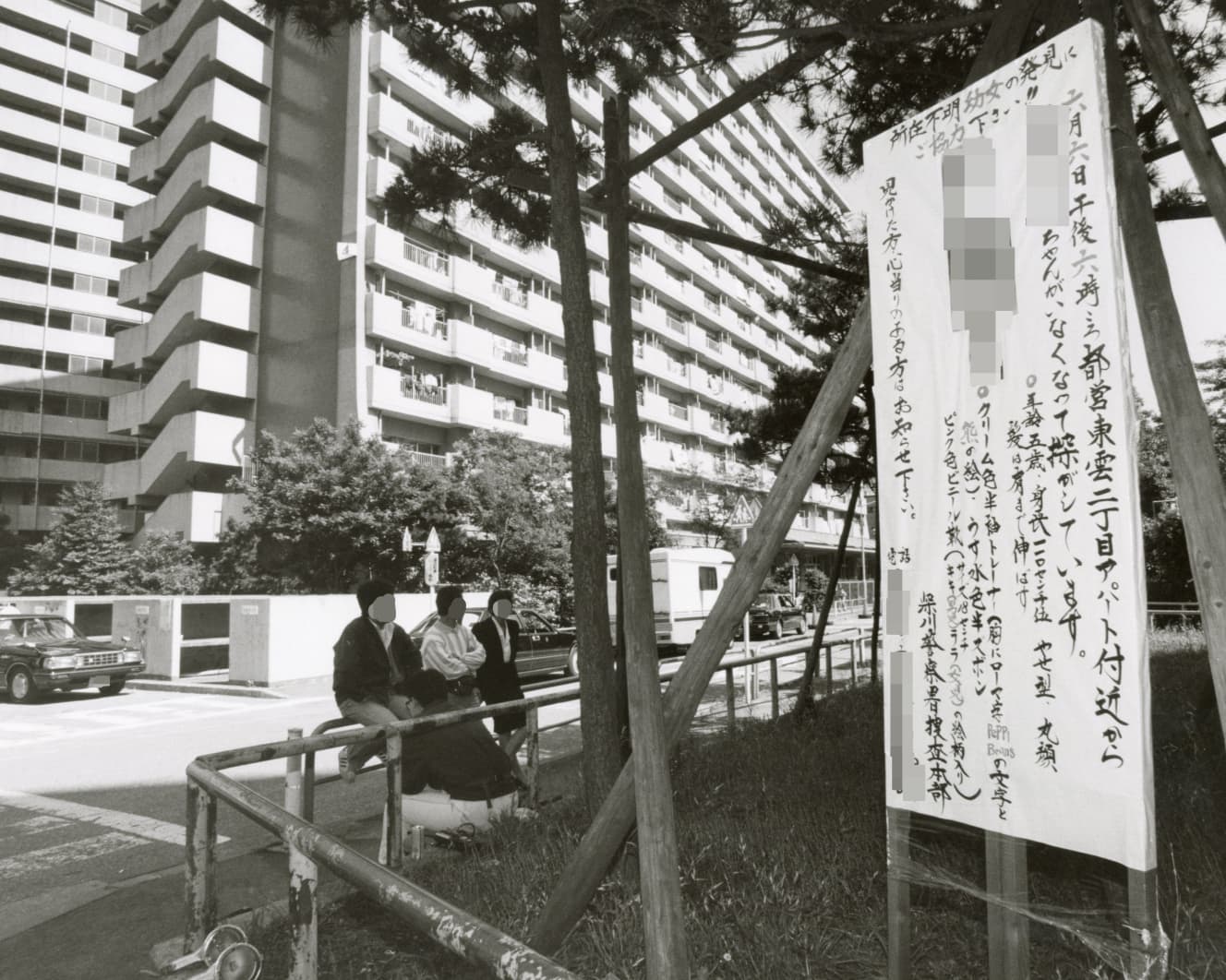
Three months later, on June 6, 1989, the fourth incident occurred. D-chan (then 5 years old), who lived in a housing complex in Koto Ward, Tokyo, was last seen playing in a neighborhood park before going missing.
Five days later, D-chan was found in Hannō City, Saitama Prefecture, in a gruesome state—her head, wrists, and ankles severed with a saw or similar tool.There was no claim of responsibility, and the crime scene was in Tokyo—a location completely different from the previous incidents. However, many people suspected a connection to the cases involving A-chan and C-chan, and the entire nation was shaken by the perpetrator’s sadistic nature.
Then, on July 23, Tsutomu Miyazaki, then 26 years old, was arrested in the act in Hachioji City, Tokyo, for committing an indecent act against a 6-year-old girl.At this point, no one yet suspected him of being the perpetrator of these serial kidnappings and murders. However, on August 9, after being interrogated by members of the Special Investigation Unit dispatched to the Hachioji Police Station, he confessed to the murder of “D-chan.” The case began to move toward a resolution.
On the YouTube channel [FRIDAY TV], Mr. Kobayashi speaks in detail about the circumstances surrounding the case at that time.


PHOTO: Shuichi Masuda (1st photo), Masaharu Uemoto (2nd photo), Masatoshi Okauchi (4th and 5th photos)