Tomoya Masaki, SoftBank: The “King” Who Broke Out This Season Reveals, “Why I Put Three Times as Much Pine Tar on My Bat as Other Players”
Special Interview [Part 2]


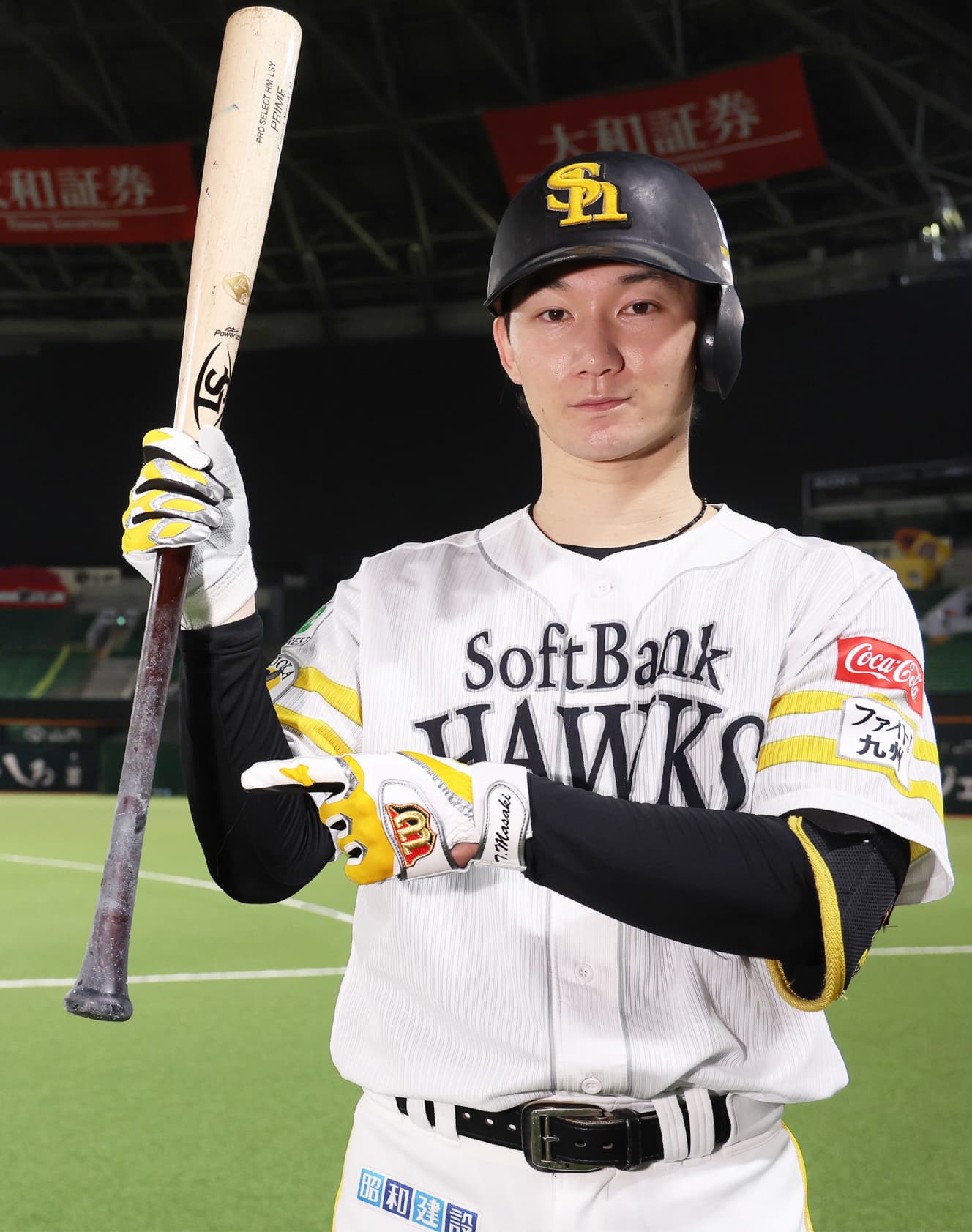
“A wink at the plate?”
This season, Tomoya Masaki (26) of the Fukuoka SoftBank Hawks took the baseball world by storm. In his fifth pro season, he reached the required number of at-bats for the first time and made a huge leap forward, hitting 28 home runs as the leadoff hitter. His nickname among fans is “Masaking.”His ability to hit one spectacular home run after another truly lives up to the name “King.”
Armed with his power-hitting ability, he turned pro in 2022 after graduating from Keio University. From the start, he was expected to be a future core player and was even entrusted with the No. 5 spot in the lineup twice at the start of the season. However, until last season, he had never recorded double-digit home runs. Contrary to expectations, his professional career had been a series of setbacks due to injuries.
During spring training shortly after joining the team, he injured the ligament in his right elbow. Then, in a game against the Seibu Lions last April, he suffered a severe injury—a partial dislocation of his left shoulder—while swinging and missing. Following advice from Manager Kokubo, he decided to undergo surgery.
Masaki reflects on this decision, saying, “It was the hardest choice I’ve ever had to make in my life.” The long days of rehabilitation can easily become monotonous. However, rather than simply waiting for his return, Masaki took the opportunity to fundamentally reevaluate his batting approach.
“I wanted to come back a better player. So I focused on building up my physical strength.”
He worked on building muscle mass and improving explosive power, and he also made adjustments to his swing. Previously, he would release the bat with his right hand at the end of his swing, but to reduce the strain on his left shoulder, he changed his form to follow through with both hands. This increased the sensation of pushing the bat forward with his right hand, making it easier to transfer power to the ball.
“To make sure I don’t let go of the bat with my right hand, I’ve been slathering it with pine tar since this year. Not only do I use a brand of spray with stronger adhesive properties, but I also apply about three times as much as other players.“So when I walk to first base on a walk, the ball boy comes over to take the bat, but I tell him every time, ‘It’s really sticky, so you’d better not touch it.’ My batting gloves also get ruined—they tear during a single game.”
I’ve also tweaked my stance at the plate. Before turning to face the pitcher, I shift my gaze toward first base. I close just my left eye, as if I were looking directly at the camera during a baseball broadcast.
“People ask me, ‘Are you winking in the batter’s box?’ but that’s not it (laughs). It’s a routine to make sure I’m looking at the pitcher with both eyes. I started doing it because I figured that if I looked at the pitcher with my right eye, I’d naturally be able to see him with both eyes.”
During batting practice, he also actively uses the “Traject Arc.” It’s a high-performance pitching machine that projects a life-size image of the pitcher and, by inputting data such as pitch type and spin rate, can reproduce pitches that closely resemble the real thing.
“I study the opposing pitcher on my smartphone before going to bed the night before, and then I double-check with Traject before the game. This has also become an indispensable part of my routine.”
A New Level Reached After Overcoming Hardships
Physical conditioning, swing work, video analysis—when asked what had been most effective, Masaki paused to think for a moment.
“Honestly, they’re all tied for first place. I’m not really sure which one was the most effective. On the other hand, if even one of them had been missing, it might not have worked out.”
The changes resulting from these efforts have led to home runs of extraordinary power.In the June 24 game against the Orix Buffaloes, he launched a super-powerful home run with a batted ball speed of 188.5 km/h. Not only was this the top speed in this season’s NPB, but even when compared to the Major Leagues, it surpassed the speeds of power hitters like Shohei Ohtani, Munetaka Murakami, and Kazuma Okamoto, ranking sixth overall.
It’s unclear whether he would have been able to achieve this season’s results if he hadn’t had the surgery and had simply continued playing. Looking back now, he says, “I’m glad I had the surgery,” noting that he was able to secure sufficient time for training.
His vision for his baseball career has also changed. Following the Japan Series, he was selected as one of the three players eligible for the “over-age” slot on the young, up-and-coming Samurai Japan team set to compete in the “Ragzas Asia Professional Baseball Championship 2026” (opening November 12).
“My goals for this year were just to play in games all year and hit double digits—that was about it. But now that I’ve gotten back to hitting like this, my goals have shifted to things like winning a title next year or being selected for the official Japanese national team.”
The same goes for his spot in the batting order. Before, he just wanted to play—no matter what spot he batted in. Now, he’s developed a desire to bat in the cleanup spot, especially as the cleanup hitter.
“Batting leadoff is fun, too. As a result of aiming to be a home run hitter capable of batting fourth, I’ve also found that I fit well in the leadoff spot. That’s the mindset I want to maintain.”
The powerful home runs that made the nickname “Masaking” famous were a new level of achievement he reached after overcoming adversity.
《Tomoya Masaki: Born in November 1999 in Tokyo. Attended Keio High School in Kanagawa before enrolling at Keio University. Joined the SoftBank Hawks in 2022 as the second overall draft pick. Has hit 12 home runs over the past four seasons through last season.Outfielder. Throws and bats right-handed. Height: 182 cm, Weight: 89 kg》


From the November 13 & 20, 2026, combined issue of “FRIDAY”
Reporting and Text: Kotaro Tajiri (Sports Writer) PHOTO: Ryoji Hanamasa