[Full Report] Aerial Tour of Tokyo’s Massive Tsukiji Redevelopment Site
Eight years since the much-publicized move to Toyosu—construction of a dome-shaped multipurpose facility, rumored to be the Giants’ new home stadium, was supposed to have been approved, so why hasn’t it happened?


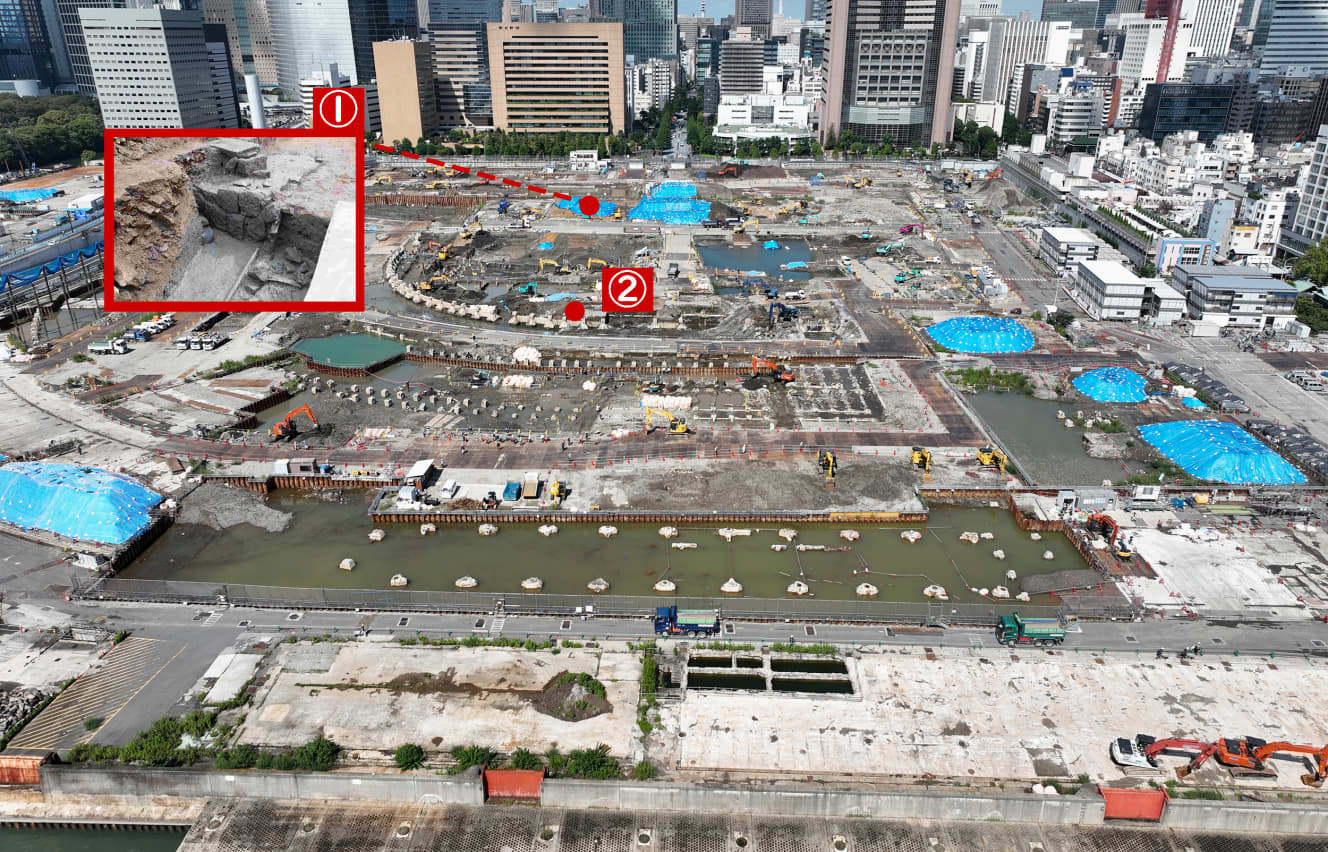
Historical remains or redevelopment?
Just a 10-minute walk from the heart of Ginza lies a vast vacant lot measuring the equivalent of 4.2 Tokyo Domes, occupying an exceptionally prime location. It is the former site of the Tsukiji Market, which was relocated to Toyosu in 2018 after years of twists and turns, including rebuilding plans and repeated postponements of the move.
The photo shows the site as it looks today from the air. The wholesale market has been completely demolished, leaving the area almost entirely cleared. When we visited, several excavators were at work, and blue tarpaulins covering piles of soil and rubble were scattered across the site.
Plans call for a massive complex centered on an all-weather dome with a capacity of 57,000, rumored to become the new home stadium of the Yomiuri Giants. Luxury hotels and commercial facilities are also planned. Yet eight years have passed since the market’s relocation, and almost nothing has been done.
In fact, a redevelopment project championed by Tokyo Governor Yuriko Koike (74) is reportedly facing a series of complications behind the scenes. Remains of Yokuon-en, a garden built during the Edo period by senior councilor Matsudaira Sadanobu, have been discovered at the site. The magnificent garden, covering an area equivalent to 1.3 Tokyo Domes, is believed to have featured two enormous ponds: “Spring Breeze Pond,” surrounded by cherry trees, and “Autumn Breeze Pond,” surrounded by trees known for their autumn foliage.
Shizuko Nagaya, representative director of the Tsukiji Yokuon-en Restoration Society, which is calling for the preservation of the garden remains, is outraged.
“The preliminary archaeological survey conducted in 2021–2022 covered only 3.4% of the entire 19.4-hectare redevelopment site. Despite this, the Tokyo Metropolitan Government announced that the remains of Yokuon-en were not important enough to warrant preservation, and the redevelopment plan was allowed to proceed. How could they reach that conclusion after examining just 3.4% of the site?
We understand that a full-scale excavation is now underway, but even when we asked the metropolitan government, we could not get a clear explanation of what was being investigated. The site has already been cleared, and it appears that the remains of the two ponds have been buried again. Are they really conducting the investigation? Despite this situation, the metropolitan government says the facilities will begin opening in stages from fiscal 2029. I can only conclude that the investigation is being conducted with redevelopment already treated as a foregone conclusion.”
In September, Nagaya held a press conference to challenge the lack of transparency surrounding the investigation. She called for the release of information on the excavation process and for public tours to be organized.
“This is land owned by the Tokyo Metropolitan Government, and the excavation costs are being paid out of the metropolitan government’s budget. Why isn’t the process being made public to residents? If the remains are destroyed by construction, the history that is lost can never be recovered.”
Is the investigation really being conducted appropriately? In response to “FRIDAY’s” inquiry, a representative of the Bureau of Urban Development stated:
“Following the completion of the preliminary survey, the site was temporarily backfilled. A full-scale excavation has been underway since July 2025. The excavation procedures and other aspects of the buried cultural property investigation are being handled appropriately, in accordance with guidance from the Tokyo Metropolitan Government’s Board of Education and the Chuo Ward Board of Education, among others.”
Tokyo Metropolitan Assembly member Reiko Ueda, who has been pursuing the issue in the assembly, argues that the plan should be reconsidered.
“The investigation budget, which was initially ¥20 billion, has ballooned to ¥145 billion due to additional work to remove buried debris and rising prices. The Tokyo Metropolitan Government probably doesn’t want to change the plan at this late stage, but both the investigation costs and the funds for redevelopment come from taxpayers’ hard-earned money. I believe the government needs to reconsider what residents truly want.”
The metropolitan government is being called upon to put the interests of Tokyo residents first.
From the October 23–30, 2026 combined issue of “FRIDAY.”
PHOTO: Masayuki Katayama