Risking Their Lives for a $20,000 Take-Home Pay… The Day the “Scaffolders” Who Support High-Rise Apartments Disappear. Behind General Contractors’ Record Profits, Bankruptcies Reach an All-Time High


High-rise apartment buildings will no longer be built. A growing number of apartment complexes will fall into disrepair and become ruins—a silent crisis is unfolding that is shaking the very foundations of Japan’s infrastructure.
While every industry faces labor shortages today, the construction industry is particularly affected by an aging workforce, and the decline in the number of workers is accelerating. Above all, there are few young people applying to become “tobi” workers—a role essential for working at heights—and the situation is becoming extremely critical.
Infrastructure such as buildings and bridges constructed decades ago during the period of rapid economic growth is aging, and demand for reconstruction and large-scale repairs is expected to surge in the future. If there is a shortage of “tobi” workers, work at heights will become impossible, and there is a risk that construction will come to a halt at every construction site across Japan.
Life-Threatening Work at Heights and the Exodus of Young People
What kind of craftsmen are “tobi” in the first place? It was said that “fires and fights were the flowers of Edo,” and the “firefighters” of the Edo period were the heroes of the city.They would rush to the scene of a fire, climb onto the roof, and use a “tobiguchi”—a tool with a metal claw at the end of a long handle—to hook onto the building and dismantle it, thereby preventing the fire from spreading and assisting in firefighting efforts. It is said that the craftsmen who handled this tobiguchi came to be called “tobi.”
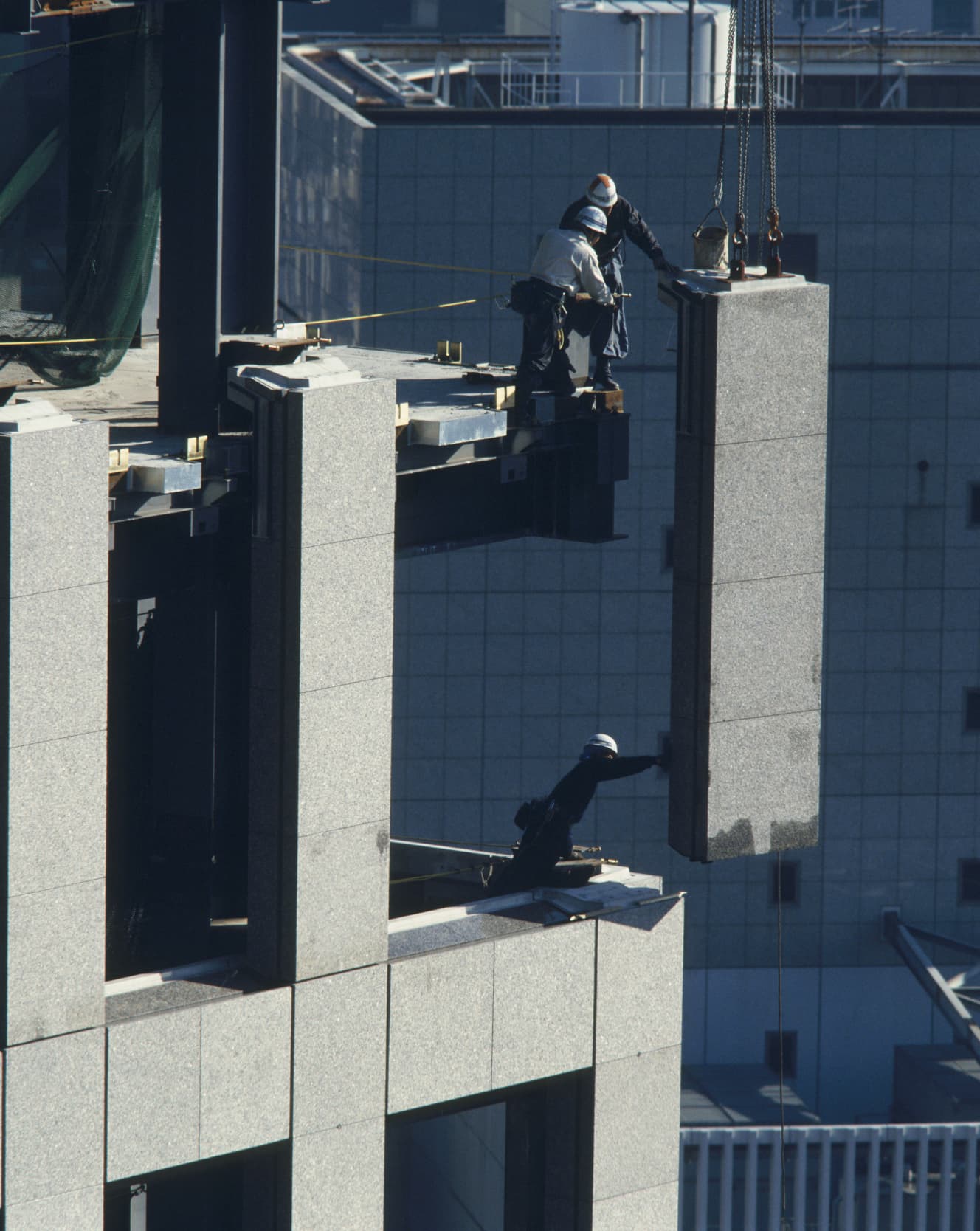
Even today, tobi are called “the flowers of the construction site” because they move gracefully at great heights.In addition to erecting and dismantling scaffolding and assembling steel frames, they sometimes transport heavy loads at heights where cranes cannot be used. The task of adjusting and installing massive steel beams hoisted by cranes at great heights with millimeter-level precision is a skilled craft that only they can perform—one that can never be mechanized.
However, the working conditions on these sites are extremely harsh. A representative from the Japan Federation of Structural Construction Contractors (Nihon Kotsu) expressed concern, saying, “We’re worried. How can we help new recruits understand the appeal of this work?” and explained as follows:
“Roofer are involved from the very beginning to the very end of a construction project—from erecting the scaffolding to taking it down. Perhaps because it’s outdoor work, people tend to shy away from it, and we’re having a hard time attracting young people.”
Keishi Okamoto, chairman of the Japan Scaffolding Industry Federation (Nitto-Ren)—an industry association for scaffolders—and chairman of Hayabusa Corporation (based in Kurashiki City, Okayama Prefecture), also expressed growing concern: “We’ve always welcomed energetic, motivated people even if they aren’t fond of studying, but lately, young people just aren’t joining us.” He further describes the dilemma on the job site, saying, “Training the next generation—especially teaching them—has become difficult; depending on how you teach, it can even be labeled as harassment.”
For ground-level work, it might be possible to get through a shift safely with support from colleagues even when feeling slightly under the weather. However, a mistake made by a scaffolder working at heights without scaffolding can be immediately life-threatening. The job involves constant exposure to danger and requires strict management of one’s physical condition at all times.
There are also issues unique to outdoor work. Mr. Okamoto explains:
“Not only are job sites often closed on weekends and holidays, but on rainy days, we work in rain gear—which reduces our work efficiency, dampens our morale, and increases the risk.To make up for delays, we sometimes work through the night, and on sunny days, we work as hard as we can. However, due to work-style reforms—such as stricter regulations on overtime—it has become difficult to catch up on these delays.”
Even those with excellent skills are troubled by the reality that physical demands become increasingly difficult as they reach middle age.
Exploitation Behind General Contractors’ Record Profits
One of the biggest factors preventing young people from entering the scaffolding industry is that wage levels do not match the demands of the job.In its “Blueprint for Structural Reform”—aimed at passing on skills to the younger generation and achieving fair unit rates—the Japan Federation of Scaffolding Contractors points out that while this work involves high risks, such as fatal falls, and workers often reach their physical limits in their 40s and 50s, making it difficult to continue for long, income levels do not reflect these circumstances.
The “scaffolder” rate set by the Ministry of Land, Infrastructure, Transport and Tourism—which represents the labor cost per person per day (8 hours) used to calculate the design cost for public works projects—is 30,780 yen.However, the Japan Federation of Scaffolding Contractors argues that, given the level of danger and physical strain, 36,680 yen—equivalent to 1.42 times the average across all industries—is appropriate.
The problem is that, in reality, actual wages for scaffolders fall far short of even the design labor unit rates published by the Ministry of Land, Infrastructure, Transport and Tourism.
Industry insiders unanimously agree that when major general contractors award construction projects to subcontractors—often after pitting them against each other in fierce competition to secure the lowest bid—scaffolders are unable to secure adequate wages.The construction industry has a unique hierarchical structure that reflects the overwhelming power imbalance between prime contractors and subcontractors (including sub-subcontractors).
Shuji Matsuura, Chair of the Technical and Skills Committee at the Japan Federation of Scaffolders (representative of Matsuura-gumi, Miyazaki City), expresses his outrage.
“Wages are slow to rise. The Ministry of Land, Infrastructure, Transport and Tourism says that design labor unit rates are increasing, but we aren’t receiving that much. There are even cases where the general contractor doesn’t pay 100 percent.”
Kentaro Tomita, Vice Chair of the same committee (Representative of Riken, Yufu City, Oita Prefecture), also reveals his distress: “The design labor unit prices announced by the Ministry of Land, Infrastructure, Transport and Tourism differ from reality. Subcontractors are by no means on an equal footing with general contractors.”
For example, some scaffolding contractors end up taking on projects—for which 10 million yen would be a reasonable price—for just 5 million yen; some are reportedly struggling to stay afloat by taking on whatever work is available just to keep the business running. From the prime contractor’s perspective, there’s nothing better than having subcontractors compete against each other so they can award contracts at lower prices.Industry insiders complain that prime contractors do not pay adequate compensation, and if they voice dissatisfaction, they risk losing future work; even when they appeal to the authorities, “the government’s response ends with a mere ‘we will provide guidance.’”
While these structural issues persist, the major general contractors—who act as prime contractors—are reporting strong financial performance. In fact, looking at the first-quarter financial results for this fiscal year from 23 major and mid-sized general contractors, 15 companies saw an increase in consolidated revenue compared to the same period last year, with 9 of those setting new all-time highs.In terms of consolidated operating profit, 19 companies reported an increase, with 7 of them setting new records. Of course, these results are also the fruit of each company’s relentless management efforts. However, it is undeniable that there is a “structural distortion” whereby these record profits are not being adequately passed on to the craftsmen at the bottom of the chain.

A Sharp Rise in Bankruptcies and a Desperate Labor Shortage
Regarding the income levels of construction workers, Yusuke Aoki, an economist at “Indeed Hiring Lab”—the think tank of Indeed, which operates a job search website—explains as follows:
“Bonuses tend to be higher in other professions, so annual income may end up being lower compared to other jobs. However, when comparing base salaries, the level is on par with other occupations.”
According to industry insiders, while some fully qualified scaffolders earn an annual income of around 6 million yen, they aim to raise this to about 8 million yen.Mr. Matsuura of the Japan Scaffolding Contractors’ Association points out that while the salaries of typical office workers rise steadily from their starting pay as they gain age and experience, he laments that in the scaffolding world , “starting at around 10,000 yen per day , even foremen take home only about 20,000 yen—at most, their pay doubles.”
It is common for scaffolders to spend 3 to 5 years as apprentices, build up a track record over a period of about 10 to 15 years, and then move on to mentoring the next generation. Mr. Okamoto says , “It would be ideal to earn a decent income by the age of 50 and then move to a different industry after that.” He also notes that the scaffolding industry “makes it easy to strike out on your own at a young age. Some people even go into business without knowing anything.” He explains that this structure makes it easy for micro-businesses, such as sole proprietorships, to proliferate.
In September, the credit research firm Tokyo Shoko Research (TSR) published a report titled “Scaffolding Industry in Distress: Bankruptcies on Track for Record High.” Based on a tally of cases with liabilities of 10 million yen or more, there have already been 110 bankruptcies from January through August of this year.While the annual high was 148 cases in 2010, this year’s total is expected to reach as high as 170.Yoshihiro Sakata of TSR’s Information Headquarters pointed out, “The smaller the business, the more likely it is to face cash flow problems due to rising material and labor costs.” He analyzed that even though the industry as a whole appears to be thriving with increased revenue and profits, extreme polarization is progressing.
Mr. Aoki of Indeed also sounds a strong warning regarding the workforce.
“The number of workers in the construction industry is declining. In particular, the number of workers in their 30s and 40s is decreasing. There is a tendency for workers to leave the construction industry as they reach middle age, so we need to consider what to do—including how to maintain physical fitness. It is important to ensure that the experience, skills, and know-how cultivated on the job site can be leveraged in their future careers.”
He adds that support is also needed to help workers expand their scope of activity beyond on-site work—into areas such as construction management, workforce development, and efficiency improvements through the use of AI and digital technologies.
Recently, the number of women and foreign workers has been increasing on the demanding construction sites. However, a representative from Nihon Kutaigai reveals, “While foreign workers are entering the scaffolding trade, their numbers are still small.”
For scaffolders, seamless teamwork is essential, and the language barrier is extremely high. Mr. Okamoto, chairman of the Japan Scaffolders’ Association, speaks highly of young people from countries such as Indonesia and Vietnam entering the scaffolding field, noting , “The talented ones are truly exceptional, and some even take on leadership roles on-site, managing Japanese workers.” However, there is concern that highly skilled foreign workers do not bring their families with them and may return home if economic growth in their home countries leads to increased labor demand, raising fears that they might eventually turn their backs on Japan.
Furthermore, while the entry of women into the construction industry as a whole is becoming more noticeable, they are almost entirely absent from the scaffolding sector. The reality is that the work—which involves dangerous work at heights and grueling physical labor—is extremely demanding for women.
Mr. Sakata of TSR points out that it is an urgent priority to establish a support system for small-scale businesses, including the succession of scaffolding skills.On construction sites where even a one-month delay in the project schedule can result in massive losses, he expresses a growing sense of crisis, stating, “ If young people do not find the scaffolding trade appealing and choose to stay in the field, there may come a time when, even if we want to build, there will be no one left to do the work.”
If we continue to ignore the cries of these “stars of the construction site”—who risk their lives to protect our infrastructure—the very foundation of our daily lives will eventually crumble. That deadline is fast approaching.
Reporting and Text: Hideki Asai PHOTO: Afro