Your Home Is Flooded… What Is the “45-cm Wall” in Fire Insurance? Essential Steps to Ensure You Receive Your Insurance Payout


Your Home Is Submerged… Compensation Standards Vary by Insurer
During the torrential rains in Chiba, many homes were submerged. Flood damage coverage under fire insurance can be a major help when rebuilding your life. In addition to fire, fire insurance generally covers damage caused by natural disasters such as lightning strikes, wind damage, and flood damage. However,
“With life insurance, there are some cases where payments are not made—such as suicide (subject to a three-year waiting period) or death caused intentionally by the beneficiary—but otherwise, the benefit is paid upon death regardless of the cause.“However, with property insurance, the extent of damage varies depending on the location of the home and its structure. Therefore, there are no clear-cut criteria stating, ‘Payments will definitely be made in this situation,’”
So says financial planner Kenji Matsuura.
That said, all insurance companies stipulate that a payout will be made if any of the following conditions are met: “flooding above floor level,” “flooding of 45 cm or more above ground level,” or “damage amounting to 30% or more of the replacement cost.” However…
“Even when we say ‘45 cm above ground level,’ if the house is built on a sloped lot, the insured and the insurance company may disagree on where to define the ground level. The insured may want it measured as 45 cm from the lowest point, but the insurance company might not accept that.“We can’t reach a conclusion without going to the site and investigating where the ground level is” (Mr. Matsuura; same below).
To get the insurance company to acknowledge the damage,
“Make sure to take photos as evidence.Take photos of the building’s exterior, as well as close-ups and wide-angle shots with a tape measure held against the spot where you believe the water reached 45 cm. If the water rose above the floor level, take photos that clearly show the water level. Even if an actual measurement turns out to be only 44 cm, you have no choice but to present that evidence. The fundamental prerequisite for receiving insurance payouts is to accurately record the facts without any attempts at falsification.”
Flood insurance covers the building and its appurtenances. This includes immovable items such as gates, fences, garages, and built-in kitchens. Cleanup costs are also reportedly included in flood coverage as “removal costs for debris,” but
“There are differences depending on the insurance company, so you’ll need to check.”
For example, air conditioner outdoor units and EcoCute water heaters may become inoperable even if they aren’t submerged up to 45 cm. If the flooding isn’t recognized as such, you won’t be compensated; however, if you have the Building Electrical and Mechanical Accident Rider, you will be covered. However,
“Some companies do not even offer this rider.”

On the other hand, movable items such as dressers and refrigerators are covered under household property insurance.
“Here, too, you should take photos showing the entire interior of the room before cleaning up. Then, you’ll need to submit a list to the insurance company detailing the damaged items and how much it would cost to replace them now. The same applies if sewage backs up from the toilet or bathroom, causing flooding above the floor level.”
It all sounds like a lot of work.
“That’s because there are so many fraudulent claims. It’s fine if you only claim for items actually damaged by the flood, but some people include items that were already broken beforehand.In the most egregious cases, there are instances where a company posing as a consulting firm approaches a home affected by water damage and advises the owner on what to claim. Their goal is to receive a larger insurance payout and take a portion of it as a consulting fee. Because of incidents like this, insurance companies have become very cautious.”
Still, even for items purchased a long time ago, is it really okay to use the current market price?
“Replacement cost refers to the ‘amount necessary to replace the building or household goods with new items of equivalent quality on the current market (replacement value)’—this applies equally to buildings and household goods.”
So does that mean a 30-year-old house would be compensated at the price of a new home?
“To begin with, the appraised value of the house is determined when you take out the policy, and the insurance payout is limited to that amount. So even if you receive the full payout, due to rising prices and soaring costs of construction materials, it might be difficult to rebuild an equivalent house at current market rates using the appraised value (upper limit) set at the time of the contract.”
Cars Are Excluded! The Need for Flood Coverage
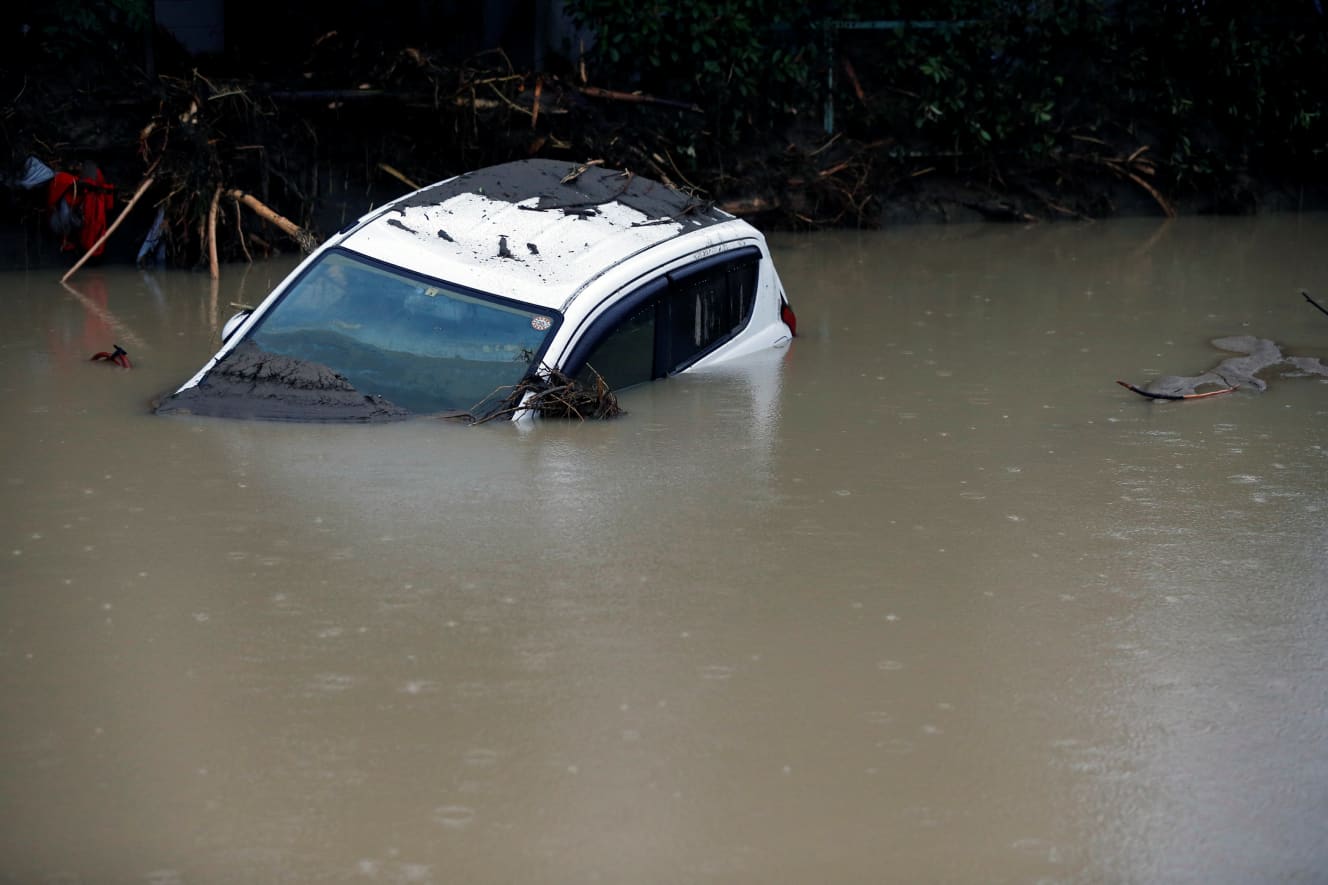
It appears that many cars were submerged during the heavy rains in Chiba, but
“Cars are not covered under flood damage coverage. If you do not have vehicle insurance, you will not receive any insurance payout.”
There are two types of vehicle insurance under auto insurance (voluntary insurance): “Standard” and “Economy.”
“In most cases, the Economy Plan excludes coverage for damage caused by contact with objects other than the car—such as animals or bicycles—but it does cover submersion. If you want to prepare for submersion at a low cost, the Economy Plan is a good choice. However, submersion caused by earthquakes, volcanic eruptions, or tsunamis is not covered, regardless of whether you have the Economy or Standard Plan.”
However, vehicle insurance is expensive. If you file a claim, your insurance rating will drop, and your premiums will increase the following year.
So, is it better to get this coverage or not?
“If it’s an expensive new car, you might want to get coverage. Even for an expensive car, once it’s 10 years old, the insurance payout won’t be enough to buy a new one. Whether or not to get coverage is up to the individual.”
Vehicle insurance is a personal decision. So, what about flood coverage under fire insurance? When you take out fire insurance, you can opt out of it if you think it’s unnecessary.
“People living in areas marked in color on hazard maps should probably keep it.”
So, if you live in an area that isn’t marked on the hazard map, is it okay to drop that coverage?
“Hazard maps are, after all, based solely on historical data. We don’t know how rainfall patterns will change in the future. In fact, during the Chiba torrential rains, even areas not marked on the map were flooded. Even on higher ground, embankments could collapse. Considering all that, I think everyone should include it.”
What if you live on a high floor of a condominium?
“Since the homeowners’ association has fire insurance for the apartment building, I believe insurance payouts for the building itself will come from that. If your personal property is damaged due to flooding, it should be covered by your personal property insurance.”
I’ve heard that if flooding occurs because a drain is clogged, insurance claims might be denied on the grounds of poor maintenance.
“It’s hard to imagine anyone intentionally clogging a drain, so if torrential rain was the cause, it’s likely to be covered. In this case as well, if you take photos and make sure the date and time (e.g., [Month] [Day] at [Hour] [Minute]) are clearly visible, the insurer should recognize that the torrential rain was the cause.”
Fire insurance policies come in one-year and five-year terms, but
“In the past, there were even 35-year policies. However, due to climate change, it has become impossible to calculate risks over a 35-year period.After that, 10-year policies were introduced, but now the longest term is five years. That just shows how difficult it is to calculate future risks. Risks are increasing year by year. When you think about it that way, a five-year policy—which calculates risks based on current conditions up to five years in the future—is likely the best option.”
There are direct insurance policies you can purchase online and those you can get through an agent, but
“I recommend going through an agent for anyone who feels uncertain about choosing insurance. The coverage details vary slightly by insurance company, and you can ask directly whether the policy includes what you need. If you have a good agent, they might even give you sound advice on what to do if flooding reaches 44 cm above ground level.”
▼Kenji Matsuura: After transitioning from a major homebuilder to a foreign-affiliated life insurance company, he became a financial planner in 2002. In addition to providing consultation services—primarily on personal life planning, life insurance reviews, and home-buying support—he also gives lectures and writes articles on financial planning. He is a part-time lecturer at Aoyama Gakuin University.His book, *The Smartest Way to Handle Real Estate Left by Parents: Straight to the Point! No Time to Wait! Things Parents and Children Should Discuss Right Away* (Subaru-sha), is available.
Reporting and Text: Izumi Nakagawa PHOTOS: Kyodo News (1st photo), Aflo (2nd photo)