“They Can’t Even Arrange Transportation,” Say South Korean Media in Scathing Criticism… Aichi Asian Games: “Sloppy Management” vs. “On-Site Enthusiasm”
Behind the Scenes of the Fierce Competition, as Seen by Sports Writer Kim Myung-wook


“If I were to grade the overall management of the Games, I’d have to give it an ‘F.’”
Fierce competition is underway at the Aichi-Nagoya Asian Games. However, organizational mishaps continue to cast a shadow over the Japanese athletes’ valiant efforts. This harsh assessment came from Yoo Seung-min, president of the Korean Sports Council, the top body in South Korea’s sports community.According to the *JoongAng Ilbo*, President Yoo made the following remarks to reporters on September 24:
“It’s normal for problems to arise early in an international competition. However, the issue is that these problems are actually affecting the athletes’ performance.”
The delegation must arrange its own laundry and practice facilities
During the men’s hockey match between South Korea and Bangladesh on September 18, an unprecedented incident occurred in which the North Korean national anthem was played instead of the South Korean national anthem, prompting an apology from the organizing committee.The following day, during the women’s handball match between South Korea and Hong Kong, neither team’s national anthem was played, and at the modern pentathlon medal ceremony on the 20th, South Korea was mistakenly introduced as the “Republic of China.”
Preparations for the competitions were also disrupted. On the 20th, ahead of the men’s basketball final against Japan, the South Korean national team’s bus to the practice venue failed to arrive. With replacement taxis arriving only once every five minutes, the team was forced to cancel its morning practice. Furthermore, during the shuttle service for the South Korean national soccer team, a driver mistakenly headed toward a baseball stadium.The South Korean sports and entertainment website “Daily An” criticized the organizers as follows:
“They have fallen into a total crisis where they cannot even properly handle the most basic task of arranging transportation.”
Problems also continued to arise regarding training conditions. The *Hankyoreh* reported on the situation as follows:
“(In baseball) players from China, Thailand, and the Philippines were unable to secure practice fields and gathered in the hotel parking lot to practice.South Korea, too, had to use an indoor practice facility that the KBO (Korea Baseball Organization) hastily rented because the Games Organizing Committee did not permit practice at the official stadium. The space was cramped, forcing outfielders to practice fielding ground balls alongside infielders.”
Accommodations also posed a challenge. Since no new athletes’ village was built for this tournament, organizers relied on hotels, cruise ships, and temporary lodging facilities; however, a major controversy erupted when a South Korean men’s basketball player posted a video on social media showing a leaking toilet in his quarters. Additionally, the appearance of a person dressed as Toyotomi Hideyoshi at a welcome ceremony for the cruise ship’s arrival was also viewed as problematic.Even though he was a local warlord, the South Korean perspective is different, as he is associated with the memory of the invasion of the Korean Peninsula. The regional newspaper *Gyeonggi Ilbo* criticized Aichi Prefecture, the host location, for “being too fixated on cutting costs and neglecting what really matters.”
Changes in the organizational structure have been cited as the root cause of the operational problems. It is still fresh in our memory that reports emerged that Dentsu, a major advertising agency, withdrew from the Asian Games in the wake of corruption and bid-rigging scandals surrounding the Tokyo Olympics and Paralympics. For this event, organizers moved away from reliance on major agencies and adopted a model closer to self-management, bringing together personnel from local governments and various sectors.
The South Korean newspaper *Asia Daily* reported that “more than 1,600 civil servants joined” the organizing committee, which could no longer rely on major advertising agencies, and quoted a representative from a sports federation as saying:
“After all, isn’t it difficult to run such a large-scale event without the expertise of major agencies?”
Meanwhile, what reached the ears of this reporter on site was the reputation of “GL,” the company responsible for venue setup, admission management, and award ceremonies at this tournament. As has already been reported in Japan, “GL” is the Japanese subsidiary of the “GL events” group, headquartered in Lyon, France.Although the company has a proven track record of planning events in more than 20 countries worldwide, it appears that “differences of opinion and misunderstandings” have arisen on-site, leading to confusion.
The on-site staff’s tireless efforts, as observed by this reporter
This is because the company has a history of financial disputes—including being sued by subcontractors for unpaid labor costs when it handled construction and operations for numerous pavilions at the Osaka-Kansai World Expo. This raises a fundamental question: Can things really go smoothly when entrusted to such a company?
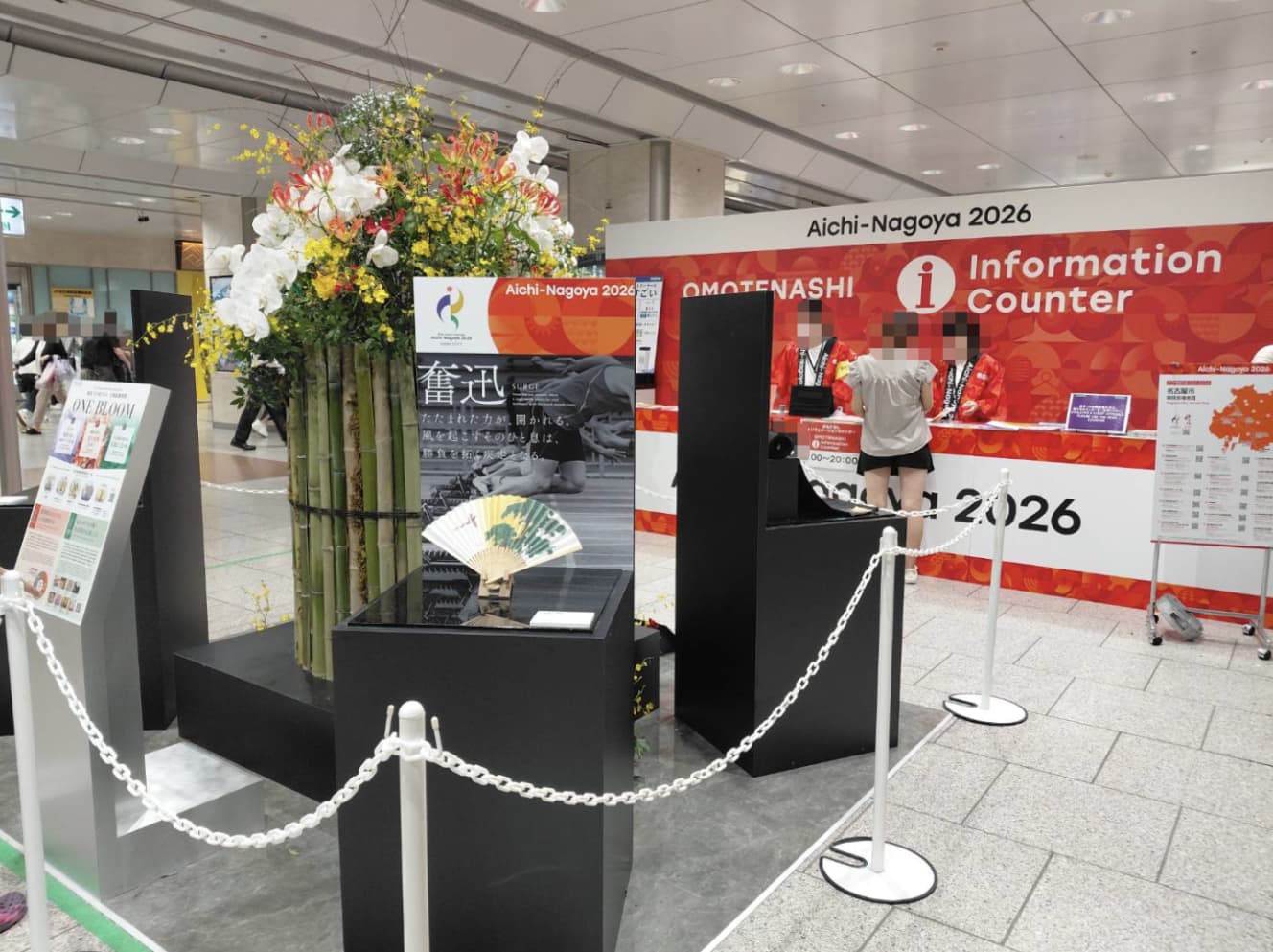
While these reports highlight the negative aspects of the organization, having stayed on-site for several days, I also witnessed the staff’s hard work. Information booths were set up at major stations leading to the venue and at hotels throughout Nagoya, where Asian Games staff provided directions with smiles.
A booth was also set up in the lobby of the hotel in Ichinomiya City where I stayed for several days, and staff members and officials from various countries, wearing official Asian Games polo shirts, were frequently coming and going. On the same floor as my room, there was a dedicated room for dropping off and picking up laundry.In the mornings, lines formed as people came to pick up their freshly laundered clothes, and it’s easy to imagine that the laundry staff were holed up in that room from early morning until late at night, working nonstop.

The posting offered an hourly wage of 1,500 yen.
I heard from people in the area that they were recruiting “part-time workers” to serve as on-site staff during the Games. To verify this, I downloaded the “Timee” app. When I searched for “Asian Games,” sure enough, I found job postings related to the event.
For example, a position checking admission passes at the Toyohashi City General Gymnasium stated “One-day shifts OK” with an hourly wage of 1,500 yen. Job descriptions for reception and patrol duties noted “No experience required,” and there were also openings for venue dismantling.Another job description stated, “We’ll teach you kindly and thoroughly,” so it’s hard to say that a lack of training due to one-time hires was the cause of the confusion. However, I did wonder whether the necessary information—including contact details in case of trouble and procedures for making decisions—was being shared with people joining on such short notice. I had assumed that all such personnel were already sorted out through the volunteer recruitment and training process, but it seems that is by no means the case.
On “X,” I also found posts expressing confusion over volunteer assignments and information sharing. One person made a particularly tragic post: “Even though I’d been adjusting my schedule and attending various training sessions for over a year, I received an email the night before my first day of service canceling my assignment. I only received my uniform, and my number of service days dropped to zero.”
There were also comments like, “I came to the Asian Games venue, but this is terrible. While there are plenty of volunteer staff, no matter what I ask, they say, ‘I don’t know,’ and even the regular staff give different answers depending on where you go.” While this doesn’t represent the entire picture, it suggests some confusion on the ground.
On the other hand, there were also comments expressing a sense of improvement and fulfillment, such as, “The second day went more smoothly than the first, as both the volunteers and the organizers had gotten the hang of things,” and “It makes me happy when spectators say ‘thank you’ or ‘good job.’” I also found comments from spectators stating, “The volunteers were incredibly kind, polite, and just the best.”
While harsh criticism from South Korea and negative media coverage from various countries were prominent, I personally witnessed the volunteer staff working tirelessly at hotels and competition venues. The support of those working outside the competition venues is essential for athletes to focus on their training and matches. I couldn’t help but hope this would be a tournament where their enthusiasm is rewarded.
PHOTO: Kim Myung-wook