Not Every Classic Song Hits the Mark… A Thorough Analysis of the Exquisite Relationship Between “Commercial Songs and Direction” That Keeps Viewers Hooked



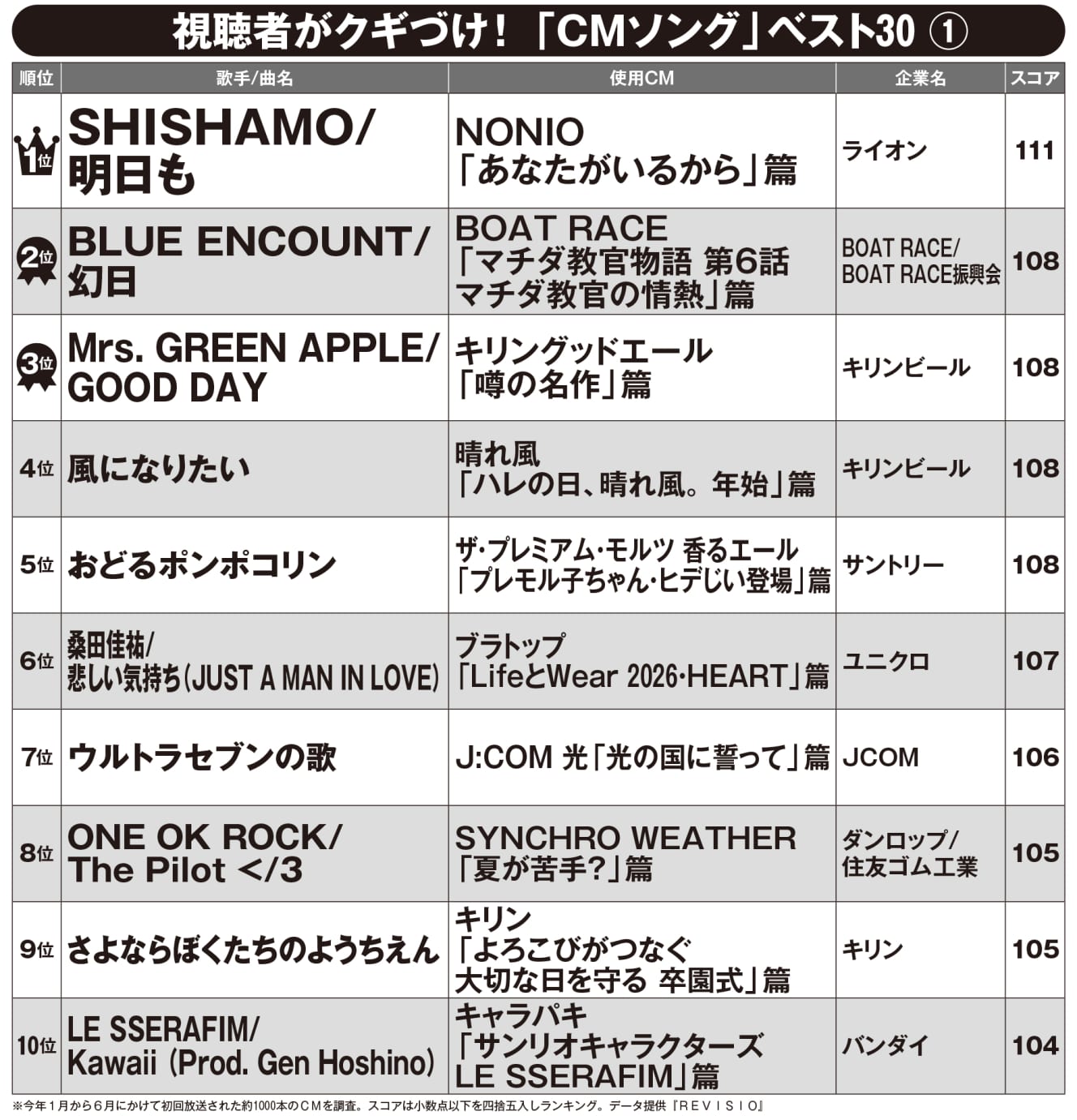
This project involved a proprietary analysis of approximately 1,000 commercials that aired for the first time in the first half of 2026, examining how closely viewers watched the screen. The first part featured acts such as Mrs. GREEN APPLE and BLUE ENCOUNT.
Click here to read the first part!
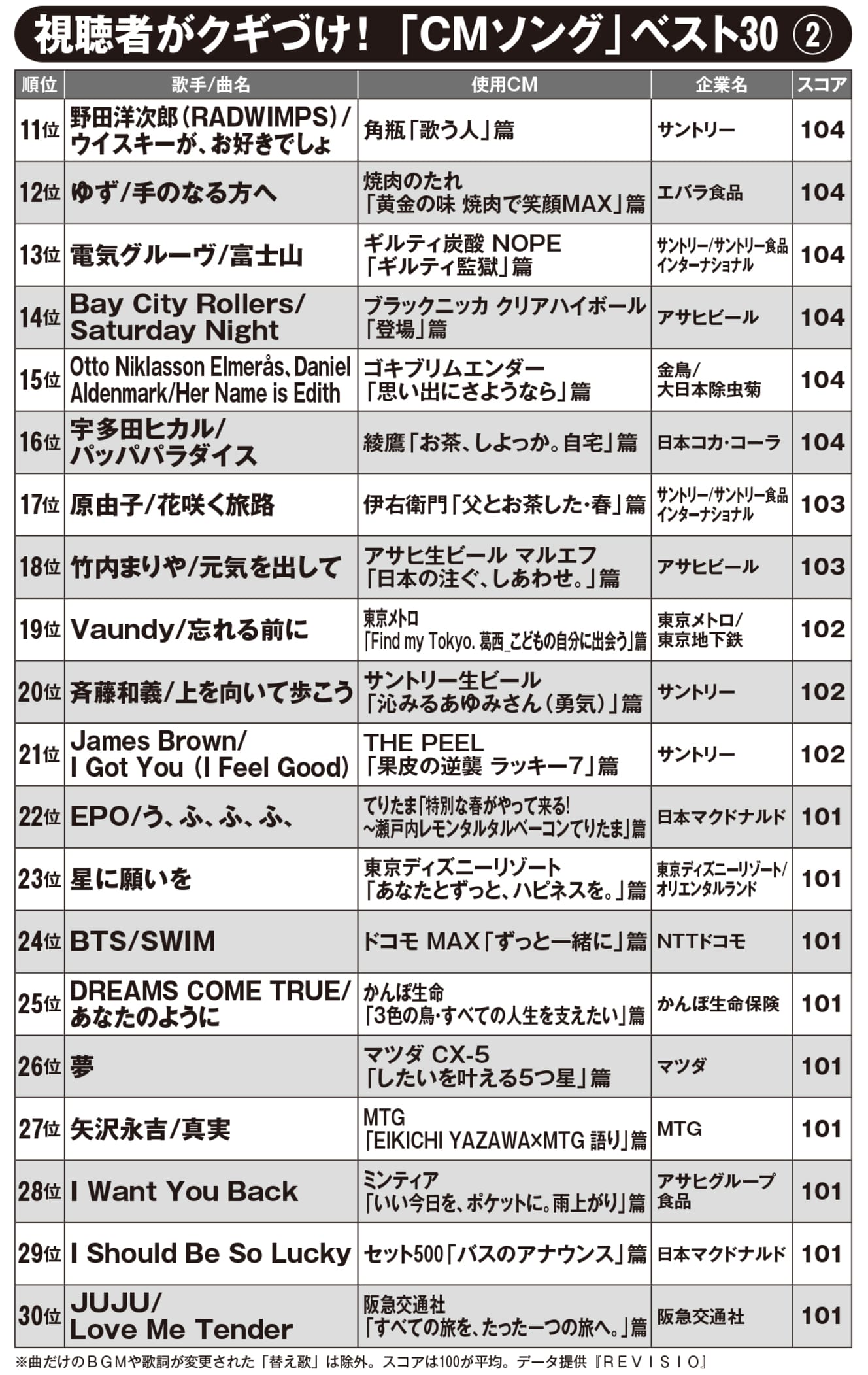
In Part 2, we’ll examine the compatibility between commercial songs, visual direction, and target audiences, using examples such as SHISHAMO’s “Ashita mo” and “Odoru Ponpokorin.”
Jazz for the Adult “Maruko”
“This is a commercial for the oral care brand ‘NONIO.’ The song selection is clearly tailored to the target demographic—people in their late 20s to early 30s. The stars are Haruna Kawaguchi and Ryo Narita, who are in the same age group and play a couple. The story revolves around a couple who, while struggling with work and occasionally arguing, still find many opportunities to get close to each other.”
The uplifting song ‘Ashita mo’ was released in 2017, coinciding with the period when the target audience was going through their youth. The commercial’s storyline and song selection are perfect for viewers in their early 30s who are grappling with life’s challenges to relate to,” says Mr. Yasutake.
No. 1
SHISHAMO “Ashita mo”
Similarly, “Kawaii” by LE SSERAFIM, ranked 10th, is also a perfect fit for the target demographic. The commercial for the “Charapaki” chocolate bar, featuring the group themselves, has captivated a young audience centered on teenagers.
10th Place
LE SSERAFIM “Kawaii”

This ranking has other notable features besides the production quality and alignment with the target audience. Eighteen of the top 30 songs were released in the 1990s or earlier. These commercials effectively leverage the songs’ nostalgic appeal and unique characteristics. Koki Mitsuhashi, Marketing Team Manager at Company R, explains:
“The theme song for the anime ‘Chibi Maruko-chan,’ ‘Odoru Ponpokorin,’ which ranked fifth, was released in 1990. The ‘The Premium Malts’ commercial features adult versions of ‘Maruko’ and ‘Tama-chan,’ played by Suzu Hirose and Sairi Ito.
Jazz plays in the background, but the lyrics kick in during the latter half of the commercial… It’s designed so that viewers realize for the first time that it’s an arrangement of ‘Odoru Ponpokorin,’ which dramatically heightens the commercial’s narrative of the cute characters growing up.
No. 11: Yojiro Noda’s “You Like Whiskey, Don’t You?” is a song originally released in 1991 by Sayuri Ishikawa and has served as the theme song for the “Kakubin” commercials, covered by many singers including Mariya Takeuchi.
“The melancholic atmosphere in this commercial—where the bar owner, played by Yu Aoi, quietly listens to a customer (Yojiro Noda) singing while playing the guitar—has remained unchanged for many years. It’s a touch that puts viewers at ease, even as times change.”
No. 11:
Yojiro Noda (RADWIMPS) “You Like Whiskey, Don’t You?”

On the other hand, there are some commercial songs that are a bit of a letdown. One is “Yume” (No. 26), originally by “THE BLUE HEARTS.” Mr. Mitsuhashi continues:
“This commercial features Haruka Ayase and showcases the appeal of the new ‘CX-5’ SUV. However, the rhythm of ‘Yume’ remains constant throughout, making it hard to leave a lasting impression. If they had added more dynamic contrast to the song—such as introducing the lyrics in the latter half, like in the previously mentioned ‘Odoru Ponpokorin’—it would have been more effective.The abundance of product explanations might also be diluting the song’s presence.”
Just because a song is a classic doesn’t mean it will captivate viewers. It’s only when a song matches various elements—such as the commercial’s content, target audience, and direction—that it truly draws attention.
“Commercial Song Attention Score” Measurement Method
Company R measured how closely viewers were watching the TV screen with the cooperation of approximately 2,000 households (about 4,300 people) in the Kanto region and 600 households (about 1,400 people) in the Kansai region. The number of seconds the viewer’s eyes were on the screen was converted into a score using a proprietary method.
With 100 as the average, the higher the score, the greater the level of attention. Since viewers often do not actually look at the screen when “watching while doing other things,” the score does not rise in such cases.
The analysis covered commercials that premiered between January 1 and June 30, ’26. Commercials featuring instrumental background music or parody songs were excluded. Additionally, commercials that were difficult to measure due to limited broadcast periods were omitted. However, commercials featuring a cover version of the original song performed by a different singer (e.g., “Odoru Ponpokorin”) were included in the rankings.
From the October 2 & 9, 2026, combined issue of *FRIDAY*