“Could the Culvert Be to Blame?” Why Is Spring Water Welling Up in a Shibuya Ward Residential Neighborhood… An On-Site Report Reveals an Unexpected “Historical Background”


Water gushed from a road in Shibuya Ward.
Hatsudai is located in Shibuya Ward, Tokyo, but it lies at the northern tip of the ward and is geographically close to Shinjuku. It is a residential area slightly removed from the hustle and bustle of the downtown district. A strange sight—water flowing out from the road surface and running across the street—in one corner of this area became a hot topic on social media.
While it’s not uncommon to see water gushing from the ground in remote mountainous areas, it’s a different story when water is constantly gushing from a road in the heart of the city. On social media, some speculated that the source of the water might be related to “culverts”—buried underground channels from a time long past.
Where did this water come from? When I visited the site to investigate, I discovered a piece of history that is no longer visible in the current cityscape.
The site is a road located between Hatsudai Station and Hatagaya Station on the Keio Line, next to the Yoyogi Post Office. Turning onto a side street and walking up a gentle slope, I noticed the wet asphalt road surface.It was a clear, sunny day when I visited, with no sudden downpours like an evening shower. Yet, about half of the two-lane road’s surface was wet.
The L-shaped gutter at the roadside was filled with gravel, and clear water was flowing through it toward the lowest point of the road. It looked just like the headwaters of a river. When I asked local residents how long it had been there, many replied, “It’s been there for a long time.” It seems this phenomenon didn’t just appear recently.
I also asked Shibuya Ward, but…
A man in his 40s who works near the site said, “It’s been on my mind, but I’m not really sure what it is.”
“My memory isn’t exactly clear, but I feel like it’s been there for at least three or four years. Since water has been flowing constantly, I used to wonder, ‘What is this?’, but before I knew it, I stopped paying attention to it.”
I spoke with several people, but couldn’t get any specific details. However, it seems the water has been flowing continuously for the past few years without stopping.
Shibuya Ward appears to be aware of this strange phenomenon of water flowing out onto the road; traffic cones placed along the roadside bear the warning: “Please watch your step carefully when passing by.” We spoke with the Road Division of the Shibuya Ward Public Works Department.
“Based on the records we have confirmed so far, this phenomenon has been occurring since around 2018. However, we are currently investigating the exact cause and have not yet been able to pinpoint the specific reason.
“Since this area has long been known for its numerous springs and rivers, it is possible that such geographical characteristics are a factor; however, we cannot make a definitive conclusion at this stage, and the exact cause remains unknown,” said a representative from the Shibuya Ward Public Works Department’s Road Division.
Regarding the possibility that road construction caused the water to flow, they clearly denied it, stating, “There have been no reports of water springing up as a result of the construction.”
Although our interview with Shibuya Ward did not reveal the exact cause of the spring water, it appears, at the very least, to be unrelated to the culvert. The only remaining clue is a small shrine called Shiratama Inari Daimyojin, which stands quietly facing the road at the site.
The “History” as Told by the Chief Priest of Yoyogi Hachiman Shrine
Upon stepping onto the shrine grounds, I found an old-fashioned hand-operated pump. Located just about 5 meters from a spot where spring water wells up from the road, it appears to have been used to draw up groundwater. When I actually pumped the handle up and down, I confirmed that water flowed, so it seems there is still groundwater there today.
The spring water from the road and the pump right next to it—it’s entirely possible that both draw from the same source. If that’s the case, learning about the well’s origins might provide a clue about the spring water. I requested an interview with Yoyogi Hachiman Shrine, which currently manages the Shiratama Inari Daimyojin, and heard their account.
“The exact date of Shiratama Inari Shrine’s founding is unclear, but it is said to have originated as a shrine for defeated samurai during the era of Minamoto no Yoshiie. It was built on the grounds of the Namiki family, who owned this area at the time. Originally, it is said to have been enshrined along a river deep within a valley, located within what is now the Shibuya Ward Sports Center General Grounds.
In 1947 (Shōwa 22), the approach path and other structures collapsed due to a landslide, so the shrine was relocated. Since 2003, management has been transferred from Bunka Gakuen—founded by the Namiki family—to Yoyogi Hachiman Shrine” (Chief Priest of Yoyogi Hachiman Shrine; same source hereafter).
It is believed that the well was dug around the time the shrine was relocated.
“Since a Dragon Deity is also enshrined on the grounds, it is believed that there are water veins in this area, resulting in many wells, and that a belief in water deities has existed here since ancient times.As for water sources, it seems there were several in the vicinity of Hatsudai and Yoyogi-Yamaya (now Yoyogi 4-chome), and I have heard that the Kawabone River—known from the children’s song ‘Spring Brook’—was one of its tributaries.Across from the Yoyogi Post Office, there are still narrow paths and stairways that retain an unnatural shape; these are said to be the remnants of a river that once flowed there.”
This history was reportedly passed down from the previous chief priest of Shiratama Inari Daimyojin. This area once had abundant water sources, and numerous small streams flowed through it. Traces of these remain within the current streetscape, albeit in altered forms.The spring water emerging onto the road likely originates from the same underground aquifer as the well at Shiratama Inari Daimyojin. However, “until fairly recently, the water flow wasn’t this strong,” he noted.
“I’ve heard neighbors speculate that the construction of the Yamate Tunnel might have altered the waterways, but this is not certain.”
Is this part of the headwaters of the “Udagawa”?
Construction on the Yamate Tunnel began in 1992. It was opened and extended in stages starting from the Takamatsu Entrance (Toshima Ward), and on March 7, 2015, the entire 18.2-kilometer route was completed with the opening of the section extending to the Oi Junction (Shinagawa Ward).It is the world’s longest expressway tunnel. Its location is only a few hundred meters away from where spring water has been confirmed.
This is merely a theory, but originally, the groundwater either seeped only slightly from the road to the surface or did not rise to the surface at all. It is possible that changes in the underground environment caused by the construction and excavation of the Yamanote Tunnel gradually altered the flow over a long period of time, causing the water to now spring forth from this location.
The “water veins that existed in this area,” as mentioned by the chief priest of Yoyogi Hachiman Shrine, converged to form the river known as the “Uda River,” which once flowed through the Hatsudai area. Several tributaries originating in what are now Yoyogi 4-chome, Hatsudai, Nishihara, Oyama-cho, and Uehara in Shibuya Ward flowed into this river.
It seems likely that this spring water is part of the Uda River’s headwaters that have resurfaced at ground level.It is said that the residence of Marquis Yamauchi, the former lord of the Tosa Domain, stood in the area that is now Yoyogi 4-chome, and that there was a pond fed by spring water within the grounds. Although the area is now filled with residential buildings and roads, it is believed that in the past, water gushing from the ground flowed through the surrounding land like a network of streams.
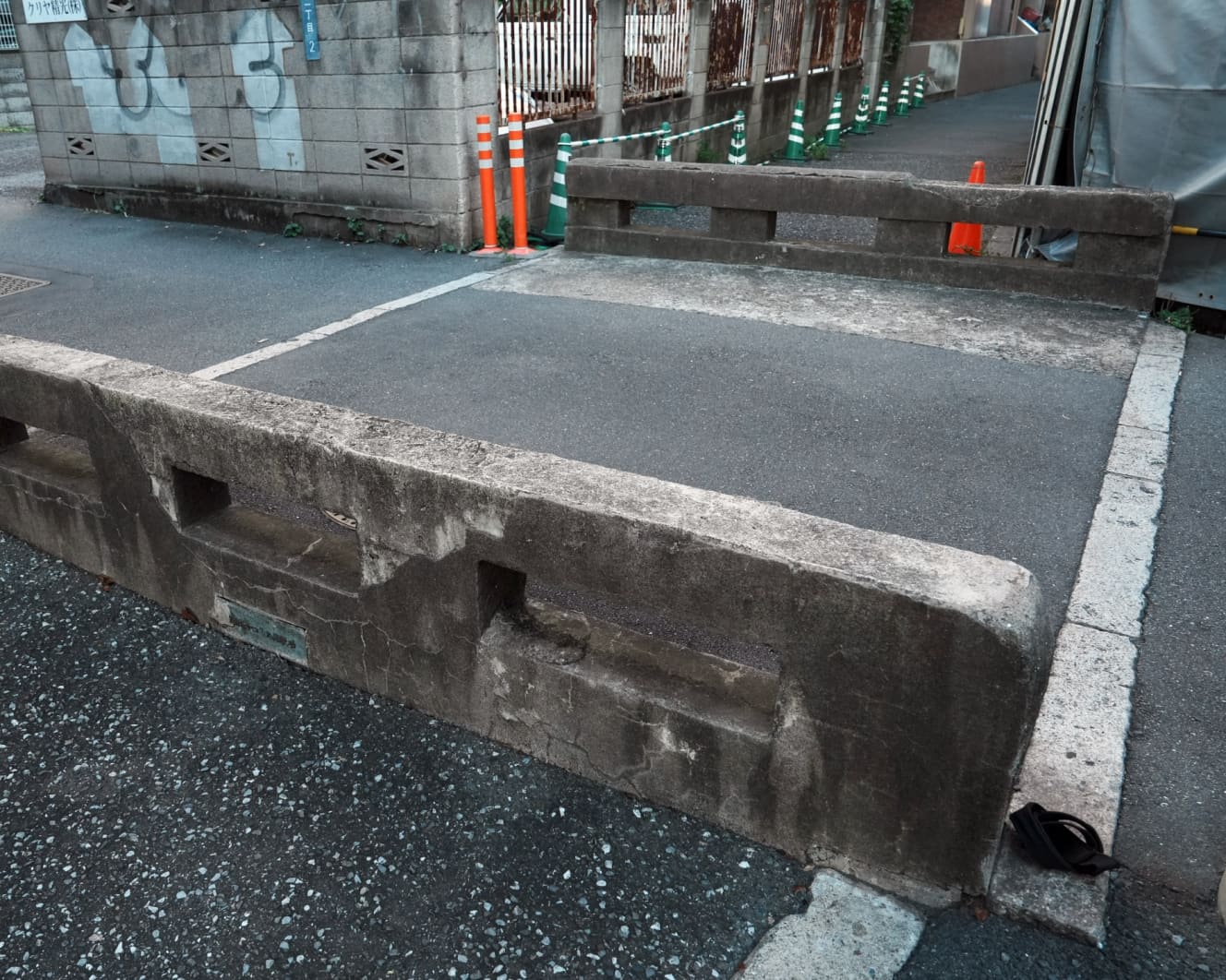
Traces suggesting that a small stream once flowed through the area still remain today. While strolling through an alley near the spot where the spring water was recently confirmed, I came across a path—presumably a former waterway—where a mysterious object resembling a bridge railing blocked the way.The section corresponding to the bridge piers was engraved with “Hatsudai Bridge,” and the railing bore the inscription “Completed in September, Showa 34 (1959).” Given that the Udagawa River was culverted ahead of the 1964 Tokyo Olympics, this bridge may have served its purpose for only a few years after its completion.
The Hatsudai spring had existed here long before the area was developed into an urban district. Although it once disappeared beneath a layer of asphalt, it must have been revived for some reason.


Reporting, Text, and Photos: Shirashi Midori