“Even though you got back in through proportional representation!” he yelled… The “petty-mindedness” Yuichiro Tamaki displayed behind the scenes of the Democratic Party for the People’s leadership race
Why, in a leadership race where re-election is a certainty? The “behind-the-scenes pressure” of yelling at the endorsers of a 30-year-old rival candidate


Petty backroom maneuvering in a leadership race they should have won
“Why did you become an endorser? You’re a proportional representation candidate who’ll be reinstated, aren’t you? You should step down.”
On both July 24 and August 9, two members of the House of Representatives received furious phone calls from a certain individual. The caller was Yuichiro Tamaki (57), leader of the Democratic Party for the People.The House of Representatives members who received the calls were endorsers of Mikihiko Hashimoto (30), a member of the Democratic Party for the People who was challenging Mr. Tamaki in the leadership election.
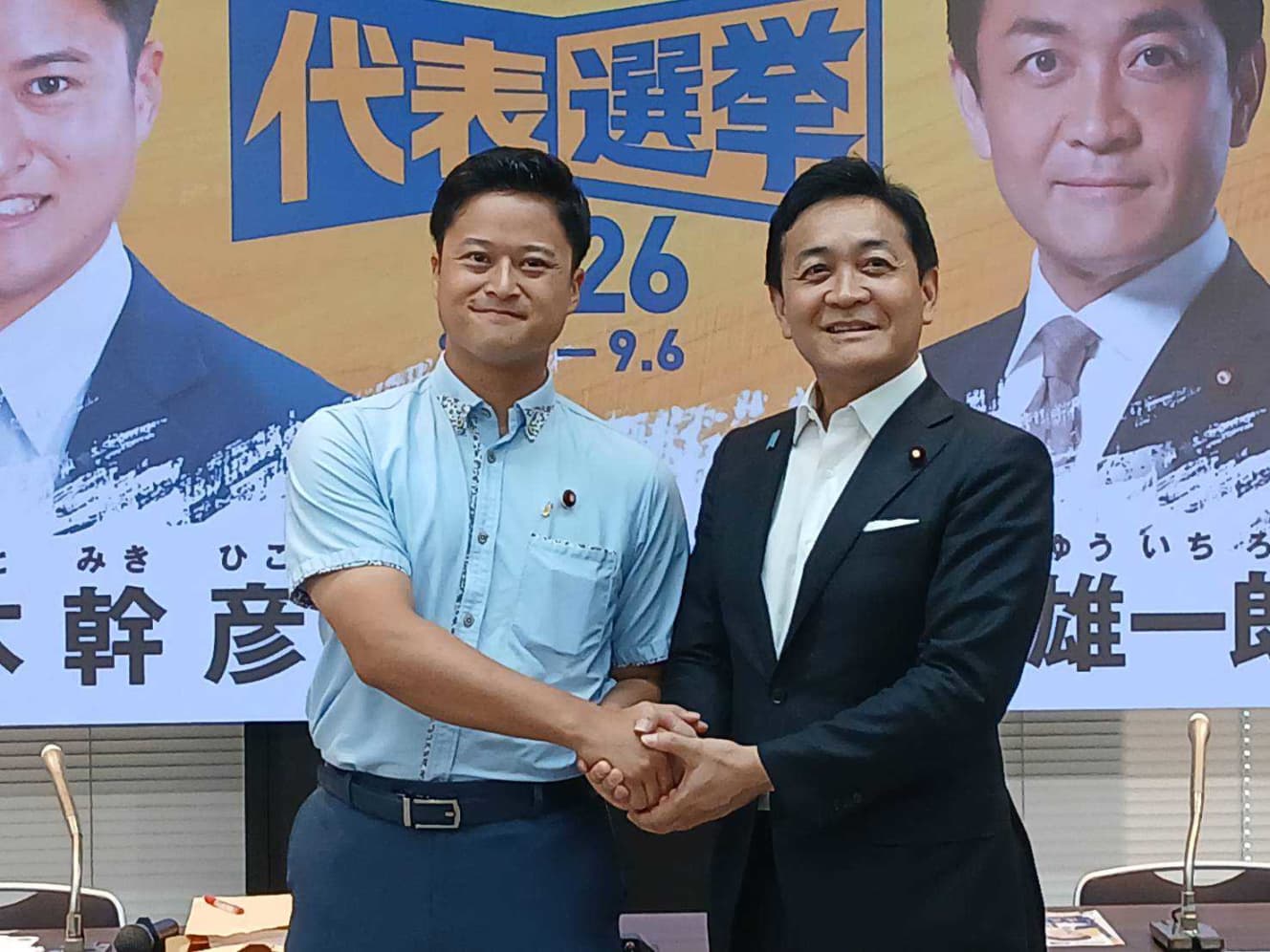
On August 22, the Democratic Party for the People’s leadership election began.This election was called due to the expiration of Mr. Tamaki’s own term as leader; it is a head-to-head race between Mr. Tamaki—who has served as leader since the party’s founding in September 2020—and Mr. Hashimoto, who has been elected twice. Over the course of two weeks, the two candidates will campaign nationwide, and a new leader will be elected at an extraordinary party convention on September 6.
However, the Democratic Party for the People is a party so strongly shaped by Mr. Tamaki that it is often referred to as his “one-man show.” Core members from the party’s founding—including Secretary-General Kazuya Hariba (59) and Acting Leader Motohisa Furukawa (60)—have played central roles in establishing its policies and operations.The party made a breakthrough by targeting the working-age population in urban areas—a demographic that major political parties had previously overlooked.
“An underrated, talented underground idol”—though Mr. Tamaki was often mocked in this way, he made early and effective use of YouTube, continuously appealing to the working-age generation with promises to “increase take-home pay” and “break through the 1.03 million yen annual income barrier.”The party started with 15 members but has now expanded to a total of 53—28 in the House of Representatives and 25 in the House of Councillors. In the House of Representatives, it ranks second only to the Centrist Reform Alliance (49 members); since there are no centrist seats in the House of Councillors, the party is now in position to become the largest opposition party.
“Over the past few years, Mr. Tamaki’s name has repeatedly come up as a key figure in political realignment, and there was a sense that he could be propelled to leadership by both the ruling and opposition parties. In particular, during the period from the collapse of the Ishiba administration last year to the formation of the Takamasa administration, the political landscape became fluid, and the possibility of a ‘Prime Minister Tamaki’ was even discussed.
“In 2024, although a scandal involving a woman was reported in a weekly photo magazine, he demonstrated his resilience by weathering the storm with a three-month suspension from his leadership position. The party exists precisely because of Mr. Tamaki’s ability to communicate, and the outcome of this leadership election is already clear,” said a reporter covering the opposition parties.
On the 21st, the day before the leadership election, the candidates held a joint press conference, where Tamaki took a firm stance against the Takashi administration, stating, “I oppose pushing for a consumption tax cut limited solely to food and beverages,” and explained:
“At restaurants where the tax cut does not apply, people will increasingly stop eating out. The number of izakaya bankruptcies is now exceeding even the levels seen during the COVID-19 pandemic. This tax cut will serve to further discourage dining out and accelerate the bankruptcy of local izakaya.Purchases such as fertilizer and seedlings will not become cheaper due to the tax cut; it is said that this will impose an additional burden of 380 billion yen on agricultural businesses, making it a tax cut that encourages farmers to leave the industry. Furthermore, if the tax is going to be raised again in two years, there’s no need to lower it now. Changing the tax rate at the register and updating product price tags will only cause confusion on the front lines.
The annual per-capita consumption tax burden on food and beverages is estimated at 36,000 yen. If the goal is to reduce this burden by 36,000 yen, the government should simply increase the 360,000-yen resident tax deduction.Since even pensioners pay resident tax, implementing a resident tax deduction would provide a broad, swift, and simple solution. We have presented this solution as well. “If they push ahead with a consumption tax cut on food and beverages, we will not join the coalition.”
He speaks fluently, incorporating catchy phrases. Meanwhile, the other candidate, Mr. Hashimoto, is a former senior Self-Defense Forces officer who was first elected in Saitama’s 13th District in the 2024 House of Representatives election.Although he was the youngest candidate at 28 when he was first elected, he was swept aside by the “Takaichi phenomenon” in this year’s House of Representatives election, losing his single-member district seat and being re-elected via the proportional representation system. Mr. Hashimoto stated the following at a press conference:
“The Democratic Party for the People is currently hitting a wall. I believe that, rather than ‘resolution over confrontation,’ we need ‘confrontation for the sake of resolution.’ Unless we undergo a transformation, I do not believe the Democratic Party for the People will become a party that garners broader support from the public.”
The Drawbacks of “Tamaki’s One-Man Rule”
There appears to be an unbridgeable gap between Mr. Tamaki, who has served as party leader for a long time since the party’s founding, and Mr. Hashimoto, a young politician who has been elected only twice.
To run for party leader, a candidate must collect letters of recommendation from eight members of the National Diet and eight local assembly members. On the morning of the 7th, the deadline for filing for the leadership election, Mr. Hashimoto managed to secure the necessary endorsers and successfully entered the race.Mr. Tamaki, on the other hand, gathered 20 letters of recommendation from both Diet members and local assembly members, clearly demonstrating the gulf in their standing.
“With Mr. Tamaki’s reelection considered a certainty, and given that holding a leadership election would entail significant costs, the party leadership had been aiming for an uncontested reelection if possible. However, holding a leadership election could also help expand the party’s base.With the unified local elections next spring approaching, the leadership election would serve as a unique opportunity for the majority of the approximately 380 local council members to showcase themselves. A re-election without a vote would mean missing out on that chance,” said the reporter.
Did Mr. Tamaki, as a leader well aware of the party’s financial situation, make the calls to have candidates withdraw their candidacies? Or did he make them to flaunt his “dominant position”?
“What was the intention behind the call to withdraw endorsements?”
When I asked Mr. Tamaki this question at his campaign announcement press conference on the 22nd, his expression changed completely from the smile he had been wearing up until then.
“I have never pressured anyone to withdraw their endorsement,”
He retorted with a stony expression.
When the reporter pressed further, saying, “But other lawmakers have heard about the calls,” Mr. Tamaki stared into space, feigning ignorance, indicating he would say no more. At that point, the moderator, House of Representatives member Seri Nabeshima (35), cut him off, stating, “We are not allowing further questions.”
A supporter of candidate Hashimoto expressed his outrage as follows:
“On July 24, several of us listened via speakerphone to a call from Mr. Tamaki to one of our lawmakers. The party leader demanded in a near-shouting voice, ‘Why did you become an endorser? Step down.’ I want people to make their own judgment knowing this hidden side of Leader Tamaki—as opposed to the different face he shows during street speeches or on YouTube.”
Was he trying to convey firsthand the intensity of this power struggle, reminiscent of the Liberal Democratic Party’s leadership election? Political journalist Akiko Azumi sighed and remarked:
“With an age gap like that of parent and child, and Leader Tamaki’s overwhelming political career advantage, his reelection is practically a foregone conclusion. The leadership election is also a chance to showcase Mr. Hashimoto.If the party has more lawmakers with strong public-speaking skills, it will help us move beyond being a collection of individual fiefdoms. We need to nurture young talent with the party’s future in mind. If we are to make effective use of this leadership election, we should approach it with integrity and aim for a win-win relationship.”
Generational change, promoting young talent—Mr. Tamaki has repeatedly spoken of these things. If he is re-elected, let’s believe he will give Mr. Hashimoto and his endorsers a chance as well.
Reporting, Text, and Photos: Daisuke Iwasaki