A Mackerel That Gives Birth to Tuna?! How 20 Years of Research Could Transform Fish Farming


Mackerel giving birth to tuna? The 20-year barrier
In recent years, poor catches of mackerel and other fish have continued. According to a survey by the Ministry of Agriculture, Forestry and Fisheries, Japan’s domestic mackerel catch fell from approximately 1.62 million tons in 1978 to about 261,000 tons in 2023, a record low. Catches of Japanese flying squid, salmon, and other fish have also plummeted. With fish in danger of becoming luxury foods, something that could potentially come to the rescue is the surrogate fish.
To farm tuna, large aquaculture ponds are required, and it takes three to four years for them to grow from eggs into adults. Feed is also expensive, and the longer they are kept, the greater the risk of disease. So why not have a small fish from the same mackerel family, such as the striped bonito, serve as a surrogate fish? The tanks could be smaller, and striped bonito become adults in about eight months. This is the surrogate-fish technology being researched by a team led by Professor Goro Yoshizaki of Tokyo University of Marine Science and Technology.
It has been more than 20 years since the research began. I thought perhaps tuna born from striped bonito would soon be appearing on the market, but:
“Not yet. The males produce tuna sperm, but the females won’t produce eggs,”
says Professor Yoshizaki.
So how do they turn a fish into a surrogate?
The method developed by Professor Yoshizaki involves transplanting the stem cells that serve as the source of eggs and sperm into a surrogate fish. However, just as humans can sometimes experience rejection after a transplant operation, these cells cannot simply be transplanted into any fish.
“We have tried various fish from the mackerel family, including chub mackerel and spotted mackerel, but it didn’t work. We thought it might work with striped bonito but now we are experimenting with another new fish.”
Even if they are going to transplant the cells into striped bonito, they first have to create a system capable of raising striped bonito.
“This is the difficult part. Fish in the mackerel family are migratory fish, and they are constantly moving around in search of the water temperature that is comfortable for them. The conditions they find comfortable are within a very narrow range of temperature and salinity, and the water must also be rich in oxygen. It takes three to four years to create a rearing system that meets those conditions. In the case of striped bonito, it took seven years.”
Twenty years can pass in the blink of an eye.


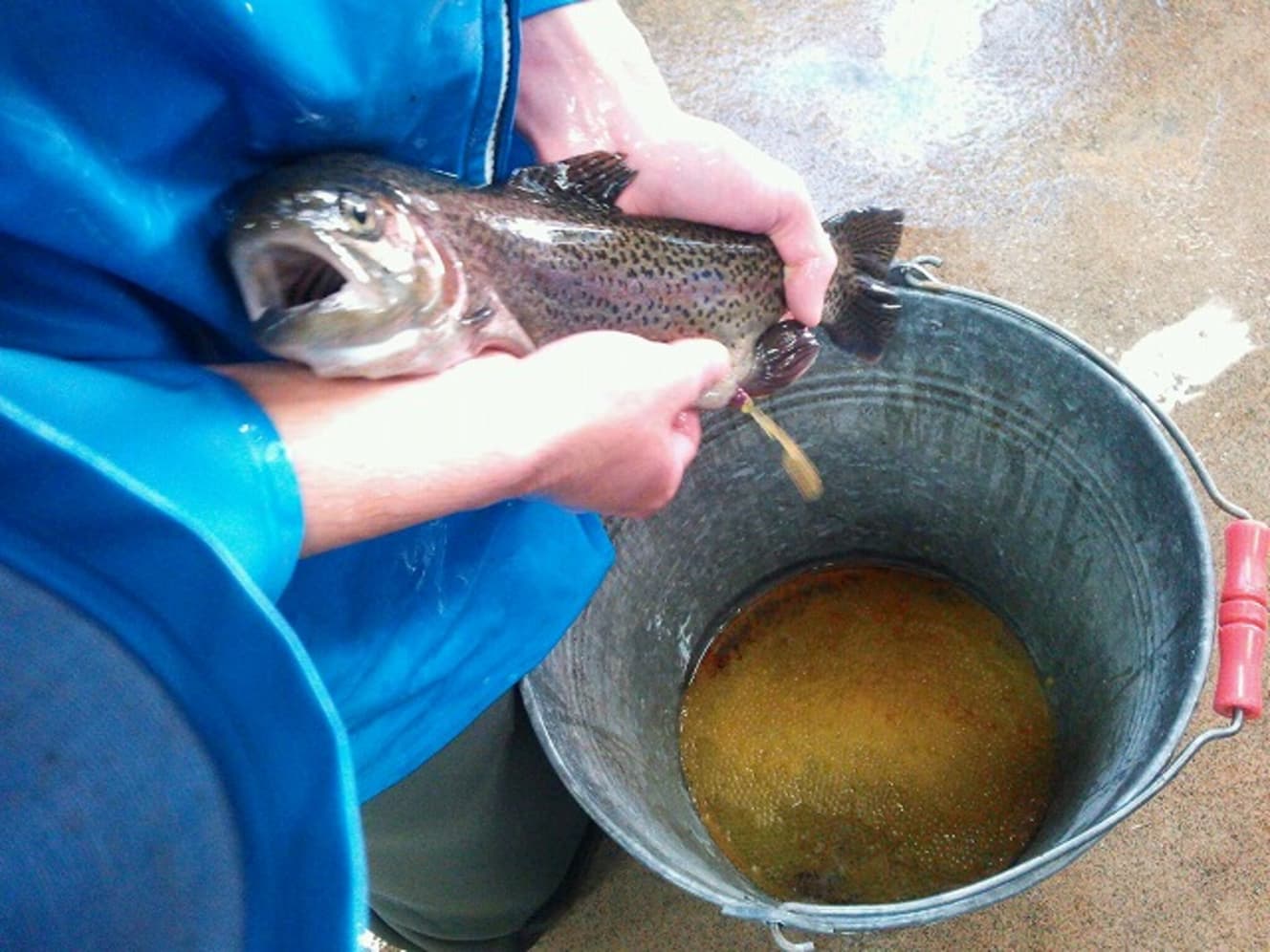
Rainbow trout giving birth to unlimited numbers of King Salmon?
require less space to raise. What’s more, salmon such as king salmon spawn only once in their lifetime, whereas rainbow trout can spawn repeatedly. This makes it possible to mass-produce king salmon. So, are they ready for the market?
“From here, it comes down to selectively breeding the king salmon that are born and improving their quality as much as possible.”
Most of the salmon currently imported into Japan comes from Norway. Norway has spent 40 years selectively breeding salmon, repeatedly improving the species so that they grow faster, are less susceptible to disease, and taste better. By contrast, the fish born in Professor Yoshizaki’s laboratory are in their wild state. In terms of quality, they are inferior to Norwegian salmon. Their potential is immeasurable, but:
“It won’t be easy to close a 40-year gap.”
I see. If you don’t mind me asking, then what is the purpose of this research?
“We’re researchers, so we’re interested in the question of why salmon spawn only once in their lifetime, while rainbow trout can spawn repeatedly. One hypothesis is that salmon do have the ability to spawn multiple times, but they only spawn once because they reach the end of their lifespan.
Another hypothesis is that salmon are inherently designed so that their ovaries and testes can produce eggs and sperm only once. We wanted to solve that mystery, so we transplanted cells from fish that can spawn only once into fish that can spawn repeatedly.”
As a result, they discovered that rainbow trout always retain copies of their eggs and sperm even after spawning, whereas salmon do not.
“We learned that what matters is not the reproductive cells themselves, but the surrounding environment that nurtures them. Solving these kinds of mysteries is one of the major purposes of our research.”
Preventing fish extinction and paving the way for regenerative medicine
Professor Yoshizaki is currently focusing his efforts on conservation research.
Humans have driven various species to extinction over the years. One example is the Japanese wolf. As a result, deer populations increased and began devouring the shoots of plants and trees. This left small mammals and birds without enough food, causing their numbers to decline steadily. The damage to farmers has also become serious.
“By causing the extinction of just one species—the wolf—we created a future that people at the time could never have predicted. At this point, we cannot predict what will happen in the future if this particular fish disappears. However, I believe that the species currently living on Earth are precious assets that should be passed on to future generations.”
Professor Yoshizaki is currently working on increasing the population of Musashitomiyo by using the freshwater form of the tomiyo as a surrogate fish. He has also succeeded in increasing the population of Miyakotanago by using the aburatabō as a surrogate fish. Furthermore, he says it has become possible to increase the population of Mekong giant catfish by using the pangasius, a small catfish, as a surrogate fish.
It has also become possible to freeze the reproductive cells of fish that are at risk of extinction, making it possible to revive the species by transplanting those cells even if the species eventually becomes extinct.
The transplantation technology is also being applied to other research. For example, small kusa-fugu are being used as surrogate fish to increase the number of male tiger pufferfish from which milt can be collected, while researchers have also produced “Yume Aji,” a hybrid of horse mackerel and white trevally.
“As we come to understand why rainbow trout retain copies of themselves and how the fate of cells is determined, this could potentially lead to regenerative medicine as well. By elucidating the mechanisms of reproduction in fish, new technologies can emerge. Clarifying those mechanisms is what we are ultimately aiming to achieve.”
▼Goro Yoshizaki: Professor at the Graduate School of Marine Science and Technology, Tokyo University of Marine Science and Technology. Doctor of Fisheries Science. After serving as a postdoctoral researcher at the Department of Agricultural Sciences at Texas Tech University in the United States and as an assistant professor at the Faculty of Fisheries at Tokyo University of Fisheries, he has held his current position since 2012. He received the Japanese Society of Fisheries Science Award in 2015, the Japan Agricultural Science Award and Yomiuri Agricultural Science Award in 2017. His major publications include “Mackerel Giving Birth to Tuna!?” (Iwanami Scientific Library).

Reporting and Text: Izumi Nakagawa PHOTO: Afro (First Photo)