Lured by High-Paying Jobs, Then Imprisoned and Tortured: Inside the Reign of Terror of a Tokuryū Crime Syndicate


Members share images of merciless punishment inflicted on traitors
A man has been stripped naked and knocked onto the floor. His hands and feet are shackled, leaving him unable even to stand. The next moment, a stun gun appears from off-screen, touches the man’s body, and flashes with a crackling sound.
The man’s screams echo through the room as multiple people repeatedly kick him in the head and body without giving him a moment’s respite. Even after the man loses consciousness, there is no sign that the assault will stop. What “FRIDAY” reporters witnessed was footage of horrifying torture carried out by members of a “Tokuryū” group.
Victims of special fraud perpetrated by anonymous and fluid criminal groups (Tokuryū) continue to pile up. Last year, the number of reported cases rose 30% from the previous year to approximately 28,000, while total losses reached an all-time high of approximately ¥140 billion. In particular, the fake police officer scam, in which perpetrators pose as police officers over the phone and defraud victims of money by suggesting that they will be arrested, has become a major social problem, with losses swelling to approximately ¥99 billion.
“Taking the situation seriously, the Tokyo Metropolitan Police Department established a ‘Tokuryū Countermeasures Headquarters’ last October. They have assembled 200 investigators and are working to dismantle the Tokuryū groups.” (National newspaper social affairs reporter)
What makes the Tokuryū groups so unusual is that they are organized almost like ordinary companies, and in many cases the people involved lack any sense that what they are doing is criminal, viewing it instead as a business. A man who once worked as a “kakeko” (a caller who deceives victims over the phone) for an organization in Cambodia described his experience:
“The ‘hako’ (the term used for a team carrying out fraud) I was in mainly handled fake police officer scams. Work started at 8 a.m. We would gather in the office in the same building as our rooms, put on headsets, and begin working. We used tablets installed on our desks to call the targets.
The people we called had been selected in advance by senior members, and their names and addresses would appear on the screen. Other than lunch breaks and going to the bathroom, we were basically on the phone constantly. We finished making calls around 6 p.m., then held a roughly one-hour meeting to reflect on our performance, after which the workday ended.”
The biggest difference from private-sector companies is their rule through fear and violence. The footage at the beginning of this article captures part of that reality. A current Japanese member of a fraud organization explained:
“Because these are spaces beyond the reach of the police, inside the ‘hako’ it’s a lawless zone. Even when recruiting members, it’s become commonplace to lure people through social media or personal connections with promises of a high-paying side job, then kidnap them once they arrive. After that, they force them to carry out work while holding them captive, and if their sales are poor, they torture them by beating and kicking them.
More brutal organizations make people work as much as possible without ever paying them, and even demand ransom from the applicants’ families. In Telegram group chats among members of fraud organizations, videos and photos of torture are routinely shared, and many organizations use them as warnings to intimidate others.”
Criminal groups lurking in Southeast Asia are breeding grounds for the special fraud cases spreading across Japan
“FRIDAY” reporters infiltrated a group chat used by a fraud organization based in Southeast Asia. Just as the member pointed out, the chat was filled with videos and photos of punishments inflicted on traitors.
One man, who was accused of betraying the organization, had blood smeared around his nose and mouth, while his face was so badly swollen that he could barely open his eyes. There was also a photo of a man who had been forced to sit in the traditional seiza position after being beaten so severely for allegedly stealing items belonging to the organization that the skin on his back had peeled away.
“Originally, the purpose of this chat was to share information about crackdowns by authorities and so on. But gradually, videos of torture started appearing. More recently, there have even been cases where people post footage of the torture they themselves suffered to report that they were victims.” (Same source)
Apparently, the footage at the beginning of the article was one such case. It was one of the videos posted in the chat in question, accompanied by a photo of what appeared to be the organization’s boss and the words, “Expose his evil deeds.”
A series of statements accused the organization of killing members through routine beatings, and the final message contained a curse: “I will become an evil spirit and never forgive you.” Perhaps the person was attempting to blow the whistle on the reality of the organization’s excessive rule through violence.
The numerous criminal groups operating in the shadows across Southeast Asia have become breeding grounds for the special fraud cases whose victims in Japan continue to increase. Cambodia, in particular, is known as a major hub where special-fraud organizations have proliferated.
“Many Cambodian fraud organizations are controlled by Chinese or Taiwanese mafias. In some cases, they purchase local resort hotels or condominiums and turn them into hideouts, while in others they establish bases in special economic zones known as ‘Enku,’ which are operated by Chinese-affiliated companies.
There are also organizations that rent land owned by influential local figures and operate their ‘hako.’ In such cases, they have to pay large bribes and protection fees, but the advantage is that they are less likely to be raided by police. The products they deal in—the methods they use—vary widely, including fake police officer scams, romance scams, investment scams conducted through social media, and refund scams. The size of a ‘hako’ ranges from around 10 people at smaller operations to several hundred workers at the larger ones.” (Same source)
In recent years, Cambodian authorities have launched cleanup operations, leading to a series of crackdowns on fraud bases and a sharp increase in organizations fleeing overseas. They are now apparently scrambling to find new places to operate.
“Chinese mafias have already begun moving to Laos, Malaysia, Indonesia, Sri Lanka, and various parts of Africa. Taiwanese mafias are extending their reach into Europe. Fraud can be carried out anywhere as long as there is an internet connection. No matter how many hideouts are raided, these organizations will never disappear.” (Same source)
While controlling their members through fear, the Tokuryū groups continue to expand their reach into special fraud schemes.
From the August 21–28, 2026 combined issue of “FRIDAY.”


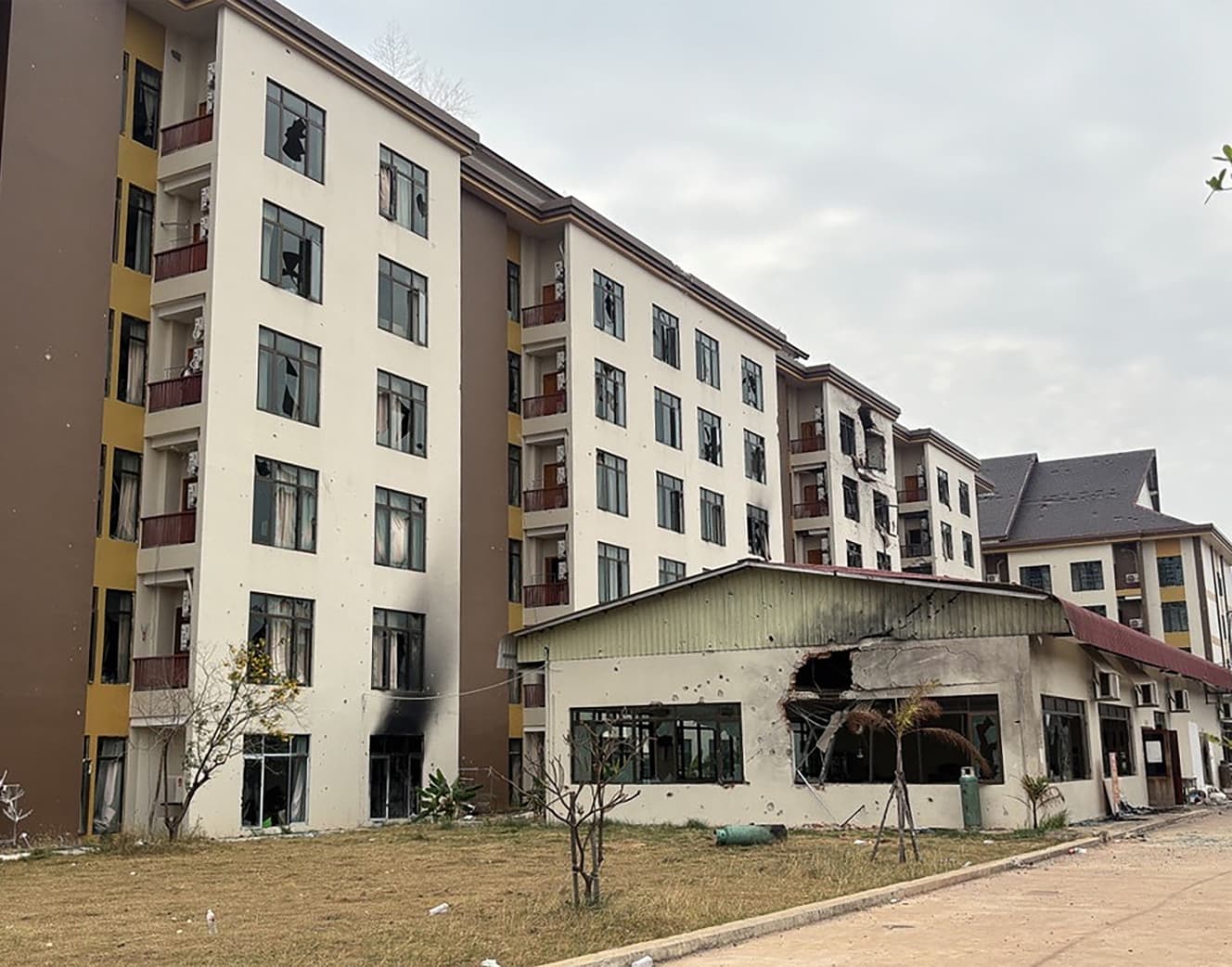
PHOTO: Jiji Press (1st and 4th photos)