He Hired 26 AI Employees for Free—and Transformed His Work Life and Side Hustle



What separates people who use AI every day without getting results from those who do? An X account run by a user known as E-tan, who grew from zero followers to more than 50,000 in just a year and a half, has been attracting attention.
Marketing, legal affairs, accounting—AI handles it all. As generative AI continues to evolve, an era is approaching in which a single person can operate with the organizational capabilities of an entire company. And there are no personnel costs.
One person already putting that idea into practice is E-tan, a 37-year-old ordinary office worker living in Hiroshima Prefecture. Alongside his day job, he runs four side businesses, including posting on X, giving seminars, and operating an online community, earning between ¥800,000 and ¥1 million per month, he says.
Will AI take people’s jobs—or will they learn to make the most of it? E-tan spoke about what separates those two paths.
The blind spot of those who fear being replaced
Administrative jobs will disappear. White-collar workers will no longer be needed. Whenever people see predictions like these, many understandably worry, “How much longer will my job exist?” But E-tan sees things differently.
“We can’t stop AI from advancing, so we have no choice but to become the people who use it. But I think people who believe AI is going to take their jobs feel that vague sense of anxiety because they haven’t studied it or learned about it. AI is definitely an essential skill for every modern businessperson, but nobody really teaches you how to use it.”
So just how big will the gap become between those who use AI and those who do not?
“There will definitely be a difference like the one between an iPhone and a flip phone. For example, creating meeting minutes manually can take half a day, but with AI, they can be completed in seconds. And the accuracy can even be better than what a person produces, while the time you save can be spent on other work.”
E-tan, who works in marketing, says that he once put in as much as 100 hours of overtime in particularly busy months. Because he got home late, he rarely had dinner with his family, and accumulated exhaustion meant that he spent his weekends quietly resting at home.
His daily life began to change in November 2022, when OpenAI released the conversational AI ChatGPT. Anyone could use it for free, and within two months of its launch, its global user base had surpassed 100 million.
At the time, however, many people warned that it could confidently produce false information and was therefore too risky to use for work. E-tan saw things differently.
“To begin with, my type of work didn’t leave much room for AI to make things up. For tasks like writing emails and preparing meeting minutes, it was simply organizing information that I had provided. I gradually started handing over recurring monthly tasks to AI, one by one, and over the course of about a year, I reduced my overtime. Now I leave work on time every day.”
E-tan then poured the time he had gained into his side businesses. In order to support his family of three on his own, he began sharing tips on X about using AI to make work more efficient. One article he posted—titled, “I hired 26 AI employees using NotebookLM, and we work together”—went viral.
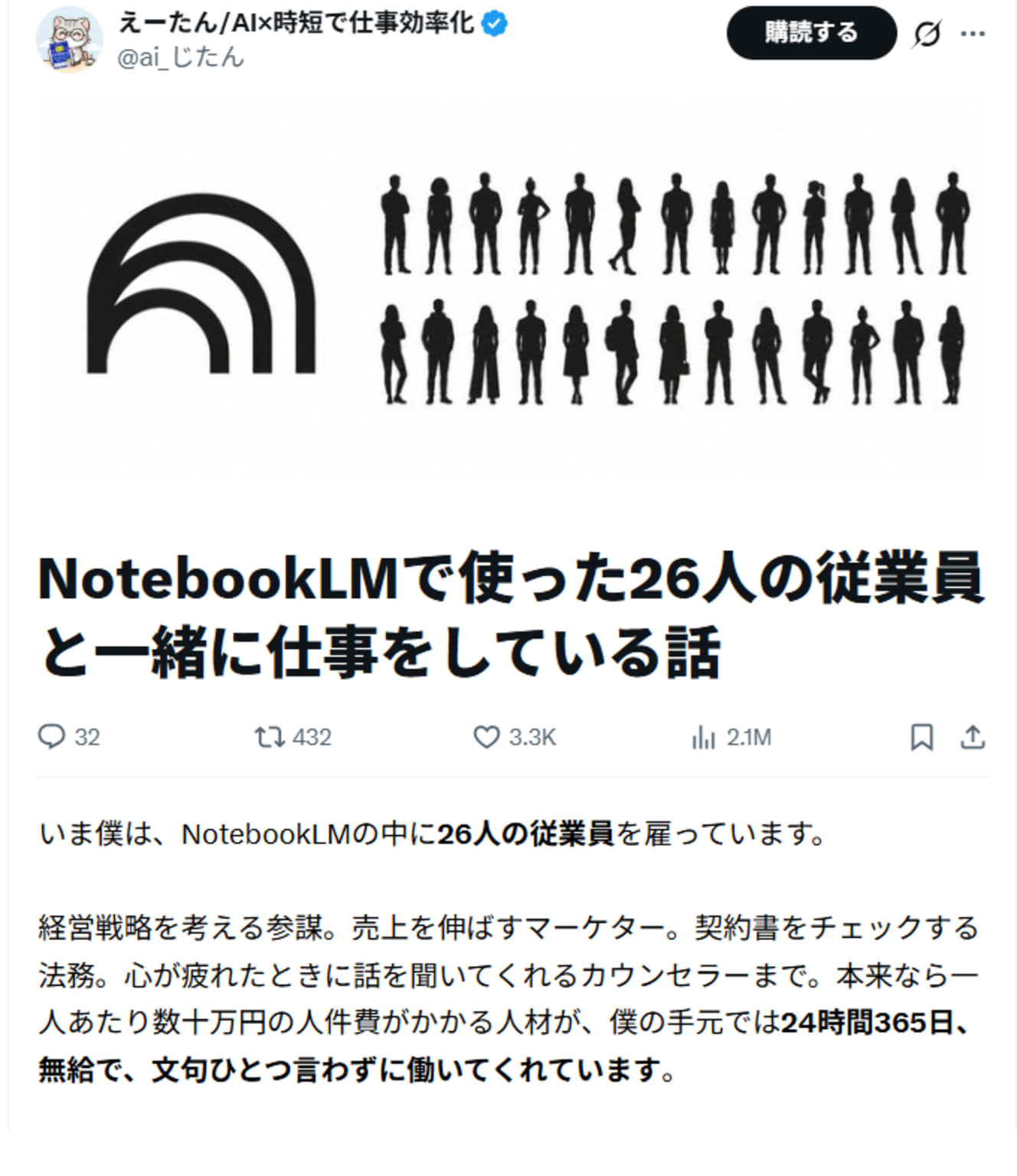
How to work with 26 free AI employees
The article that generated such a huge response explained how to create 26 AI employees, each assigned a different role, including corporate strategy, marketing, sales, legal affairs, and accounting. The tool used is NotebookLM (now Gemini Notebook), provided by Google. Because it generates answers based on materials that users upload, inaccurate information is less likely to slip in.
“For example, if you feed it sales know-how, you can create an AI notebook specialized in sales. You can also define its tone of voice, personality, and way of thinking. If you give it the role of a department manager with 20 years of experience dedicated to sales, you can create an AI employee who always puts the customer first.”
Give AI knowledge and a personality. When those two elements come together, AI can become a dependable subordinate that offers feedback and suggestions. The result of creating one for each type of job was a team of 26. Incidentally, he says he decided on that number after consulting with Claude.
“Part of me wanted it to go viral, so I chose a number that wasn’t too many or too few—something that would make people who saw it think, ‘What is this?’”
But the article’s real purpose lies beyond simply creating 26 AI employees: bringing them all together to hold meetings whenever a task requires it. The key to making that happen is Gemini.
“With NotebookLM alone, you can only interact with each notebook one-on-one. But by linking NotebookLM with Gemini, you can have multiple notebooks discuss things with one another within Gemini.”
On a single screen, AI employees representing different professions can begin discussing an issue. He says this is how he uses them in actual work.
“For example, you can have an AI employee in general affairs list the tasks that take a long time, and then have an AI employee in charge of AI implementation suggest ways to reduce the time required. It’s every bit as effective as a meeting between real people.”
Their usefulness is not limited to improving work processes.
“Whether you’re running a company or starting something new, such as developing a project, I think the important thing is how to break out of the limits of your own thinking. By holding repeated meetings with these AI employees—who could be considered experts in their respective fields—you can find better answers for yourself.”
What makes it possible for him to manage all 26 AI employees efficiently, he says, is a document he calls his “self notebook,” which puts his personal information into words and is fed to each of them.
“My ‘self notebook’ is about 50,000 Japanese characters long. I write down my goals, my experiences so far, my strengths and weaknesses, and other details, then have all of my AI employees read it. That way, the AI employees develop a proper understanding of who I am, making more accurate and meaningful interactions possible.”

The reality of an AI side hustle earning ¥800,000 a month
E-tan, who has assembled a team of 26 AI employees, is currently engaged in four side businesses.
“The first is posting on X, the second is sponsored work on X, the third is online seminars, and the fourth is an online community. Roughly speaking, they bring in between ¥800,000 and ¥1 million a month in total.”
That income is separate from his salary at his regular job. And it did not take him particularly long to reach that point.
“I started using X in March 2025 and began monetizing it in September. After that, I started receiving sponsored opportunities and earned around ¥50,000. Once my follower count surpassed 10,000 in December, both the fees and the number of opportunities gradually increased.”
His third venture, seminars, also began after he was invited to speak at a free seminar in December and saw promising results. From March of the following year, he began hosting paid seminars on his own. Around the same time, he launched “Aisaro,” an online community for people serious about learning AI and X, which has also proved popular and now has around 100 members.
It sounds like a dream come true, but the reality behind it is far from glamorous.
“Every day, I leave work on time, and after finishing the housework and childcare, I start my side work at 9 p.m. I usually finish around 2 a.m., so I get about three to four hours of sleep. AI evolves every day, and if you don’t keep up with it constantly, you’ll quickly be left behind. But I once pushed myself too hard and became unwell, so now I’m trying to find a sustainable balance.”
It may sound grueling, but he sees it differently. Although he now spends more time working overall than when he was putting in 100 hours of overtime a month, he laughs and says, “AI is like a hobby for me, so I’m able to enjoy what I’m doing.”
“Back then, getting promoted at my company was the most important measure of success in my life. But while the people around me kept moving up, I couldn’t. Supporting a family of three on the salary of an ordinary employee was difficult, and we were constantly covering our monthly deficits with bonuses. My personal allowance was ¥15,000 a month, and I couldn’t afford to let my child pursue the things they wanted to do. Every day, I worried that I might not even be able to send my child to university.”
He says he and his wife also gave up their shared hobby of traveling, while eating out was kept to a minimum because it was too expensive, so they cooked at home whenever possible. But AI, he says, removed the financial barrier that had stood between him and the things he wanted to do.
His position at his day job has also changed. Originally a member of the marketing department, he now works in an AI promotion department, helping lead the company’s efforts to adopt AI internally.
“I’ve been able to apply the AI knowledge I gained through my side work to my regular job as well, creating a positive cycle. Both at work and in my side businesses, many people tell me that they find what I share useful. Having my horizons broadened in that way has also made me realize that my regular job isn’t everything.”
Is now the last chance to learn AI?
E-tan makes everything available for free, including how to create his 26 AI employees and his other know-how.
“A year ago, I was spending most of my time working and still running a deficit every month. Financial constraints meant I couldn’t enjoy my hobbies or go out with my family, and I was constantly worried about the future. Now, thanks to AI, I’m busy, but I’m living a fulfilling life.”
There are still many people in the same position he once was. That is why, he says, he does not hold anything back—and why he believes people should start as soon as possible.
“AI has changed dramatically in just the past year. It will probably continue evolving at an incredible speed. That’s why I think that people who can’t use AI now will still be unable to use it five or ten years from now. It’s obvious that AI will become increasingly integrated into our daily lives, so I believe now is the last opportunity to learn.”
Some people may think it is fine to start whenever they choose. But, the article argues, that assumption is overly optimistic. AI is evolving far faster than humans can learn how to use new tools. For now, we are still in a phase where humans give AI prompts and instructions—but eventually, AI will begin operating more autonomously.
By the time that happens, those who suddenly decide to start using it may no longer have the opportunity to learn even the basic thought process of how to give it effective instructions. In other words, the dividing line is right now: whether people remain passive consumers of AI as a black box, or become people who understand its characteristics and know how to control it.
“A lot of AI-related content focuses only on useful applications and techniques. But what I really want to convey is the way of thinking that comes before all of that: ‘What do you want to achieve by using AI?’ I think the clearer a person is about that, the better they will be able to make use of AI.
In my own case, because I had a clear idea of what I wanted to do, AI kept helping me achieve it. I want as many people as possible to understand that.”
▼ E-tan — A 37-year-old company employee living in Hiroshima Prefecture who uses AI and time-saving techniques to reclaim time for both work and life. He once worked as much as 100 hours of overtime per month, but achieved the ability to leave work on time through the use of AI. His hobby of AI led him to begin posting on X, where he gained 56,000 followers within one year and four months of launching his account. A leading voice in sharing NotebookLM tips, he provides practical, easy-to-replicate methods for improving workplace efficiency every day. In July 2026, he published his first book, “The Ultimate Guide to Working Faster with AI: Practical NotebookLM Skills” (KADOKAWA).
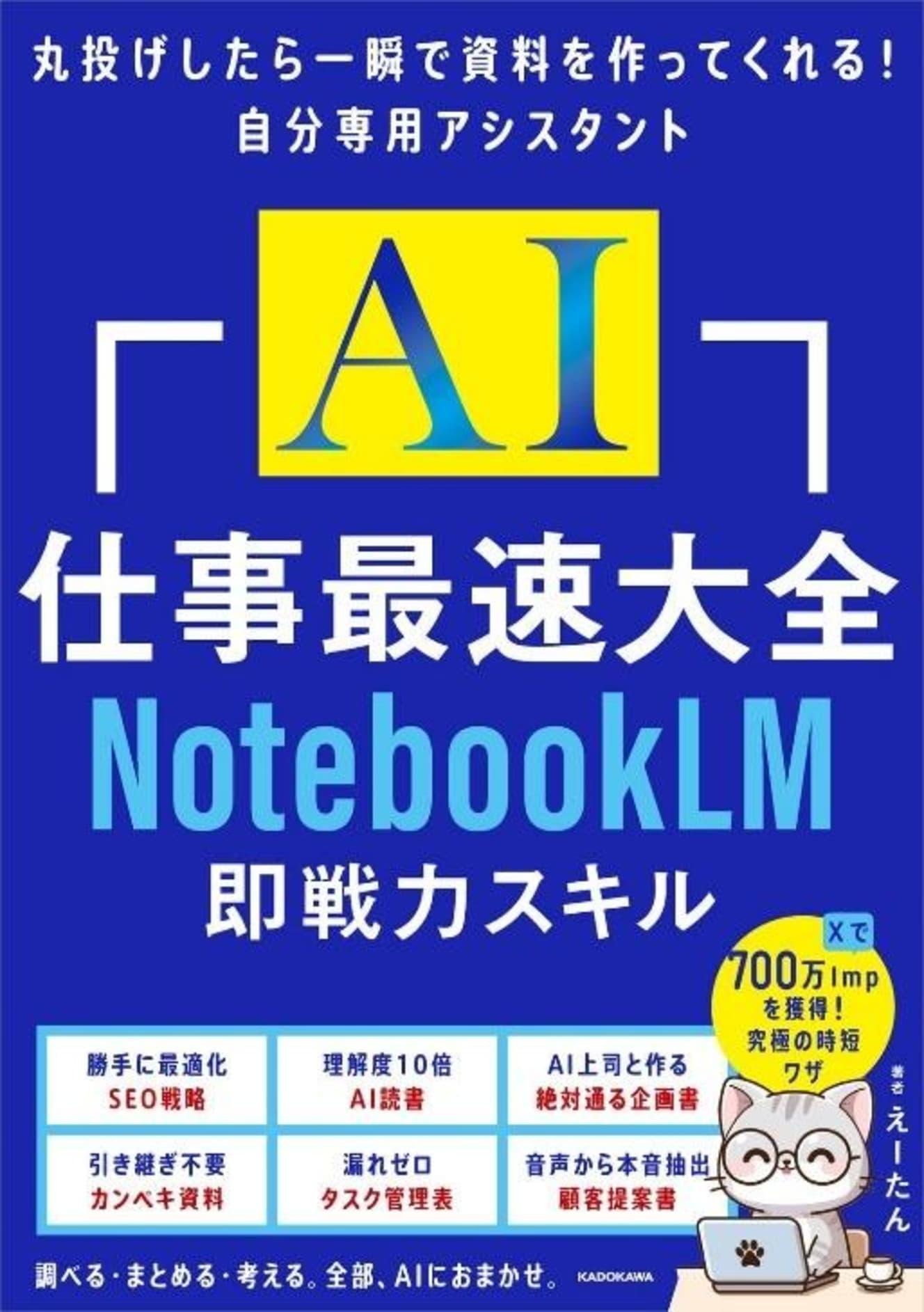
■ Click here to purchase “The Ultimate Guide to Working Faster with AI: Practical NotebookLM Skills.”
Reporting and Text: Motiko Abe-gawa
Works as a freelance writer primarily for web media. She is also involved in the production of books and corporate PR magazines. Without a specific area of expertise, she covers a wide range of topics that pique her interest, including history, comedy, health, beauty, travel, food, and elder care.
PHOTO: Afro (First Photo)