Aid Where It’s Needed Least? Inside the Kumamoto Earthquake’s Deepening Crisis of Car-Sleeping and Mismatched Relief


Temperature soared above 40°C setting a new record and heatstroke deaths were reported
Two days after the earthquake, on July 30, a “FRIDAY” reporter landed at Kumamoto Airport and drove toward Hikawa Town, which had been struck by an earthquake registering a maximum seismic intensity of 7. More than 3,000 households—roughly 70 percent of all households in the town—had lost water and electricity. When the reporter arrived at the town hall, support efforts involving Self-Defense Forces water trucks were in full swing.
At 2 p.m., the thermometer in hand had already surpassed 35°C. Under the intense sunlight, sweat poured out simply from standing still. Skin exposed to the direct sunlight turned bright red and began to throb like a burn. Regretting not buying a straw hat at the airport, the reporter spoke with people who had come to collect water. A man in his 60s who had just finished filling his containers could not hide his anxiety.
“Even when I sweat, I don’t have water to wash my face. I can barely do the laundry either. They say there’s still no prospect of restoration. I feel like my life is in danger.”
At the water distribution point, several female students who appeared to be junior high school students were helping distribute drinking water and alpha rice. They were also living at an evacuation shelter, but had volunteered to help, saying, “We have to think about what those of us who are able to move can do and take action.” Their willingness to participate in relief efforts despite the extreme heat was deeply admirable.
In the evening, the reporter entered Yatsushiro City, where 20 people had died. Even after sunset, the temperature barely dropped. The piercing sunlight was gone, but humidity remained above 60 percent, and the thick, sticky heat clung to the body like being inside a steam sauna.
While parked in the Yatsushiro City Hall parking lot for a meeting, the reporter noticed something strange. As the night deepened, more and more cars began arriving. The parking lot, which could accommodate more than 300 vehicles, was less than half full before 8 p.m., but by midnight, it was about 80 percent occupied.
Ten portable toilets had been installed on the premises, and residents were gathering there to sleep in their cars. Some families had even gone so far as to rent cars specifically for the purpose.
Why were they choosing to sleep in their cars? A man in his 50s who had come with his wife in a Suzuki Solio explained why.
“When the earthquake struck Kumamoto 10 years ago, aftershocks measuring around 5 to 6 on the Japanese seismic intensity scale kept occurring. We’re afraid our house could collapse because of aftershocks, so we can’t sleep there with peace of mind.”
In fact, aftershocks continued that night as well. The reporter personally felt about five of them. Even relatively small earthquakes caused the cars to shake violently. Each time, the occupants were jolted awake, making it impossible to get a good night’s sleep.
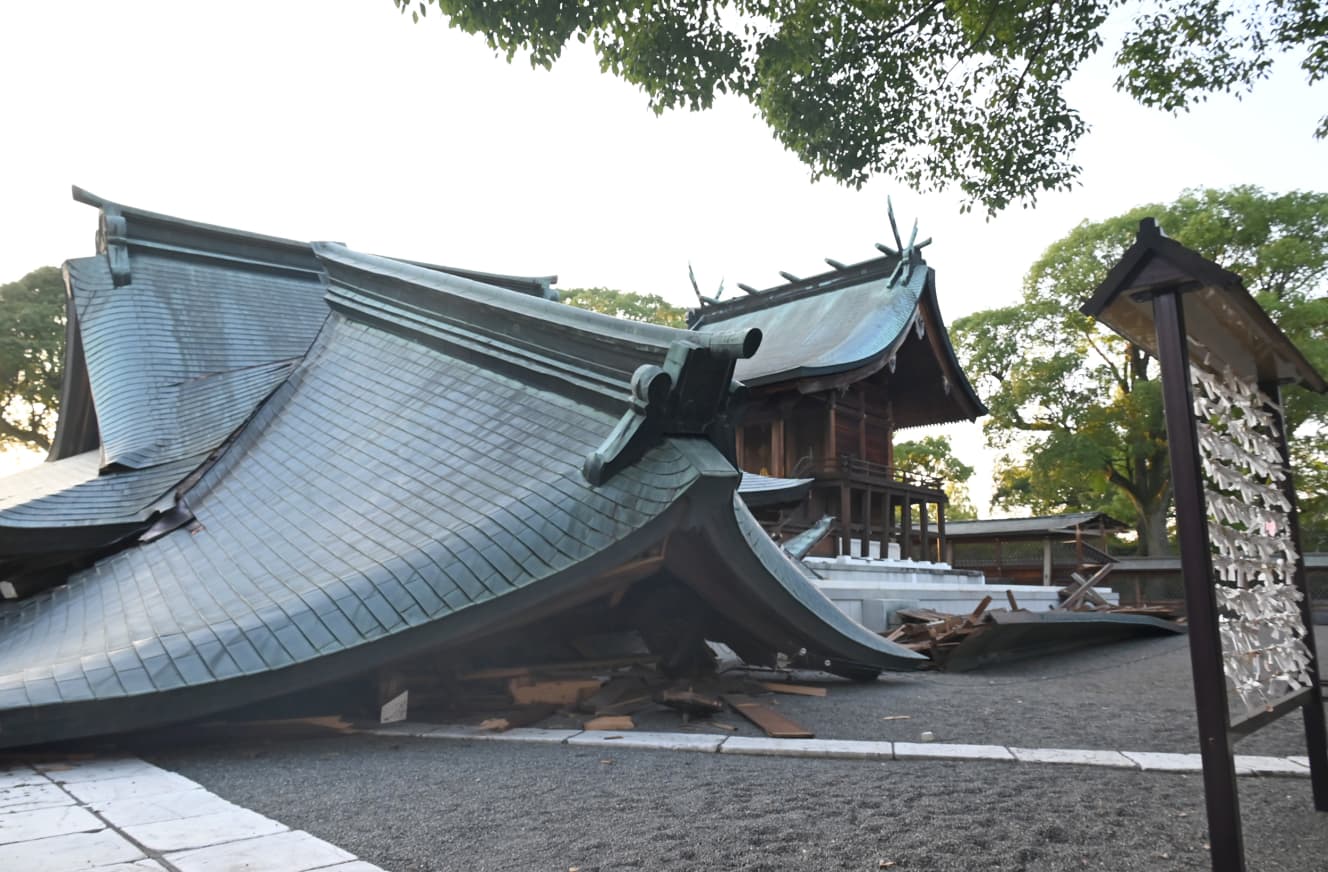
When dawn broke, the scorching sun illuminated the devastating scars left by the earthquake. The worship hall of Yatsushiro-gu Shrine, located within the grounds of the nationally designated historic Yatsushiro Castle ruins, had completely collapsed. The pedestrian walkway on Ueyanagi Bridge, which spans a local road, had fallen away, while near the Yatsushiro Interchange, sections of a fault had thrust up through the ground. Standing before the enormous scars of crustal movement—some seemingly more than two meters high—that were beyond anything human beings could control, the reporter felt a chill run down their spine.
Even when government-issued air conditioners arrive the day after the earthquake, they cannot be used–why the cooling equipment is unusable
Government relief supplies have been arriving one after another, but significant challenges remain when it comes to dealing with the extreme heat. Defense Minister Shinjirō Koizumi (45) proudly announced that 300 air conditioners had been transported to Kumamoto the day after the earthquake, but a mismatch has emerged between the equipment and the electricity infrastructure available at evacuation sites. A woman living at an evacuation center in Uki City, where the earthquake registered a maximum seismic intensity of 7, explains:
“Having learned from the earthquake 10 years ago, we had sufficient supplies of daily necessities and food stocked up, so we haven’t experienced much inconvenience. But it’s hot. It’s just unbearably hot. The government provided us with 12 portable cooling units, but they consume a lot of electricity, so we can’t run all of them at full capacity.
Apparently, several air conditioners were also brought to the evacuation center at Onobuta Elementary School in the city, but there isn’t enough power to operate them, so they have reportedly just been left unused.”
The reporting team also visited Aeon Mall Kumamoto, where an explosion had occurred, as well as Kumamoto Castle—but the sweltering heat took its toll on the journalists as well. On the third day of reporting, the accompanying photographer suffered from dehydration, forcing the team to cut the assignment short.
On August 3, the prefecture recorded a maximum temperature exceeding 40°C for the first time in its recorded history, marking an unprecedented extreme heat day. A woman in her 70s who had been sleeping in her car also died, reportedly from suspected dehydration, as the disaster-stricken region continues to suffer the double burden of a devastating earthquake and historic heat.
To prevent any further loss of life, truly appropriate and rapid assistance is urgently needed.
From the combined August 21–28, 2026 issue of “FRIDAY”


PHOTO: Masahiro Senryu