Are Middle-Aged Men in Shorts a Turn-Off? A 40-Something Reporter Tries Medical Hair Removal for Nose and Ear Hair


Is shin hair offensive? The middle-aged man’s grooming crisis
With summer in full swing, Japan is grappling with the middle-aged man in shorts problem. A sad debate has emerged over claims that seeing middle-aged men’s hairy legs is unpleasant, particularly after Tokyo’s energy-saving Cool Biz initiative made it possible for workers to commute in knee-length shorts. And, inevitably, middle-aged men’s shin hair has found itself in the firing line.
Will middle-aged men now feel pressured to hide their leg hair while also grooming other areas considered unwanted hair?
Perhaps in response to this growing trend, Shonan Beauty Clinic began offering medical laser hair removal for nose and ear hair in June 2026. Could the service become a savior for middle-aged men struggling with unwanted hair? A male reporter in his mid-40s visits Shonan Beauty Clinic to try the treatment for himself and investigate the latest trends in men’s hair removal.
The new normal for young men? The latest in male grooming

For insight into the current state of men’s hair removal, the reporter spoke with Dr. Kanako Misonou, deputy director of Shonan Beauty Clinic’s Shinjuku Main Branch.
“The number of men choosing hair removal is increasing, and at our clinic, we are seeing more male clients opting for medical hair removal—not only for beards, but for the entire body.
In the past, most men did not use sunscreen or follow a skincare routine, let alone pursue cosmetic treatments. Today, particularly among younger people, these practices have become completely normal.
As these habits become more commonplace, I feel that resistance to aesthetic medicine has decreased year by year. The growth of social media has also given people more opportunities to post photos of themselves, making them increasingly conscious of how they are seen by others,” says Dr. Misonou.
Indeed, skincare among younger generations has become so widespread that it is now often seen as standard practice. Meanwhile, more middle-aged and older people are using parasols for sun protection. Taken together, it seems clear that attention to appearance—from skincare to visible body hair—is becoming increasingly common and may eventually be regarded as a matter of basic grooming etiquette.
And if that is the case, then surely nose and ear hair—which can seem to grow at an alarming rate with age, particularly among middle-aged men—would naturally become another target for grooming.
“Just one or two stray hairs in the ears or nose can sometimes undermine an otherwise clean appearance. These are also areas that people may find difficult to notice themselves, so I think medical hair removal can help prevent those little grooming oversights.
While the treatment is primarily intended for cosmetic purposes, properly caring for areas that are easy to neglect can also help people feel more confident, offering psychological as well as aesthetic benefits.”
With that in mind, the reporter decided to take on the challenge of medical hair removal for his nose and ear hair in an effort to sharpen his appearance—and perhaps gain a little extra confidence along the way.
The treatment uses a laser to apply heat to the hair follicles, damaging them to reduce future hair growth. By undergoing multiple sessions timed to the hair growth cycle, permanent hair reduction can be achieved. Results vary from person to person, and depending on the amount of hair and the treatment area, some people may require more than 10 sessions to reach a satisfactory result.

Snap! The reality of nose hair removal
First, the reporter undergoes a skin consultation with a doctor to determine whether medical hair removal is suitable. After receiving an explanation of the procedure and completing the necessary paperwork, it is finally time for the treatment.
Once inside a private treatment room, he lies down on the bed and the procedure begins. For nose hair removal, only the area about one centimeter from the nostril entrance is treated. The hair deeper inside the nose is left untouched—the treatment is limited strictly to the visible area.
Rather than immediately firing the laser, the first step is shaving the nose hair in the treatment area using a specialized shaver. The laser is then applied three times to each side. With every pulse comes a sharp “snap!” and a brief, electric-like jolt. Once you get used to it, it is manageable, but the first few pulses can be a little surprising.
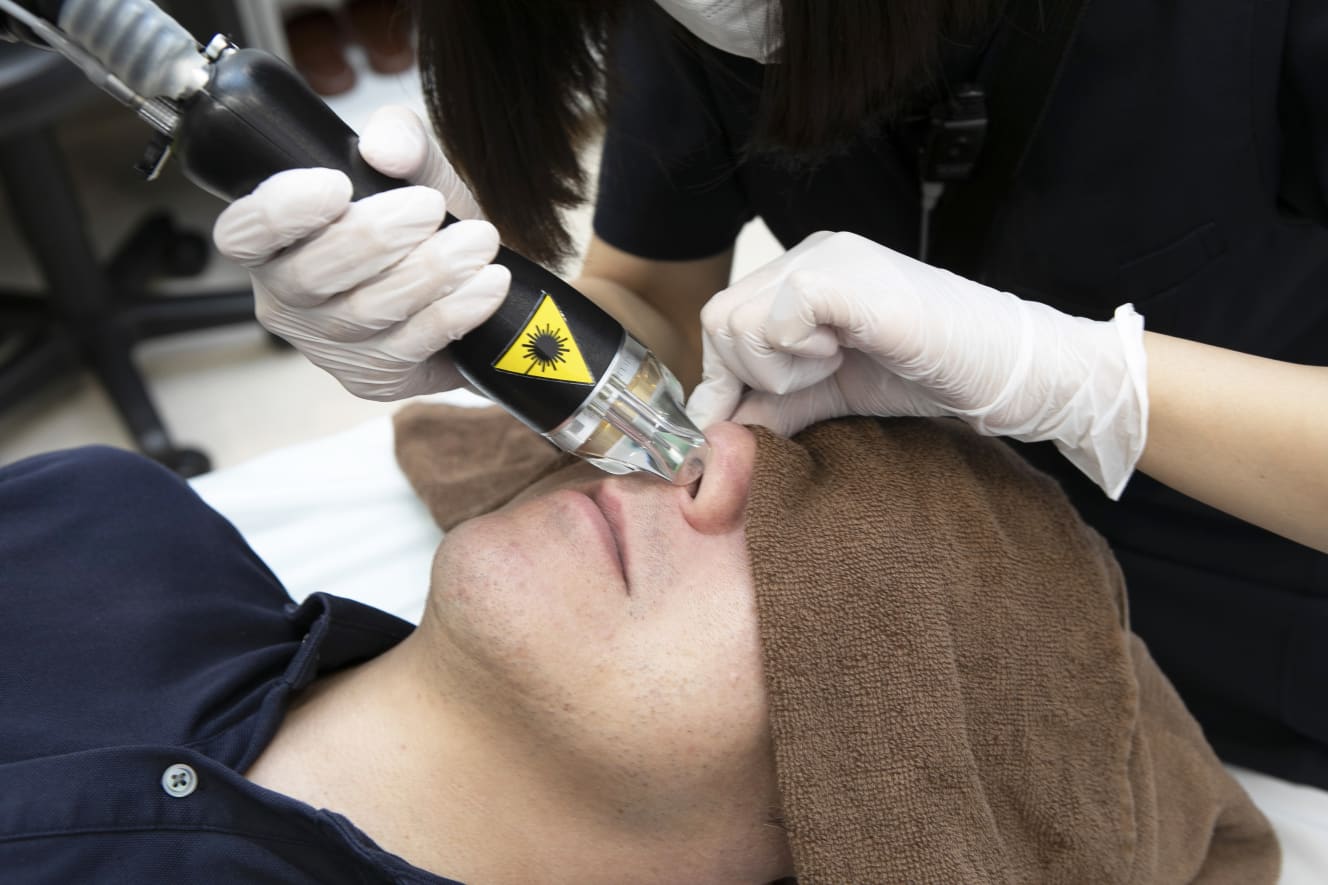
Next comes the ear treatment. Again, the hair is shaved before the laser is applied. Unlike the nose, there is virtually no pain at all. The entire procedure for both the nose and ears takes about 10 minutes.
Afterward, there is a slight burnt smell lingering inside the nose, but there is no impact whatsoever on eating or daily life. If it is this easy, the reporter figures he can comfortably return for the remaining two sessions.
The thought of no longer having to deal with the irritation of an occasionally overgrown, itchy nose hair—or suddenly noticing one or two ear hairs that have been left to grow unchecked, then wrestling with the mirror to pluck them out—already feels like a considerable relief.

No need to go completely hairless: Hair reduction for grown-ups
Having tried nose and ear hair removal, the reporter suddenly becomes much more enthusiastic about unwanted-hair grooming. He therefore asks Dr. Misonou how other men are approaching hair removal.
“Some people choose full-body hair removal, but beard removal is by far the most common.
It depends on the individual and the image they want to project. Some people remove their beard completely, while many others remove only the hair on their cheeks to clean up and shape their beard. Completely removing a beard can sometimes make a person look too youthful, while others feel that keeping some facial hair gives them a greater sense of authority. So, the idea is to design the beard in a way that suits the individual.
Another option is eyebrow grooming, where the surrounding hairs are removed to create a cleaner shape. Many men probably do not have a regular habit of grooming their eyebrows, but hair removal can help maintain a neat shape without requiring constant upkeep. In particular, I get the impression that many business owners and executives who frequently meet people incorporate aesthetic treatments, including medical hair removal, into their grooming routines.”
Personal grooming, it seems, is no longer limited to clothing. Hair on the head, eyebrows, beards, nose hair, and ear hair—all forms of visible body hair—are increasingly becoming part of the broader concept of looking well-groomed.
But what about the controversial issue of middle-aged men wearing shorts and their leg hair? After prefacing her answer by saying that she was not familiar with the details of the debate, Dr. Misonou had this to say:
“Personally, I think people should wear whatever they like. But if someone is hesitant to wear shorts because they are concerned about being seen, medical hair removal for the lower legs can help them feel more comfortable and confident about showing them.
And if someone feels embarrassed about removing all their hair and having completely smooth legs, it is also possible to simply reduce the amount of hair or make it finer and less noticeable. For people who are uncomfortable with the completely hairless look, I recommend a hair-reduction treatment.”
Medical hair removal and unwanted-hair grooming are becoming increasingly popular, particularly among people in their 20s and 30s. Of course, those younger generations will themselves become middle-aged in another 10 or 20 years—and by then, unwanted-hair care may well be considered a standard part of basic grooming etiquette.
As Dr. Misonou puts it, “In an era when people are expected to live to 100, those in their 40s and 50s are still relatively young.” Perhaps middle-aged people today have reached the point where they, too, need to update their ideas about grooming in order to keep pace with what younger generations consider normal.
Maybe the middle-aged man in shorts is actually a messenger from the near future—a summer visitor sent to remind us what the next generation of grooming standards may look like.
Reporting and Text: Daisuke Takahashi PHOTO: Mayumi Abe (Reporting), Kyodo News (First Photo)