Think Your AIRism Still Works? This Laundry Mistake May Have Ruined It


Is the claim that it deteriorates after a few years a myth? The truth about its actual lifespan
June this year (2026) was unusually cool—the coolest in decades—and apparel companies struggled with sluggish sales of summer clothing. But once the rainy season ended in July and intense heat arrived, the situation changed dramatically. Summer apparel began flying off the shelves.
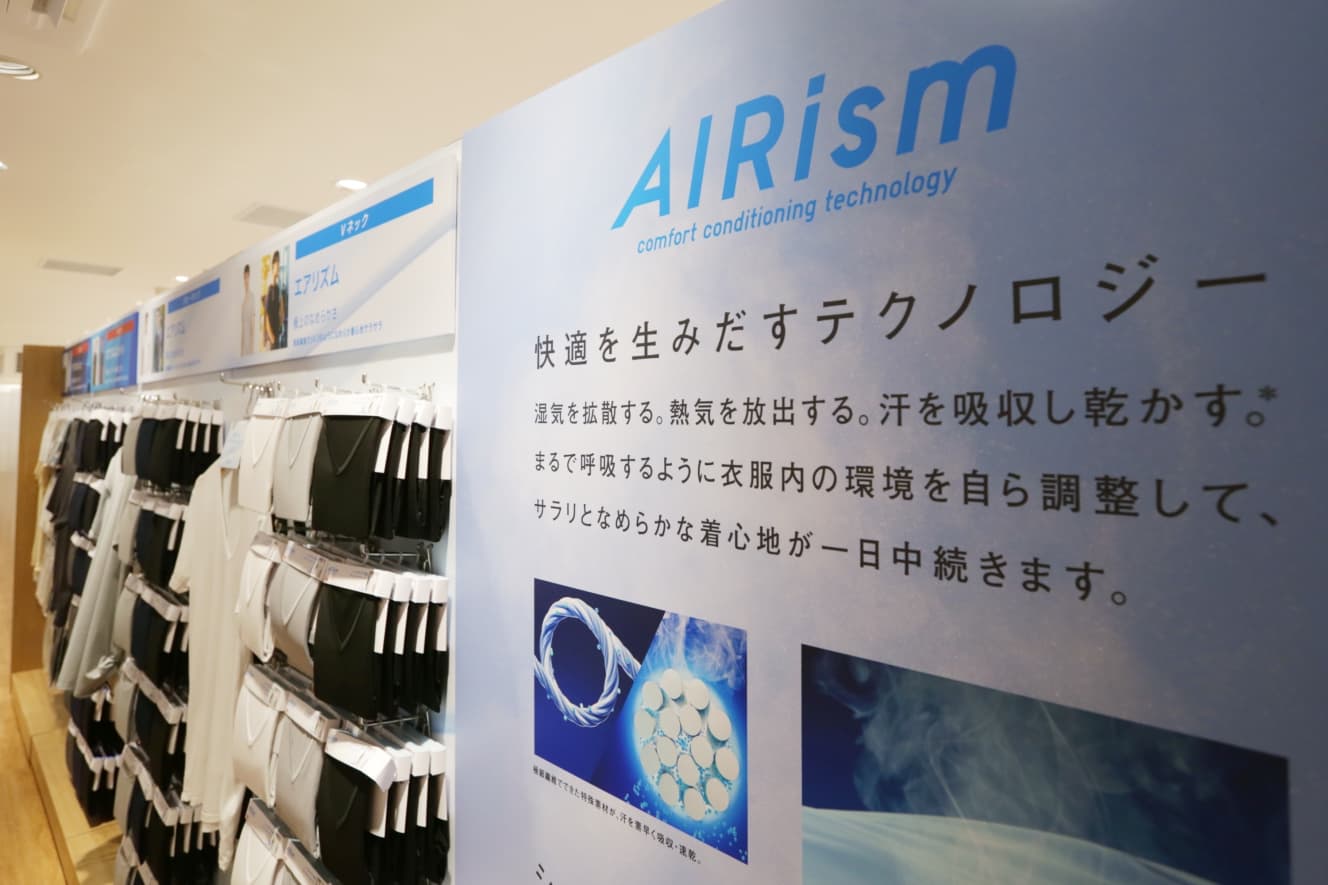
When scorching days leave you drenched in sweat, moisture-wicking, quick-drying clothing becomes indispensable. While many people associate this category primarily with summer underwear such as AIRism, companies led by Uniqlo and GU now offer moisture-wicking, quick-drying T-shirts and polo shirts as standard outerwear as well.
With the peak season for summer clothing now underway, articles and social media posts asking, “How long does AIRism last?” have become increasingly common online. Many of them make the same claim: that after wearing AIRism or similar moisture-wicking, quick-drying garments for several years, they feel the clothing has lost some of its performance. But what could be causing this?
The performance of most moisture-wicking, quick-drying garments—including AIRism—is supported by polyester. Nearly all such garments contain a high proportion of polyester, and 100% polyester products are far from unusual.
Polyester, a synthetic fiber, is considerably more durable and resistant to deterioration than natural fibers such as cotton and linen. For that reason, it is difficult to imagine its moisture-wicking and quick-drying performance visibly declining simply from repeated washing.
For example, the men’s AIRism Crew Neck Short-Sleeve T-Shirt sold this summer is made of 88% polyester and 12% polyurethane (except for light gray, which is 89% polyester and 11% polyurethane). Given the characteristics of polyester—which accounts for nearly 90% of the fabric—it is difficult to believe that a few years of household washing would significantly reduce its moisture-wicking or quick-drying ability.
On a personal note, the author is someone who sweats easily and has worn only polyester-based moisture-wicking, quick-drying clothing during the height of summer for about five years. Despite repeated washing in a home washing machine over that period, not a single garment has noticeably lost its moisture-wicking or quick-drying performance.
Could polyurethane be the culprit instead? Polyurethane is responsible for stretch, so it has little to do with moisture-wicking or quick-drying performance. Polyurethane can break down over roughly three to 15 years, depending on conditions, so it is possible for a garment to lose its elasticity. But stretchiness and moisture-wicking performance are entirely unrelated.
To investigate further, the author interviewed several textile industry professionals with expertise in materials. Their answer was this: using large amounts of fabric softener can often cause clothing to lose its absorbency.
Many people probably believe that fabric softener works by making fibers themselves softer. In reality, it reduces friction by forming a film-like layer on the surface of the fibers. In other words, its effect is similar to coating the surface of the fibers.
This is why using fabric softener can often reduce the absorbency of 100% cotton towels. While the towels may feel softer, many people are unaware that their ability to absorb water may have declined. It is important to recognize that using fabric softener on plant-based natural fibers such as cotton and linen carries a high risk of reducing their absorbency.
Polyester moisture-wicking fabrics work differently from natural fibers such as cotton and linen. Cotton and linen fibers themselves absorb water. Polyester fibers, on the other hand, are not inherently absorbent. Instead, when non-absorbent polyester yarn is woven into fabric, capillary action allows moisture to spread throughout the fabric. The fabric as a whole absorbs and disperses moisture, but because the polyester fibers themselves do not retain it, the garment dries more quickly than cotton or linen.
Although the mechanism differs, using fabric softener can reduce the absorbency of polyester moisture-wicking fabrics just as it can with cotton or linen. In recent years, more people have been using generous amounts of fabric softener in pursuit of a pleasant scent and a fluffy feel—but this may actually be the biggest cause of declining performance. If washed using only water and laundry detergent, polyester moisture-wicking, quick-drying fabrics rarely lose their functionality.
There have also been cases in recent years where excessive use of fabric softener has produced such strong odors that it has led to what is known in Japan as “kōgai,” or fragrance pollution. In such cases, it is reasonable to suspect that the garment’s absorbency has also been significantly reduced. Using more fabric softener than the recommended amount offers little benefit and comes with clear drawbacks.
So, if you’ve recently felt that my AIRism doesn’t absorb sweat as well as it used to, try stopping the use of fabric softener and washing it several times with only water and regular laundry detergent. As the fabric-softener coating gradually comes off the fibers, some of its moisture-wicking and quick-drying performance should return.
Deodorizing performance may be lost after about two years
Aside from fabric softener, another concern is functionality added through post-treatment.
There are two main ways functional properties can be incorporated into textiles: they can be built into the fibers during yarn production, or they can be applied to the fabric after it has already been made. The latter is known as post-treatment.
Because post-treatment generally involves applying chemicals or other agents to the surface of the fabric, the treatment will inevitably wear off with repeated washing. This does not mean it disappears after just a few washes—products sold in Japan generally retain their functionality for some time—but many such treatments tend to wear off after roughly 30 to 50 washes. In reality, relatively few post-treatment products are designed to withstand 100 washes.
This summer’s men’s AIRism lineup offers not only moisture-wicking and quick-drying performance, but also cool-to-the-touch and antibacterial/deodorizing functions. Uniqlo has not disclosed the specific processing methods used, so it is impossible to say for certain. However, within the textile industry, antibacterial and deodorizing properties are very often added through post-treatment.
As a result, it is reasonable to assume that these functions gradually wear off with repeated washing. Exactly how many washes AIRism can withstand before this happens has not been disclosed, but based on typical industry standards, 30 to 50 washes may be a reasonable estimate. It is unlikely that the treatment is designed to retain full performance for 100 washes.
For example, assume the treatment lasts for 50 washes. If you own five AIRism shirts and rotate them daily, each shirt would be washed around four to five times per month. At that rate, the antibacterial and deodorizing function would last for roughly 10 months of actual wear. If you wear AIRism only from May through the end of October, that works out to about two years before those functions are lost.
The same may apply to the cool-to-the-touch feature. Assuming it is also a post-treatment designed to withstand around 50 washes—although some cool-touch fabrics achieve this effect without post-treatment—the effect may become less noticeable after roughly two years.
As mentioned earlier, if AIRism is washed using only water and laundry detergent, its moisture-wicking and quick-drying performance is unlikely to decline significantly, meaning it could easily remain usable for around five years. However, if antibacterial, deodorizing, and cool-to-the-touch performance are important to you, those benefits may fade after two to three years, making that a reasonable time to consider replacing the garment.
For those who are satisfied as long as the moisture-wicking and quick-drying performance remains intact, AIRism can potentially be worn for more than five years. Either way, it is probably best to avoid using fabric softener whenever possible.
Reporting & Text: Mitsuhiro Minami
Born in 1970.After graduating from college, he joined a mass-market clothing retail chain and became a reporter for a textile industry newspaper in 1997. After resigning in 2003, he worked in public relations for a T-shirt apparel manufacturer, as a magazine editor, in sales for a major trade show organizer, and in public relations for a fashion vocational school before becoming independent. He currently works as a freelance textile industry writer and public relations advisor.
PHOTOS: Kyodo News (first photo), Afro (second photo)