[Full Story] Teruo Iwamoto Reveals the Message Japan Coach Hajime Moriyasu Sent Before the Brazil World Cup Match
He Rushed to Brazil for a Friend He Still Talks to Every Month… A Single, Memorable Exchange


Growth, but still short of the world’s best
“Honestly, I thought we could win. At halftime, I was so confident that I even called an acquaintance in Japan from NRG Stadium in Houston and said, ‘If we score a second goal, it’s over.’ But in the second half, little by little, we were pushed farther and farther back. I don’t think the Japan national team has been forced to retreat that deeply as an entire team in recent years. Japan had maybe one shot in the second half, right? There were some good things, but we also saw our limits. That’s my impression of the Brazil match.”
Former Japan national team midfielder Teruo Iwamoto (54) watched all four of Coach Moriyasu’s Japan matches at the North, Central America and Caribbean World Cup in person.
“I’d say the group stage was a passing grade. There were many people who thought the opening match against the Netherlands would be difficult, but Japan managed to earn a dramatic draw. When they beat Tunisia 4–0, everyone must have started dreaming. We had never seen the Japan national team dominate an opponent to that extent on the World Cup stage.”
But once again, Japan were eliminated in the first round of the knockout stage. They finished at the Round of 32, falling short of the previous two tournaments. Considering the expectations surrounding a team that had been described as the strongest Japan team ever, the ending left something to be desired.
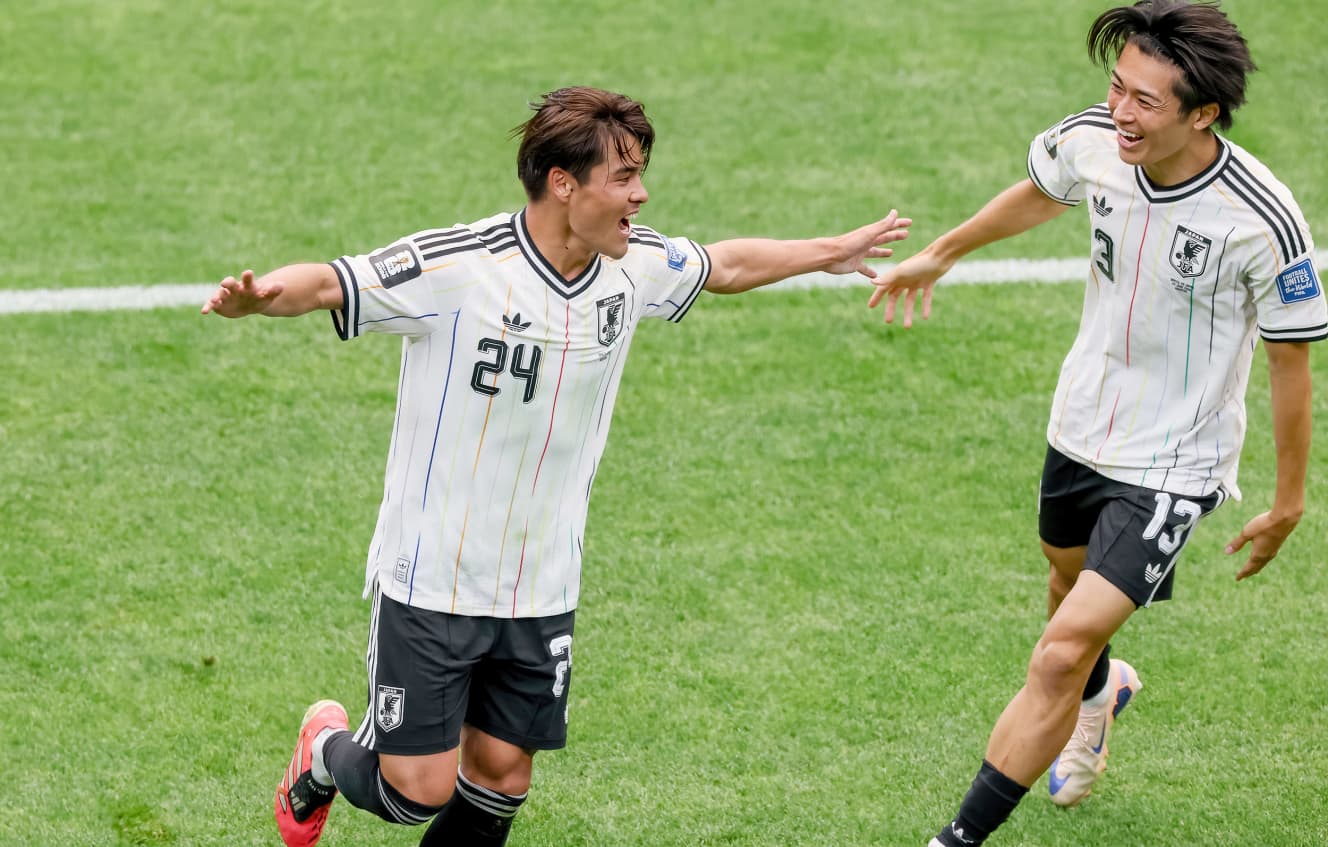
“Japan controlled the first half. When Sano (Kaishu, 25) scored to put us ahead, the stands erupted. But, as expected, the World Cup is no easy place. Brazil changed the way they played in the second half.”
Brazil’s ace Vinícius (26), who had played more centrally in the first half, moved out wide in the second half, taking up positions along the touchline and forcing Japan’s two wing-backs deeper.
“They used diagonal balls and kept sending crosses into the area in front of Japan’s goal. Japan struggles when the ball is delivered into the danger area that way. The equalizer came after Brazil had pushed deep down the flank and then delivered a diagonal cross. Come to think of it, Japan also conceded the comeback defeat against Belgium at the 2018 World Cup in Russia from a ball delivered from the flank. So, in a sense, one of Japan’s longstanding weaknesses was exposed once again. There’s no doubt that Japan has improved, but the gap separating them from the world’s best is still enormous.”
He was the same Poi-chan as always
I witnessed the weight of that wall from the stands again at this World Cup, just as I had at the 2018 Russia tournament and the 2022 Qatar tournament. And this wasn’t for work. I have consistently paid for my own trips to watch the World Cup in person. At this tournament, ticket prices had soared, while the weak yen and local inflation also drove up the overall cost of attending matches.
“When I saw the amount on my credit-card bill, I actually looked at it twice (laughs). I had also covered part of my travel companion’s expenses for the time being, but even so, it was shockingly expensive. I looked for the cheapest hotels I could find and cooked for myself in rooms with kitchens.”
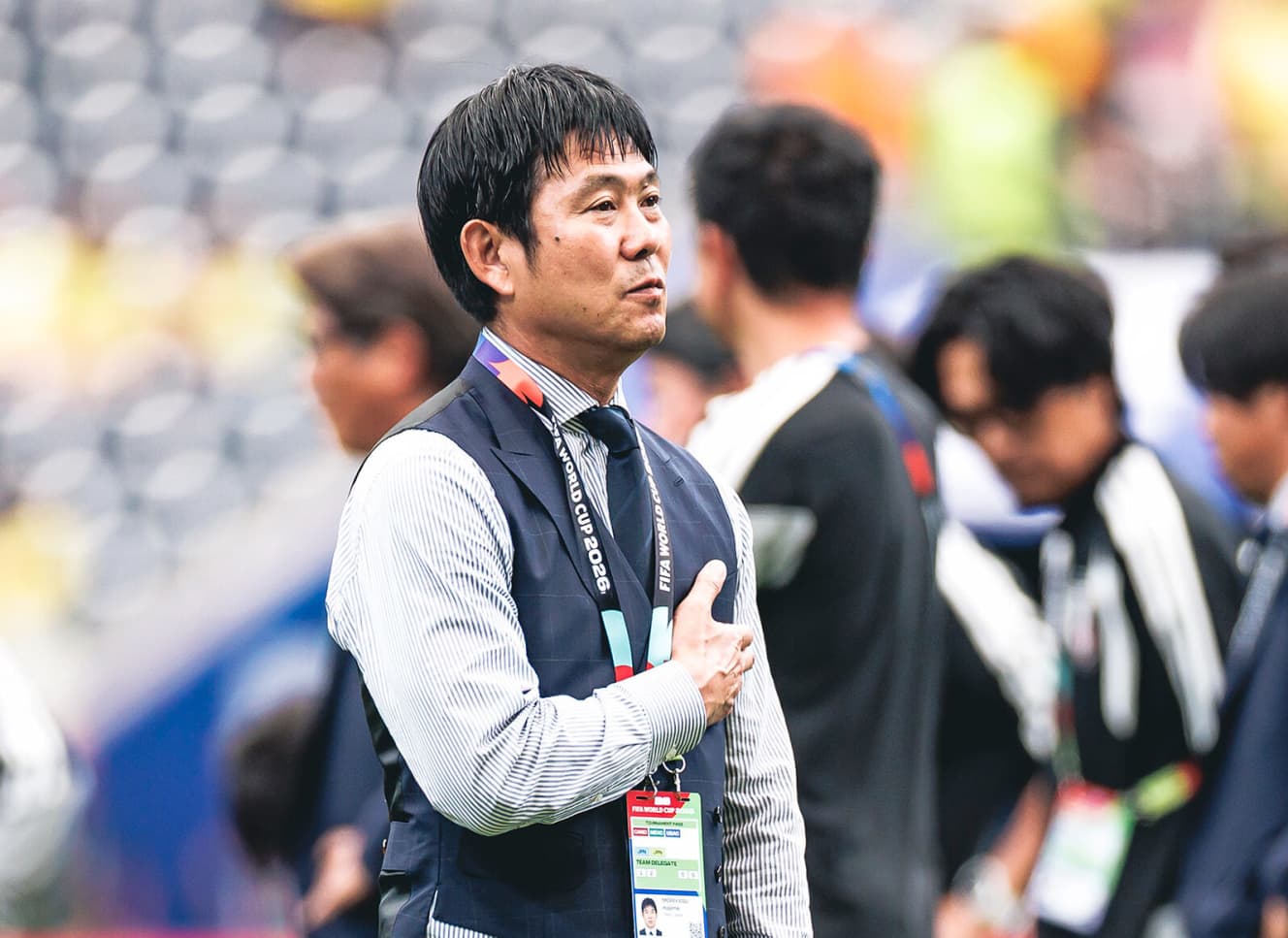
Why go all the way to the World Cup at such expense? One major reason is manager Hajime Moriyasu (57). The two first met in 1994. From the very day Teruo Iwamoto was first selected for the Japan national team at age 21, they grew closer, and later became teammates at Kyoto Purple Sanga (now Kyoto Sanga) and Vegalta Sendai.
As a term of affection, Iwamoto calls Moriyasu, who is four years older than him, “Poi-chan.”
“Of course, there are things you can’t understand unless you see the games in person, and it’s a learning experience for me too. But I go to the World Cup to support Poi-chan. Our positions were fairly close. I played on the left side, with Poi-chan as the defensive midfielder behind me. Simply put, he used to clean up after me (laughs). I was the type who didn’t defend much and wanted to stay forward, so he’d tell me things like, ‘You should tuck in a little more [toward the center].’ His advice was always spot-on.”
The last time they met before the World Cup was May 22, just before the final domestic training camp, but Iwamoto says, “He was the same Poi-chan as always,” with a smile.
“Even when I casually said something like, ‘I think we’ll beat the Netherlands and Tunisia and draw with Sweden,’ he’d respond, ‘Two wins and a draw, huh? It’d be nice if that happened’ (laughs). We meet about once a month and talk for two or three hours, and most of the time it’s about soccer. Sometimes we talk about the national team, but he never lets any inside information slip. He’s very strict about that.”
During the tournament, Iwamoto deliberately avoided contacting him. There was, however, one memorable exchange.
“Poi-chan wore a vest for the Netherlands and Tunisia matches, but he wore a jacket against Sweden, and Japan struggled toward the end. So I wrote in my column for a sports magazine that I wanted him to ‘take off the jacket and fight’ against Brazil. Then he sent me a LINE message. He wrote, ‘For tomorrow’s match against Brazil, I’ll take off the jacket and fight.’ And sure enough, he wore a vest against Brazil. No matter how famous he becomes, he hasn’t changed at all. He’s had the same hairstyle forever. He doesn’t even have any gray hair (laughs).
“In the eight years since he became national-team manager, there were times when he failed to get the results he wanted and was heavily criticized. Knowing that I work as a commentator, Poi-chan tells me, ‘If it helps you with your work, don’t hesitate to criticize me.’ Even though he must want as many people on his side as possible, he always thinks from the other person’s perspective. Poi-chan has also told me, ‘If Japan will become a stronger team because I step down, I’ll step aside at any time.’ He’s always thinking less about himself and more about what will happen to Japanese soccer and what the national team needs. I think it’s precisely because he has no distractions or ulterior motives that he doesn’t waver no matter how much he’s criticized, and that his words resonate with the star players who are succeeding overseas.”
Regarding Moriyasu, reports after the tournament said that the Japan Football Association had approached him about continuing in the role on a short-term contract. One proposal reportedly would have him remain in charge through the Asian Cup, which begins next January.
“I don’t think there would be any problem with him staying on through the next World Cup. If he steps down, the question becomes, ‘So who comes next?’ But it wouldn’t be easy to find someone who knows the current Japan national team better than Poi-chan, can bring the players together, and can handle that level of pressure.”
They are close, yet neither crosses the line. There is affection between them as friends, yet Iwamoto still maintains the detached perspective of a former Japan international. Having paid his own way across the ocean and watched Moriyasu Japan’s campaign from the stands, his words revealed both his deep trust in Moriyasu and the pragmatic perspective of a former Japan international who knows just how high the world’s barriers remain.


From the July 31, 2026 issue of “FRIDAY”
PHOTO: JMPA: Hiroyuki Komatsu (4th photo)