Japan’s Top Student Analysts Are Giving the University of Tokyo Baseball Team a High-Tech Edge With VR
The Return of the Akamon Storm: A Historic Feat in the Tokyo Six Universities Spring League—Earning Points with Back-to-Back Wins Over Hosei University for the First Time in 98 Years


Students with a strength in data are making strides with tehcnology!
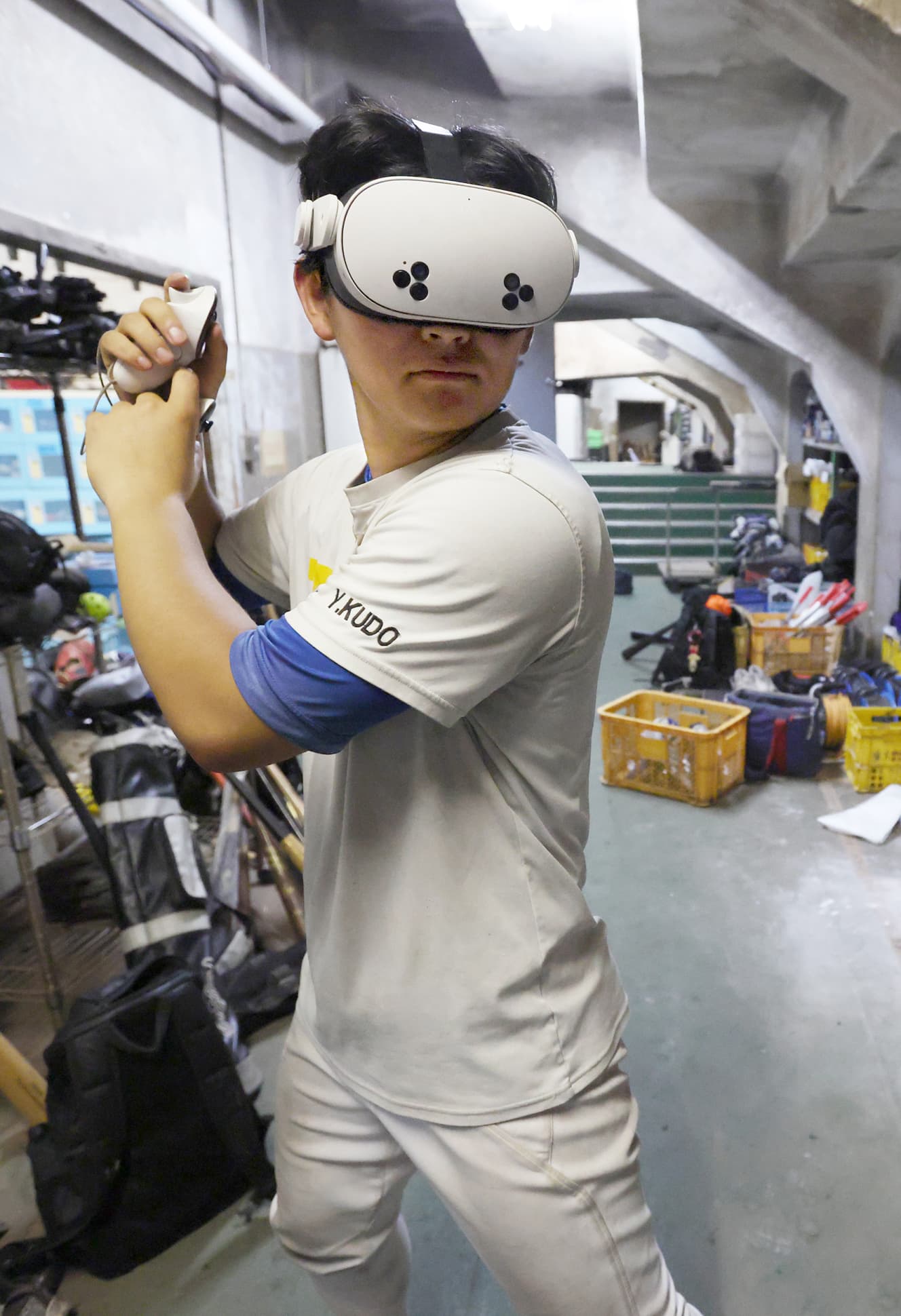
“Before games, we can repeatedly watch footage of the opposing pitchers and study them, so even when I face a pitch type for the first time, it no longer feels like my first look at it.”
The player speaking while wearing VR (virtual reality) goggles is Ryōhei Kadota, a fourth-year student and first baseman on the University of Tokyo baseball team (first photo). The goggles display footage of key pitchers from rival teams in the Tokyo Big6 Baseball League, including Waseda and Keio. The University of Tokyo has been making strides by harnessing VR technology. Kadota continues:
“The footage shows the pitcher actually throwing the ball from the mound. The system realistically recreates the spin and trajectory of each pitch type for each pitcher. We watch the VR footage beforehand and build specific images of the opposing pitchers—for example, identifying pitchers whose fastballs tend to have a cutting or running action—and devise strategies accordingly.”
The VR system was developed independently by the University of Tokyo baseball team. A student analyst who was enrolled in the Department of Physical Engineering in the Faculty of Engineering completed a prototype in spring 2024, and the team has continued updating and improving its analytical accuracy.
“The pitchers’ movements are based on footage filmed from behind home plate at Jingu Stadium, where the league games are played. For analyzing the ball and other data, we use measurements from ‘TrackMan,’ a ball-tracking system installed at the stadium. One of Tokyo’s strengths is that, compared with other universities, it has more students who can make use of that kind of data and program with it.” (same source)
The benefits of VR for improving the team’s hitting ability became apparent during this spring’s league season. In the game against Hosei University on May 10, No. 1 batter Yu Hasegawa (second-year, outfielder) hit a two-run home run in the third inning, helping Tokyo defeat Hosei 8–5 with 13 hits. Tokyo had also won the previous day, 2–1, giving the team two consecutive victories over Hosei and a winning series point. It was the first time in 98 years that Tokyo had taken consecutive wins and a series point against Hosei, which boasts numerous players with Koshien experience. The victories evoked memories of the “Red Gate Storm” of spring 1981, when Tokyo won six games and finished fourth.
VR is not the only thing supporting Tokyo’s resurgence. The presence of nearly 20 student analysts is also important (other universities have around 10). The analyst division of the University of Tokyo baseball team was established in December 2020, spearheaded by Shu Saito, who now works as a data analyst attached to the general manager of the SoftBank Hawks. Second-year analyst Sadatoshi Kanazawa explains:
“Before the analyst division was established, individual players analyzed opposing teams and came up with strategies themselves. Now, we divide the analysts into groups according to areas such as opposing pitchers and position players, and provide players with the necessary data and footage. We don’t simply analyze data; we communicate the data that will help us win.
The premise is planning for mistakes. For example, suppose we analyze the opposing No. 4 hitter and determine the pitch and location that give us the lowest probability of being hit. However, there is no guarantee that a Tokyo pitcher will be able to throw that effective pitch. If the pitcher misses his spot, what type of pitch is he most likely to throw, and where? If the batter hits that pitch, where and what kind of ball is likely to be hit? We take all of that into consideration when providing the data. Our goal is to become ‘the best analysts in Japan.’”
The team is also working on building
In addition to data analysis, the team is also putting considerable effort into improving its players’ physical conditioning. Kanazawa continues:
“The management system overseen by the student trainers and head of training is contributing to our physical development. Starting this year, we share figures such as body weight from weekly fitness assessments, and each player considers their own diet and training methods. The entire team is working together to improve physical strength. Most of the players have successfully gained weight. Ken Akashi (fourth-year, catcher), who had three hits against Hosei in the aforementioned game, has gained 6 kg since last fall, bringing his weight to 80 kg.
Our BMI—the figure calculated by dividing body weight by the square of height—which was among the lowest compared with other universities, is now the highest in the Tokyo Big6 before the start of the spring league season. In terms of physical size, I don’t think we’re inferior even to players who have experienced playing at Koshien.”
On the wall of the University of Tokyo’s Yayoi Campus baseball field in Bunkyo, Tokyo, there is a photograph of a scoreboard showing a 2–3 score, with the words “Gashin Shōtan” (enduring hardship and hardship to achieve one’s goal) written above it. The photo was taken during Tokyo’s narrow loss to Meiji this spring. Tokyo is no longer a team that is simply expected to lose. Using the frustration of such defeats as motivation, the team is aiming to make an even greater leap forward in the autumn league.
The goal: “To become the best analysts in Japan”


From the July 31, 2026 issue of “FRIDAY”
PHOTO: Kazuhiko Nakamura