“I Could Have Quit Acting at Any Time” – Yutaka Mizutani Reveals the Thinking Behind His Long Career
Special Interview: In His 61st Year in Show Business… The hit drama series *Aibou*, in which he stars, Celebrates Its 26th Anniversary, and His First Co-Starring Role with Daughter Shuri Is Making Headlines!


After experiencing setbacks
“Ah, it had finally begun at last—that’s what I felt when I watched the finished footage for the first time. I realized that the nearly 60 years I had spent in the entertainment industry had been one long preparation, and that now, finally, my own world was beginning.”
Actor Yutaka Mizutani (73) began talking about his life with a gentle gaze. The footage he referred to at the outset was his latest film, “Piccola felicità — Chiisana Shiawase (A Little Happiness),” which is currently being released in theaters around Japan. It is his fourth film as a director and an ambitious project in which he took on five roles himself: conceiving the project, directing, writing the screenplay, producing, and starring.
Mizutani first rose to prominence with the 1974 Nippon TV drama “Kizu Darake no Tenshi (Angels Covered in Wounds),” followed by the “Netchu Jidai (Passionate Days)” series (1978 onward, Nippon TV), which achieved ratings of over 40 percent, and then the hugely popular “Aibou (Partners)” series (TV Asahi), which celebrates its 26th anniversary this year. He has remained at the forefront of the industry throughout his career. So what does he mean when he describes all of that as merely a preparation period?
“I had been interested in the world of film and television since I was a child. My earliest memory is probably from when I was three or four years old. I watched ‘Kurama Tengu’ at a traveling outdoor cinema. Adults and children alike sat on straw mats spread out on the ground to watch. I remember everyone bursting into applause when Kurama Tengu defeated the villains. It was incredibly exciting.”
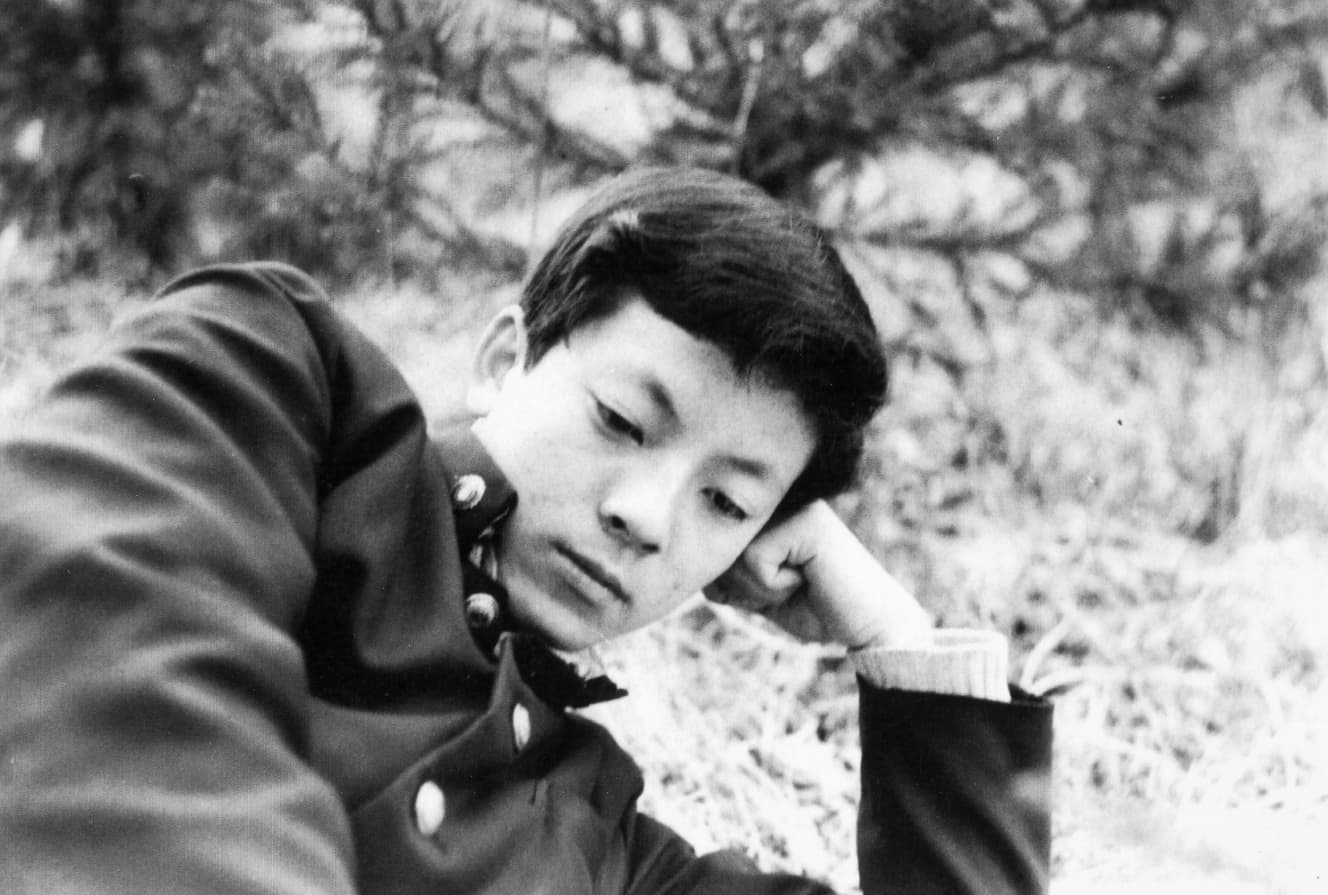
Later, after watching American television dramas, he thought, “I want to enter this world,” and joined the Himawari Theatre Group. He made his acting debut at the age of 14 in the Fuji TV drama “Magma Taishi (Ambassador Magma).” However, during his third year of high school, he decided to quit acting and study abroad in California, USA.
“I decided to study abroad because I wanted to see a new world. But then my father’s company went bankrupt, so I had to give up on studying abroad. I also failed my university entrance exams in Japan, became completely despondent, and left home. I eventually made my way to a restaurant on the shores of Lake Yamanaka, where I lived and worked for about two months.”
At the time, Mizutani himself had no intention of returning to the entertainment industry. However, those around him did not leave him alone and approached him about appearing in a television drama. He returned to the set, initially thinking of it as a temporary job.
“Even though I considered it a temporary job, I never approached anything half-heartedly. I gave every production everything I had. Doing everything I possibly can is something I have always tried to live by. But when each project was over, for some reason I never felt as though I had really accomplished anything. No matter how well something was received, I found it strangely difficult to feel a sense of fulfillment. I always thought, ‘There must be another world out there that I’m better suited for.’ I was always prepared to quit acting immediately if I ever found that world.”
A promise with Yusaku Matsuda
That outlook changed when Mizutani was 38, the year his daughter, Shuri (35), was born.
“When I saw my daughter’s name entered in the family register, I was suddenly overcome by the feeling that I now had someone to protect. Of course, my work depended on receiving offers, but it was the first time I thought I wanted to continue working as an actor for as long as I possibly could.”
September 21, the day Shuri was born, was coincidentally also the birthday of Mizutani’s close friend Yusaku Matsuda, who had died the previous year at the age of 40.
Mizutani met Matsuda when he was 20. Mizutani appeared as a criminal in “Taiyo ni Hoero!” (Nippon TV), the police drama in which Matsuda had become hugely popular playing the character Jipan Deka. The two immediately hit it off and developed a close relationship in which they could talk about anything.
“Actually, around 1988, when Yusaku-chan was hospitalized with bladder cancer, I was diagnosed with the same illness. We were hospitalized at the same hospital and underwent surgery, but since neither of us had made our condition public, the nameplate outside my hospital room combined our two names and read ‘Mizuta Hōsaku.’ Yusaku-chan was like, ‘What the heck is this name?’ and was completely bewildered (laughs). Since we were both going in and out of the hospital, whoever happened to be discharged would visit the other, and we would talk about all sorts of things. We even talked about directing a drama together once we had both recovered.”
However, that dream was never realized after Matsuda’s death.
In fact, Mizutani had received numerous offers to direct films since he was in his 30s. He turned them all down.
“Most of the offers came because I was already well known as an actor. But wouldn’t it be disrespectful to those who had devoted their entire careers to directing if I became a director for that reason alone? So I decided I wouldn’t do it until I was prepared to continue directing for the rest of my life. I finally developed that resolve when I turned 60.”
As a film director, Mizutani went on to make three films in his 60s: “TAP—THE LAST SHOW— (2017), Hikinige—Saiko no Saiaku na Hi— (Hit-and-Run—The Best Worst Day; 2019),” and “Taiyo to Bolero (The Sun and the Bolero; 2022).”
He also wrote the screenplays for the latter two films, demonstrating his growing enthusiasm for filmmaking. Yet his feeling that no matter how much I do, I never feel as though I’ve really done enough remained unchanged.
He began filming “Piccola felicità” in 2024, just as he was thinking, “Maybe I’m going to spend the rest of my life like this.”
“Piccola felicità” means “little happiness” in Italian. It is an omnibus film depicting the lives of three pairs of men and women in their 60s, 40s, and 30s as they face turning points in their lives.
“There had been no plans at all to turn it into a film, but I had actually finished writing the screenplay in 2022. I have always carried the question, ‘What is happiness?’ in my mind. We tend to assume that happiness is something we feel when something extraordinary happens. That’s why people chase after happiness. But perhaps it is actually the small moments of happiness found in everyday life that matter most. Thinking that, I began weaving the story together, telling myself, ‘I hope I can create a world like this someday.’”
A happy word from his daughter
The project initially began as an independent production. Another project had been canceled just before filming was due to begin, and when Mizutani was thinking about what he could do for the actors and staff who had already been booked, he suddenly remembered that he had this screenplay.
At the time, even a distributor had yet to be secured. Still, he told those around him that they would at least hold a preview screening even if the film was never released, and began filming. He also cast himself because of budget constraints.
“I knew I could come to the set every day, and I wouldn’t cost them any money,” he said with a laugh.
Another aspect of the film that has attracted considerable attention is Mizutani’s first father-daughter co-starring appearance with Shuri. He recalls that the idea actually came from Shuri herself.
“While I was writing the screenplay, she asked me, ‘Can I read it?’ so I showed it to her. But I never asked what she thought about it, and I wasn’t considering casting her either. Then Shuri found out I was going to film it and said on her own, ‘I can be in it if you want.’ I haven’t told her this at all, but I actually wrote the role of the woman in her 30s while picturing her in my mind. I don’t know whether she sensed that, but I was very happy that my daughter was the one who told me she wanted to be in the film.”
On set, the two maintained a strictly professional director-actor relationship. Mizutani would sometimes give her directions about how to move or behave depending on the circumstances, but he says he never gave her advice about the acting itself.
“I could tell that she had worked out the character for herself. Even normally, we might exchange our impressions, but we hardly ever discuss acting in depth. Ever since Shuri was a child, I kept telling her, ‘Don’t come into this world.’ The gap between heaven and hell is so enormous in this industry, and I didn’t want her to suffer. So when she decided to pursue acting, it seems she consulted with Ran [Mizutani’s wife], but she didn’t really tell me. Now, though, every time I watch her act, I think, ‘I’m glad she came into this world.’”
Last year, Shuri married Ryōki Miyama (27), formerly of “BE:FIRST,” and gave birth to her first child. Seeing his daughter holding her own baby reminded Mizutani of the time when he himself decided to commit to a life as an actor.
“It feels strange. It seems like only yesterday that I was holding my daughter in my arms, and now she has become a mother herself.”
Looking back on the filming of this movie, Mizutani said that everything I have encountered up to now has taken shape in it.
“People on set would often ask me, ‘What are we doing today?’ I wasn’t conscious of it, but apparently I have a habit of suddenly suggesting that we do something that isn’t in the script, and everyone looks forward to seeing what I’ll come up with. I suppose it’s probably because that’s how I was brought up and developed as an actor.”
For example, in the final episode of the legendary drama “Kizu Darake no Tenshi (Angels Covered in Wounds),” Mizutani’s character Akira suddenly dies after his cold develops into something more serious. Osamu, played by Kenichi Hagiwara, puts the body of Akira, his younger protégé, into a metal drum and abandons it on Yumenoshima before fleeing. However, this shocking final sequence was not originally in the script.
“Director Eiichi Kudo added it right there on the spot. The scene where Osamu says, ‘I’ll get you a woman,’ and sticks nude photographs all over the dead Akira’s body was also an idea the director came up with on the spot. Right up until the last moment, he was thinking about how to make it more interesting. I think that approach naturally became part of me as well. Even right up until the clapperboard goes, I’m always looking for something that might make it more interesting.”
Mizutani decided to organize screenings of “Piccola felicità” at halls across Japan because of his own memories of traveling cinemas. Even towns without movie theaters generally have some kind of public hall. He wanted people to be able to enjoy the world of cinema together, and the distributor handling the film supported his idea, resulting in a traveling screening tour at 23 locations across Japan as of June 30.
“The reason I never felt as though I had really done enough was because I was always thinking, ‘Isn’t there something even more interesting I could do?’ I came to realize that this is what helps me discover things about myself that I didn’t know and gives me the motivation to keep moving forward. I’m incredibly excited to see what kinds of encounters and discoveries await me as I head toward a new world that I still can’t see.”
——————
The fourth film directed by Mizutani, “Piccola felicità — Chiisana Shiawase (A Little Happiness),” began its nationwide theatrical rollout on Saturday, July 11. For theater information, visit piccolafelicita.jp. “YUTAKA MIZUTANI” (published by A PEOPLE), a book about his life as a director, is also on sale.
ーーーーーーー


From the July 17 & 24, 2026, combined issue of “FRIDAY”
Interview and Text: Akinori Nakagawa PHOTO: Takehiko Kohiyama Hair and Makeup: Miwako Toyama (THYMON Inc.)