Can AI Ease the Pain Medicine Can’t? Inside a Pharma Giant’s Bold New Career Support Venture


This is what Rie Hirakawa, who is in charge of the project, explains.
EVE was launched in 1985, the same year Japan’s Equal Employment Opportunity Law was enacted. It was a medicine born at a time when women were beginning to enter the workforce in greater numbers. Over the following 40 years, as the product lineup expanded, it has addressed women’s physical pain. As a form of support for emotional pain, development began in July 2025 on “BeliEVE Mentors,” a service that allows users to consult with an AI through a chat format about career-related concerns.
“Is reduced working hours a burden?” AI answers real-life concerns
However, women had already been consulting AI about their problems. So how is this different from services provided by existing AI?
“Existing AI tends to affirm what the person seeking advice says, but it can be difficult to receive advice or insights based on real-life experiences. With this service, we fleshed out the AI with real stories from working women so that conversations could provide users with insights through advice based on actual experiences.”
To flesh out the AI, SSP conducted interviews with women from a wide range of industries, in addition to a large-scale survey. Based on this material, the company analyzed their values and other characteristics and created six types of female AI mentors with different ages, values, and occupations.
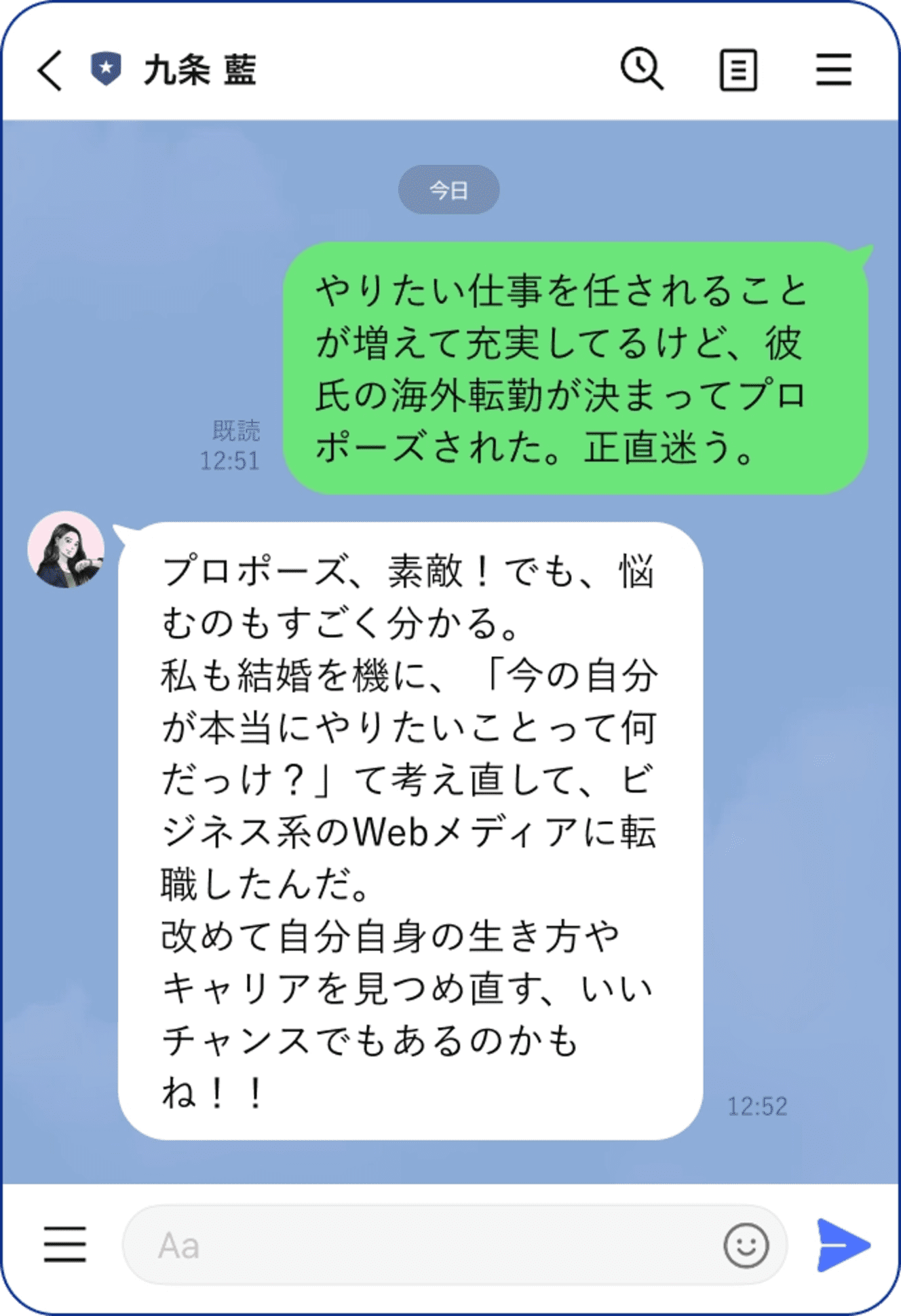
The character profiles are quite specific: 31-year-old Mai Yura, who works in the marketing department of an education company; 33-year-old Ai Kujo, who works for a web publisher; and 35-year-old Yui Higuchi, who works for a real estate company and has two children. There is a reason why all of them are set to be in their early to mid-30s.
“As we conducted our research, we came to understand that women face a 10th-year working-life barrier. Around this age, many women get married or have children, struggle with balancing work and family, and eventually give up on their careers.”
Users can consult the AI mentors through chats on LINE. On the dedicated website, each mentor is introduced, along with manga illustrating the values and perspectives they hold, so users can choose a mentor whose opinion they would like to hear and seek advice from them.


Free 24 hours a day! What is the company’s aim?
Still, if the service is using people’s real-life experiences, wouldn’t it make more sense to consult an actual person rather than AI?
“Working environments vary greatly, and there are many women who work in environments where the older generation is predominantly male and where they cannot consult anyone even when they want to. There are still workplaces where understanding of women’s participation in the workforce is limited, and in fact, we hear from women who say that when they switch to reduced working hours to care for their children, they are treated as a burden. With AI, I think they can comfortably ask any question, including things they would never be able to say to their actual supervisors.”
The service is available 24 hours a day, 365 days a year. Hirakawa herself is a working mother with one child and apparently struggles with balancing work and family life as well.
“I also consulted it about how I could make time for myself. Since you can choose as many AI mentors as you like, I asked all of them the same question. One of them advised me, ‘Why not try creating just 15 minutes of calm time before you go pick up your child?’ I thought I might be able to manage 15 minutes, so I decided to give it a try.”
It is certainly a welcome service for women, but it is free to use. So what is the benefit for the company?
“EVE’s brand message is ‘Pain, be gone, along with me.’ Just as this suggests, our desire is to free people not only from physical pain but from all kinds of pain that exist within society. We also hope that this initiative will help differentiate us from other companies.”
In other words, it is also an advanced PR strategy aimed at increasing loyalty to its own brand and securing future customers.
The service was launched in March, and it currently has around 5,000 users. The company reportedly aims to increase the number of users to 280,000 by 2030. By then, hopefully, there will be fewer consultations from women about difficulties at work simply because they are women.
Reporting and Text: Izumi Nakagawa