Can the Seibu Lions Rise Again? Hitting Coach Yoshiie Tachibana Believes They Can


“Can you comeback?”
After finishing at the bottom of the standings in 2024 and in fifth place in 2025, the Saitama Seibu Lions had endured several disappointing seasons. This year, however, the team’s offense has undergone a clear transformation and continues to perform well.
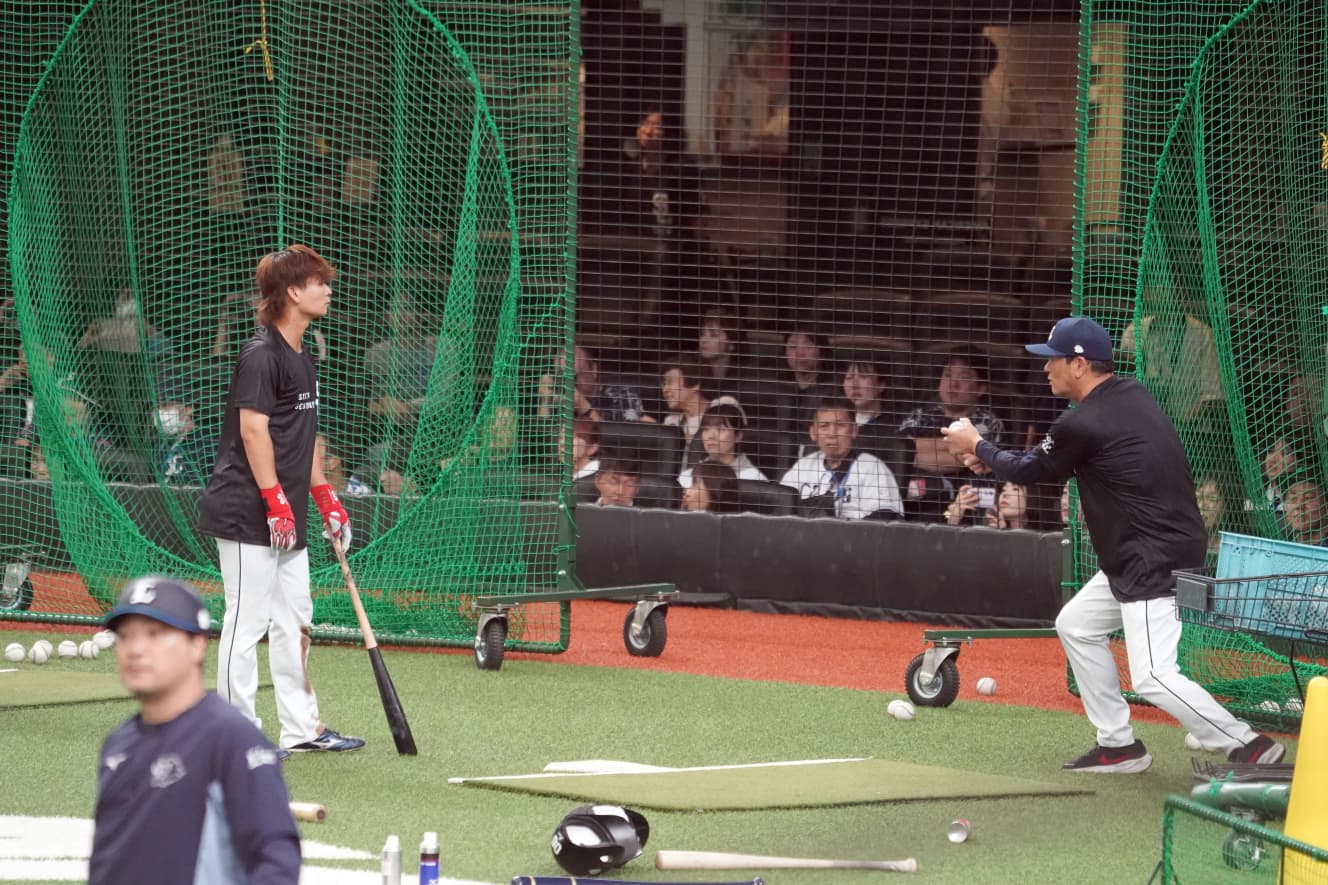
One of the driving forces behind that turnaround is hitting coach Yoshiie Tachibana (67), who returned to the organization last season.
Tachibana had been coaching the Samsung Lions in South Korea since 2023 when the Seibu Lions approached him just before the Korean league playoffs.
“Can you come back?”
With that call from the club, Tachibana returned to his former team for the first time in 18 years.
“I never imagined that I would come back to the Lions. In the end, all I can do is keep doing what I’ve always done.”
Tachibana spoke about the reasons for the team’s improved batting performance and the missing pieces needed to restore the club to the level of its golden era.
Asked why the offense has improved so dramatically after years of struggles, Tachibana pointed first to the experience accumulated by the players.
“The experience from last year has helped to some degree. More than anything, they’ve simply become accustomed to facing top-level pitchers.”
Although technical instruction remains important, Tachibana says the quality he values most is decisiveness at the plate.
“Once you’re standing in the batter’s box, there’s no time to be thinking, ‘Should I do this, or should I do that?’ The most important thing is being able to commit yourself to a particular pitch in a particular location. At the top level, you have to make adjustments on the fly. Sometimes I’ll tell players to focus on simply letting their hands do the work. You’re facing pitches that come in at 150 kilometers per hour, so if I give them too many instructions, they won’t have time to process them. What matters is whether their hands react as soon as they see the ball, and I try to teach them the mindset necessary to make that happen.”
Tachibana also credited the increased depth of the roster and the heightened sense of competition created by the arrivals of free-agent acquisitions Masashi Kuwahara (32) and Kazunari Ishii (32).
“Unfortunately, many of our players hadn’t built up much experience before now. Then players like Kuwahara and Ishii, who had already established themselves as everyday regulars, joined the team. If that inspires the younger players to fight for their places, I want to teach them how to do it.”
Tachibana reserved particular praise for Kuwahara, the gritty veteran who helped carry the team through the first half of the season before suffering an injury on April 21, at which point he was batting over .300.
“His determination to attack the ball is truly remarkable.”

It’s like watching a grandfather and his grandchildren talking
“The key is to go up there intending to hit the ball, not just watch it. Of course there will be swings and misses and foul balls, but that kind of mindset is absolutely essential. If you’re just standing there waiting, you’ll fall behind in the count before you know it.”
The defining characteristic of this season’s Lions team has been the emergence of its young talent.
Among a group of young outfielders once mockingly referred to by fans as the “Dongurizu”—a play on the Japanese expression “donguri no seikurabe,” which refers to people of roughly equal ability—the player who has become the symbol of the team’s “Break Through” slogan is Shinya Hasegawa (24). After leading interleague play in hits and winning the MVP award, he has emerged as one of the faces of the club.
Tachibana says he recognized the change in Hasegawa almost immediately.
“On the very first day of spring camp this year, I watched him hitting in the indoor practice facility and immediately noticed that he was completely different from last year. I told him, ‘You’ve got a really good swing.’ He has a deep, relaxed stance that allows his hands to move freely. Because he uses his hands so well, he can shorten or lengthen his swing as needed. Last year, his body was moving ahead of his hands, so he ended up hitting pop flies to the opposite field. This year, his hands are leading the way, which allows him to drive home runs in the direction he’s aiming.”
Tachibana also had high praise for Natsuo Takizawa (22), who has posted an outstanding batting average of over .300 while serving as the team’s No. 2 hitter.
“Natsuo has always had the ability to swing the bat with authority.”
“Last year, I told him that just because he’s fast doesn’t mean he has to keep trying to hit the ball toward shortstop. It’s perfectly fine for him to pull the ball. If pulling the ball leads to overswinging, then he can start thinking about hitting toward shortstop or third base again. By building up his approach that way, his perspective broadens. Those are the kinds of conversations we have.”
Tachibana’s frequent and enthusiastic conversations with the younger players have attracted attention on social media, where people have commented that it looks as though a grandfather is chatting with his grandchildren.
At the same time, his approach also includes the strictness necessary to instill a sense of responsibility in regular first-team players.
Tachibana recalled an incident involving Takizawa after a game in which the young infielder had failed to record a hit and was visibly disappointed. As Takizawa tried to leave without participating in the customary postgame high-fives, Tachibana stopped him.
“I told him, ‘That’s not acceptable.’ Simply being out there on the field means you’ve already fulfilled an important responsibility, so if the team wins, you need to celebrate it properly. The same goes for Hasegawa. The young players who are getting opportunities have to carry the team on their shoulders. You can’t behave like that just because you personally didn’t get a hit. I told him that because I was thinking about his future.”
Another notable characteristic of this year’s Lions team has been the exceptional offensive production from the catchers.
In addition to the improved performances of Yuto Koga (26) and Sena Tsuge (29), Tachibana says the arrival of first-round draft pick Taiga Kojima (22) has also had a significant positive effect.

Mr. Tabuchi led the way
“Catchers have an enormous amount on their plates, so I basically just tell them to go out there and enjoy hitting. I don’t give them a lot of detailed instructions about batting. Players like Yuto Koga and Taiga Kojima are hitting near the top of the lineup now. Kojima is excellent at timing his swing, and he can swing at breaking balls and fastballs in exactly the same way. He’s patient, which allows him to put up good numbers, and he has a great eye at the plate. Watching his at-bats is a lot of fun.”
As both a player during the Saitama Seibu Lions’ golden era and a coach from 2004 to 2007, Tachibana witnessed the emergence of young stars such as Hiroyuki Nakajima, Takeya Nakamura (42), and Takumi Kuriyama (42) after established players such as Alex Cabrera and Kazuhiro Wada left the team.
Asked what the current Lions team still lacks in order to build another golden era, Tachibana answered without hesitation: experience and a willingness to lead.
“During what people call the golden era, we won the games we absolutely couldn’t afford to lose. The current players haven’t experienced that yet. When I was playing, accomplished veterans such as Koichi Tabuchi were about a generation older than us, and they pushed the team forward relentlessly. All we could do was follow them. We battled one another for regular positions and fought to establish ourselves. I played with the mindset that if the guy next to me made the first team, I wouldn’t.”
During Tachibana’s playing career with the Lions from 1977 to 1991, the team was managed by legendary figures such as Rikuo Nemoto, Tatsuro Hirooka, and Masaaki Mori. During that period, the Lions won eight league championships and seven Japan Series titles, creating one of the most dominant eras in Japanese baseball history.
“At the moment, there aren’t many players who can drive the team forward with that kind of intensity. Kuwahara has come in and done his part, and Sosuke Genda (33) is working hard as well. But players like Manaya Nishikawa (27), Seiya Watanabe (23), Takizawa, and Hasegawa are already regulars despite their youth. It may be difficult, but I want those younger players to gain experience and develop the mentality needed to lead the team.”
Tachibana believes the atmosphere within the club is far from negative.
“This year, the players on the bench have been much more vocal, and everyone has stayed focused on the games. That’s why even pinch hitters and pinch runners have been able to produce results immediately.”
Asked one final question—whether the Lions’ golden era would return—Tachibana responded emphatically.
“I truly want to make this team strong again. The Lions have always been associated with strength. We played under that pressure, and we even felt it during practice. You have to possess the mental strength to overcome that pressure. That’s why I tell the younger players that they have to develop that kind of attitude. Once they become stronger mentally, the Lions will become much, much stronger.”
This season, the legendary Kuriyama reached the milestone of 2,000 career hits and is preparing to retire. When the leadership of veterans like him combines with the energy and ambition of the younger players striving to surpass them, the Lions may once again break through the competition and stand at the summit of the Pacific League—and all of Japan.




Reporting and Text: Norifumi Arakida (FRIDAY Digital Entertainment Desk)