Even With Fewer Home Runs, He’s Definitely Improving! The Amazing Batting Progress Brought About by the “Short, Heavy Bat” Chosen by Shohei Ohtani


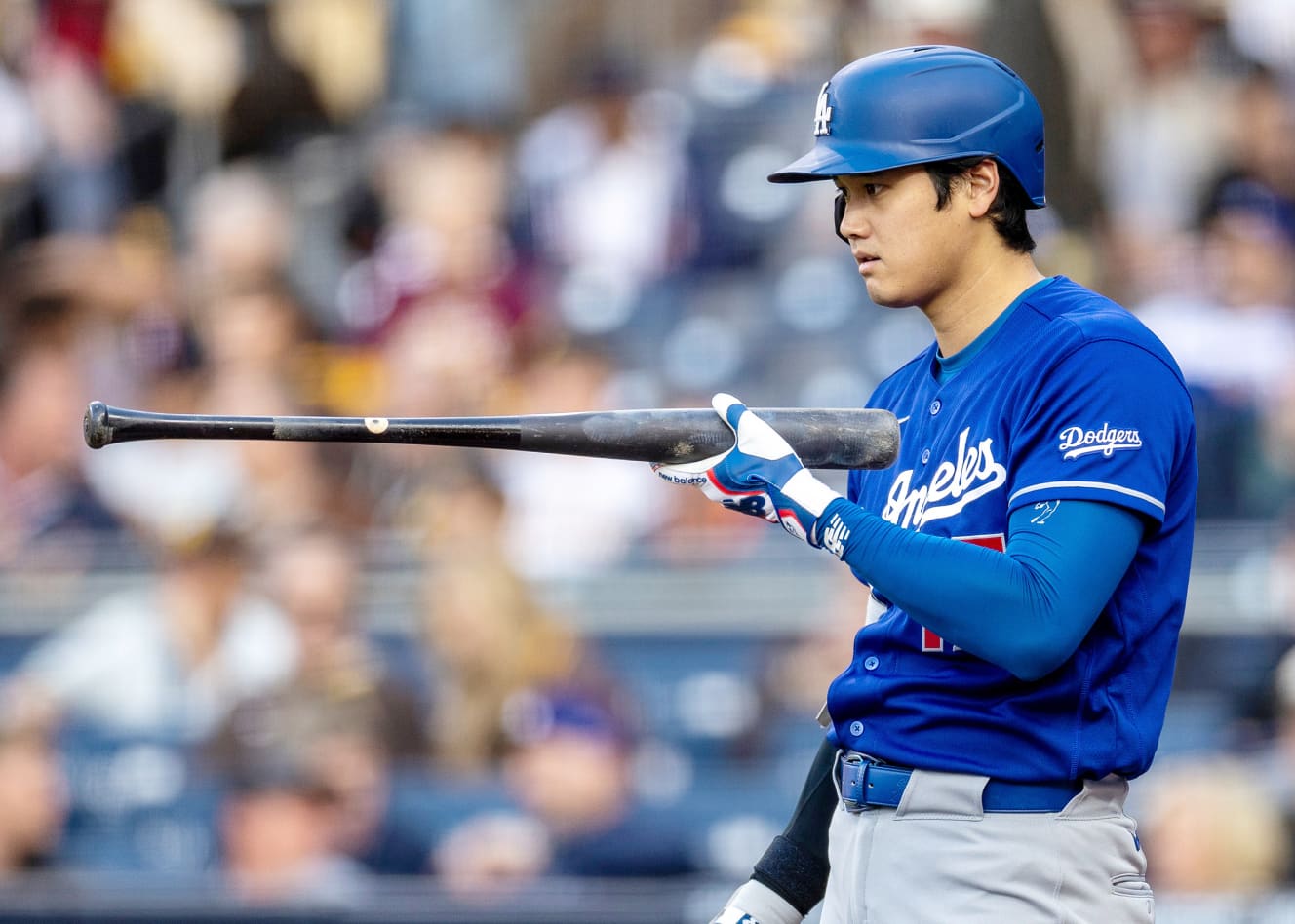
Ohtani checks the condition of his bat just before stepping into the batter’s box. Top-tier players value the compatibility with their equipment above all else.
A craftsman who works with the Samurai Japan players thoroughly analyzes the superstar’s “partner”
“Since his home run pace has slowed compared to last year, some media outlets have labeled him as being in a ‘slump,’ but in terms of his performance at the plate, he is a far more formidable hitter now,” said Takahiro Tokutsu, a professional baseball analyst.
As of the end of June (Japan Standard Time; same applies below), Shohei Ohtani (31) has recorded 18 home runs—the most on his team—and is making an overwhelming impact as the Dodgers’ main power hitter. On the other hand, since he had already hit 29 home runs at the same point last year, there are quite a few voices pointing out a decline in his power.So why is Ohtani “more fearsome” this season?
“His batting average of .297 and on-base percentage of .412 both exceed last year’s numbers.Above all, the number of at-bats where he misses the sweet spot of the bat has clearly decreased. For example, his 18th home run on June 30 came when he was down to two strikes; he crushed a pitch that came in high and inside from the ball zone with pinpoint accuracy.
Currently, Ohtani is using a slightly shorter bat and has mastered a ‘mature batting style’ that allows him to rack up hits using only 70 to 80 percent of his power” (ibid.).
Just as Mr. Tokutsu said, the superstar’s “partner”—which measured 35 inches (approx. 88.9 cm) at the start of this season—has now been shortened to 34 inches (approx. 86.4 cm). However, while the length has changed, the weight remains approximately 907 grams, the same as last season.
What is the purpose of this “short, heavy bat”? Hiroki Morisaki, a bat craftsman who also works with Samurai Japan players and the representative of “MR Bat,” explains (the following remarks are from Mr. Morisaki).
“The farther the heaviest part of the bat—the core—is from the body, the more a player tends to feel a weight greater than the actual number on the scale. In other words, even if the weight is the same, a shorter bat feels lighter in practice. This helps reduce the physical strain on the player.As he turns 32 in July, this bat is well-suited for a season in which he’s going full throttle as a two-way player. This change offers a glimpse into Ohtani’s intelligence.”
Why Shohei Ohtani’s Batting Sound Is Completely Different from That of Other NPB Players
However, shortening the bat carries the risk that centrifugal force will no longer come into play, resulting in the ball not traveling as far. In fact, quite a few fans attribute his decline in extra-base hits this season to the shorter bat…
“That’s a misconception. What matters more than the length of the bat itself is the distance from the grip to the sweet spot. Let’s assume that the sweet spot on the approximately 88.9 cm bat Ohtani used previously was located 15 cm from the tip.
Even if that bat were shortened to about 86.4 cm, moving the sweet spot 2.5 cm closer to the tip would allow centrifugal force to act just as effectively. Furthermore, because the bat is shorter, swing speed and maneuverability increase, which in turn boosts batted ball speed and contact rate.”
It is said that the special coating used on the Chandler bats Ohtani uses is what efficiently converts this formidable swing into powerful hits.
“When Ohtani hits the ball, it makes a high-pitched sound, almost like a metal bat—different from that of NPB players.Actually, this is due to the difference in the coating. In Japan, urethane coatings are the norm, and they’re suited for players with a style like that of Hiromitsu Ochiai (72), who flexes the bat to grip the ball (extending contact time) and drive it.
On the other hand, the finish on Ohtani’s bat is made from a special resin developed by Chandler as a trade secret. It is characterized by its extreme hardness, making it suitable for players like Ohtani who have a short distance from the top of the swing to impact and who “collide” with the ball to drive it.
“It’s likely that no bat currently on the market is harder than those made by Chandler. Only Ohtani—who possesses physical stature, power, and technique far beyond the norm for a Japanese player—can truly master this bat.”
As a pitcher, Ohtani has maintained an ERA in the 1.00s while already racking up eight wins. In June, he also stepped up his game as a hitter, posting phenomenal monthly stats: a .341 batting average, eight home runs, and an OPS of 1.095.Armed with his transformed “partner,” he is charging toward his fourth consecutive MVP title.
From the July 17 & 24, 2026, combined issue of *FRIDAY*
PHOTO: AFLO