Is the Nikkei at 70,000 a Bubble!? Experts Warn of the Risk of a Crash and the 4 Right Ways to Invest in the TOPIX


Why Pros Focus on the “TOPIX”
Japanese stocks have been hitting new record highs almost daily, and in June, the Nikkei 225 broke through the 70,000-yen mark for the first time in history.
According to the “Survey on the Distribution of Shareholdings” for fiscal year ’25, released by the Tokyo Stock Exchange and others on the 2nd of this month, the total number of individual shareholders reached a record high of 91.98 million.It is believed that new investors—primarily young people aiming to build wealth by utilizing NISA accounts—have entered the market to avoid missing out on the stock rally. However, with the booming stock market in full swing, there are likely quite a few people regretting, “If only I’d bought back then…” or “I’ve completely missed the boat.”
However, Kenji Matsuoka, a financial planner with a background in securities, offers the following perspective:
“ There’s no need to lament that you got a late start. No one knows when stock prices will rise or fall. Even professional investors cannot perfectly predict the so-called ‘right time to buy.’
That’s why the concept of regular investment—buying the same amount every month to diversify risk—is so important. If you have surplus funds, any time is a good time to start. In a situation like now, where specific stocks are experiencing sharp volatility, I recommend buying a ‘Japanese Stock Index’ fund, which allows you to diversify your investment across the entire market.”
Thanks in part to the popularity of NISA, index investing has now become firmly established as the standard approach to building wealth. When considering how to ride the growth of Japanese stocks, which index should you choose?
When it comes to Japan’s representative stock indices, there are two that are familiar from the news: the “Nikkei Stock Average” and the “TOPIX (Tokyo Stock Price Index).”
The “Nikkei Stock Average” is a simple average of the 225 major stocks on the Tokyo Stock Exchange Prime Market, selected by the Nikkei Inc. It is calculated by adding up the stock prices of each company and dividing by the total, so it is strongly influenced by “high-priced stocks” with high per-share prices, such as Fast Retailing and Tokyo Electron.
On the other hand, the “TOPIX” is calculated based on the “market capitalization” of a broad range of stocks listed on the Tokyo Stock Exchange’s main markets (such as the Prime Market). It can be described as a comprehensive index that reflects the overall momentum of the Japanese stock market, taking into account not only stock prices but also the number of shares outstanding.
“Professional asset managers, known as ‘institutional investors,’ do not place much weight on the Nikkei Stock Average as a benchmark (a standard for evaluating investment performance). This is because the Nikkei Average is prone to distortions—even a slight rise in the price of a specific ‘high-priced stock’ can cause the overall market index to spike dramatically.
The index that professionals continue to value and trust as a comprehensive measure of the entire Japanese stock market is the TOPIX. That has remained unchanged for a long time.”
The Nikkei Average’s Overvaluation and the Semiconductor Bubble
In the current Japanese market, which of the Nikkei 225 and the TOPIX is seeing more buying activity? A key indicator used to measure this is the “NT Ratio.” Calculated as “Nikkei 225 ÷ TOPIX,” it serves as a gauge of market strength and market imbalances.The higher this ratio is, the more it indicates that specific high-tech stocks or certain large-cap growth stocks are driving the market.
“Looking at the latest data, the NT ratio has risen to unprecedented levels, temporarily reaching a record high of 18 times. Behind this are the unusual price movements that have occurred over the past year or so.
The Nikkei 225, which stood at around 42,000 yen last September, surged by about 80 percent to the 70,000-yen range in less than a year. In contrast, the TOPIX, which was around 3,100 points last September, has risen only about 30 percent to its current level of approximately 4,000 points.
This means that only a very small number of companies comprising the Nikkei 225 have been bought up excessively, causing their stock prices to be driven up dramatically. Under normal circumstances, market forces would have kicked in to slow the rally before the gap widened this much, and the NT ratio would have declined.
According to the Bollinger Bands indicator, the gap had persisted at a level that, statistically speaking, occurs with only about a 2% probability. Although the situation is currently correcting itself, the Nikkei Average still appears significantly overvalued. This trend of correcting the distortion is likely to continue for some time.”
Despite such an abnormal divergence, why has the Nikkei Average been able to maintain its high levels? The driving force behind this is said to be specific semiconductor and IT-related stocks.
“The Nikkei 225 is still being propped up to a considerable extent by a handful of giant stocks such as SoftBank Group, Tokyo Electron, Kioxia, and Advantest. The momentum in the semiconductor sector, in particular, has been phenomenal; Kioxia, for instance, recorded an explosive surge—one that’s hard to believe at first glance—with its stock price rising more than 40-fold in just one year.
Rumors are circulating that as many as 600 Kioxia employees have seen their personal assets exceed 1 billion yen simply by holding the company’s stock.”
There is a strong sense of expectation in the market that “the semiconductor bubble will continue.” That is why, Mr. Matsuoka says, the market tolerates the Nikkei 225 being overvalued relative to the TOPIX.
“ If you’re just starting to invest in Japanese stock indices and have to choose between the Nikkei 225 and the TOPIX, those who believe ‘the momentum of semiconductor-related stocks will continue’ should buy the Nikkei 225, while those who think ‘they’ll start to fall eventually’ should buy the TOPIX.
However, I personally think it’s better to go with the TOPIX.”

TOPIX Investment Strategies to Prepare for a Market Crash
Here’s why Mr. Matsuoka recommends the TOPIX.
“ Looking at market history, the abnormal imbalance between the Nikkei 225 and the TOPIX will inevitably correct itself. The Nikkei 225, which has been overvalued beyond its true worth, will soon be pulled back to a level that reflects the actual performance of Japanese companies as a whole. Eventually, we will enter a correction phase where the two indices converge.”
Looking calmly at the outlook for stock prices in Japan and the U.S., I predict that the Nikkei Average could fall to around 60,000 yen by around September.”
If such a broad market decline occurs, the Nikkei 225—which relies heavily on specific stocks—will suffer significant damage. However, the TOPIX, which is broadly and thinly diversified across the entire market, is highly likely to experience a much milder decline. From the perspective of risk management, the TOPIX is the more advantageous choice.”
Furthermore, the Tokyo Stock Exchange’s ongoing “TOPIX Reform” will serve as a powerful tailwind for those looking to invest in Japanese stocks going forward. The TSE is revising the TOPIX selection criteria for the first time in decades, gradually excluding stocks with low liquidity and companies with few shares in circulation, while adding new, high-quality stocks that reflect the real economy.
“I believe that by revising the selection criteria, the TOPIX will evolve into a more efficient index that better reflects the reality of the Japanese economy. This is a factor that can be viewed positively.”
If you consider the moment when you have money available to invest as the “right time to start,” some people might think, “I’d rather invest in high-profile individual stocks than in an index.”
“No matter how much momentum they have, directly targeting individual stocks like Kioxia at this point is far too risky for a beginner’s investment strategy.Stocks that have skyrocketed 40-fold in a single year are, of course, subject to extreme short-term volatility, and no one can predict whether they will rise another 40-fold or plummet. This is no longer investing—it’s closer to gambling.
Moreover, individual stocks that have surged this much require several million yen just for the minimum purchase unit. For individual investors who want to buy steadily in small amounts using accounts like the New NISA, aren’t these stocks simply out of reach to begin with? ”
Four Strategies for Rethinking an All-Orkan Portfolio
It’s said that many people currently using the New NISA are investing all their assets in the “S&P 500” or “Orkan.”
Should even those who have “all-in on the S&P 500” or “all-in on the All-Country Index” consider investing in Japanese stock indices?
“Japanese corporate earnings are currently hitting record highs for the fifth consecutive year across all industries. I think few people actually realize it, but the Japanese economy is in excellent shape right now, and corporate fundamentals are very strong. It’s definitely worth reconsidering Japanese stocks as a way to diversify your portfolio.
Personally, I recommend allocating a certain amount of funds to the TOPIX index.”
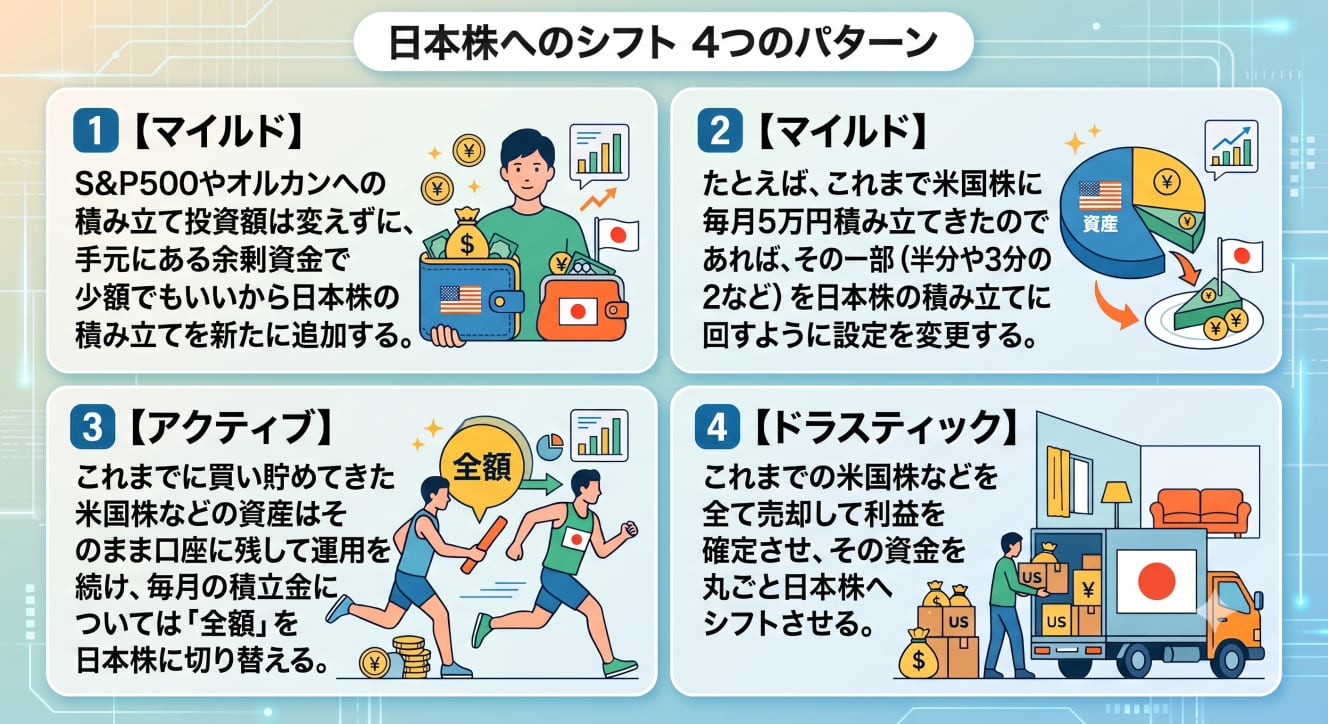
Here, we’ll introduce four patterns for “how to allocate funds” as proposed by Mr. Matsuoka.
- Pattern 1 [Mild]: Without changing the amount you’re investing in the S&P 500 or global index funds, use any surplus funds you have on hand to start a new, even small, regular investment in Japanese stocks.
- Pattern 2 [Mild]: For example, if you’ve been investing 50,000 yen monthly in U.S. stocks, adjust your settings to redirect a portion of that amount (such as half or two-thirds) toward regular investments in Japanese stocks.
- Pattern 3 [Active]: Leave the assets you’ve accumulated so far —such as U.S. stocks—in your account and continue managing them as usual, while redirecting your “entire” monthly investment amount to Japanese stocks.
- Pattern 4 [Drastic]: Sell all your existing U.S. stocks and other assets to lock in profits, then shift the entire amount of those proceeds into Japanese stocks.
“Pattern 4 is a rather bold choice, and the average person doesn’t need to force themselves to do it just to overcome psychological resistance. It’s a wise decision to choose based on ‘what you can personally tolerate.’”
The Japanese stock index that individual investors should choose is the TOPIX—the tried-and-true option that allows you to directly benefit from the solid fundamentals of the Japanese economy as a whole.If you’re regretting that you “got a late start,” you might want to reconsider a portfolio heavily weighted toward the S&P 500 or the All-Country Index, and calmly begin a regular investment plan in the TOPIX using the New NISA—all within a range of risk you can tolerate.
▼Kenji Matsuoka: Financial writer and financial planner. After working as a market analyst at a securities firm, he became independent in 1996. He writes articles on finance and asset management, primarily for business and economic magazines.His books include *The First-Year Guide to Robo-Advisor Investing* and *Easy to Understand with Plenty of Illustrations! The Book That Guarantees You’ll Save Money with Cashless Payments*.
Reporting & Text: Sayuri Saito PHOTO: Afro