[Playback ’96] “O-157 Outbreak Scandal”: We Confront Health and Welfare Minister Naoto Kan About the Government’s Slow Response!


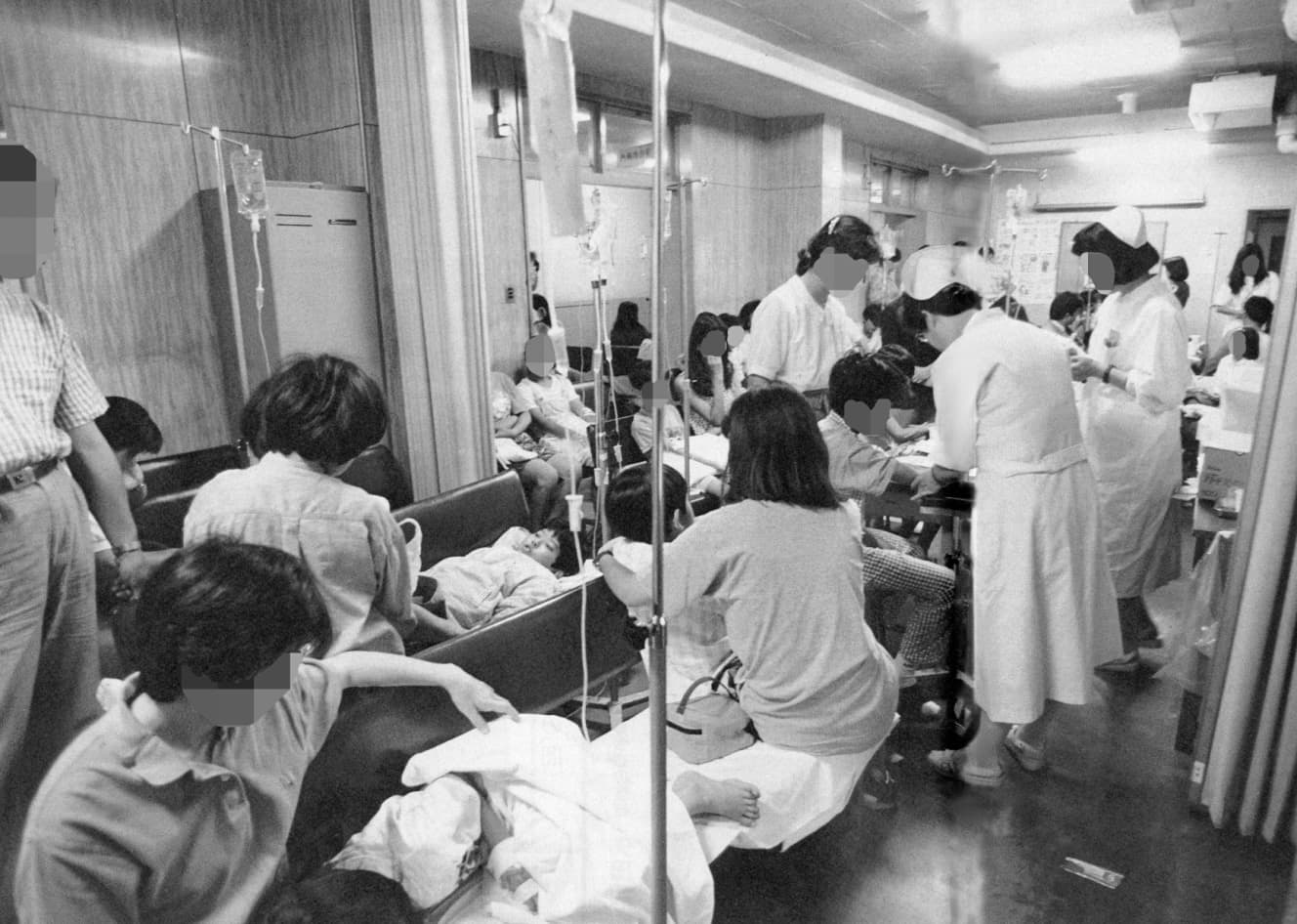
What was *FRIDAY* reporting on 10, 20, and 30 years ago? We take a look back at the topics that were in the news at the time in [Playback Friday].This time, we’re featuring the August 2, 1996, issue —*“Unprecedented Ravages: Is O-157 an Infectious Disease!? An Emergency Interview with Health Minister Naoto Kan!” *.
1996 was the year pathogenic E. coli O-157 ran rampant, shocking Japan.In late May, a mass food poisoning outbreak occurred in Oku Town, Okayama Prefecture, primarily affecting elementary school students; 416 people fell ill and two died. In June, mass food poisoning outbreaks caused by the same pathogen occurred in quick succession in various locations, including Gifu and Hiroshima.Then, on July 12, a mass food poisoning outbreak in Sakai City, Osaka Prefecture, reached an unprecedented scale, resulting in 9,528 cases and four deaths (text in 《》 is quoted from past articles; titles reflect those at the time).
School lunches for testing were not preserved
As of the August 2 issue of *FRIDAY* (on newsstands July 19), the number of patients in Sakai City had exceeded 4,000. Nationwide, the number of cases had surpassed 6,000, and it was expected that this figure would certainly continue to rise. One reason cited for the unchecked spread of the outbreak was the slow response by local authorities.Given the sequence of events, there was no doubt that school lunches were the source of the O-157 infection, yet there was no sign that the cause was being investigated.
“For example, in the mass food poisoning incident that struck schoolchildren in Sakai City, Osaka, from July 12 to 15, the school lunches suspected of being the source—despite all the commotion—had been preserved for only three days.The incubation period for O-157 is four to nine days, making it nearly impossible to trace the route of infection based solely on school lunches from three days prior. Under these circumstances, it is only natural that they would be accused of negligence.”
Experts also pointed out that “O-157, like Shigella, can cause infection with even a small number of bacteria and is transmitted from person to person, so it also has aspects of an infectious disease.” In fact, in the United States, where there was a surge in O-157 cases in 1993, the disease was designated as what Japan would call a “notifiable infectious disease.” However, the Ministry of Health and Welfare’s response was far too slow. The article states the following:
“When asked about this issue, the Ministry of Health and Welfare stated:
‘A subcommittee of the Infectious Disease Prevention Council is currently considering how to classify O-157 under the Infectious Diseases Control Law. Furthermore, since the law itself has become outdated, we are proceeding with a comprehensive review,’
” was the response. However, if it will “probably be around fall” before the details of that ‘review’ become clear, isn’t that far too late?”
*FRIDAY* also directly questioned Health and Welfare Minister Naoto Kan (currently Minister of Health, Labor, and Welfare) about designating O-157 as a communicable disease. However, this was his response:
“‘If it needs to be designated as an infectious disease, we will do so, but the key point regarding statutory infectious diseases is whether or not to isolate patients. Given that, I don’t think immediate isolation is necessary at this stage. After all, the most important thing right now is to determine the cause.’”
However, during the reporting, some experts also suggested that “humans could be a possible route of transmission.” They noted that the existence of “asymptomatic carriers”—people who show no symptoms—could be contributing to the spread of the outbreak. Since O-157 carries the risk of leaving severe long-term complications, a swift response—free from “bureaucratic red tape”—was urgently needed—.
The “Daikon Sprout Scandal” Erupts
On August 6, 1996, the Ministry of Health and Welfare designated infections caused by enterohemorrhagic E. coli, such as O-157, as notifiable infectious diseases.The ministry determined that the Food Sanitation Law, which applies to food poisoning, was insufficient to prevent secondary infections. This designation enabled the government to require municipalities and public health centers to report cases and to conduct on-site inspections of facilities suspected of being sources of infection. However, out of consideration for human rights and privacy, it was decided that patients would not be isolated.
An interim report was released the following day, July 7. An investigation into school lunches in Sakai City ultimately failed to identify the source of the infection. However, the following sentence in the report caused a major stir:
“Daikon radish sprouts shipped from a specific production facility on July 7, 8, and 9 are considered the most likely source.”
The report stated that“daikon radish sprouts shipped from a specific production facility on specific dates were identified as the most likely source of the contamination,” and that it “did not indicate any safety concerns regarding products shipped on other dates or from other facilities.”However, the phrase “most likely” was taken out of context, leading to reputational damage that caused stores nationwide to halt sales of daikon radish sprouts. The situation escalated into a scandal that resulted in producers going bankrupt or closing their businesses, and even led to suicides. The true source of the infection remains unidentified to this day.
Faced with fierce protests from daikon radish sprout producers, the government was forced to scramble to respond. On August 15, Health Minister Suga even staged a public performance in front of reporters, eating daikon radish sprouts. It is said that Minister Suga ate three packs of daikon radish sprouts topped with dressing at that time.
The 1996 O-157 outbreak served as a major catalyst for revising hygiene management standards for school lunches.HACCP, an international hygiene management system for producing safe food, has since become more widespread, and in recent years, large-scale food poisoning outbreaks caused by O-157 have been rare. However, in September 2025, a case was reported in Shimane Prefecture in which 102 people developed symptoms. The cause is believed to have been undercooked hamburger patties.

PHOTO: Jun Mayumi (1st photo), Takashi Hotta (2nd photo)