The Influencer Trap: How Fake Sponsorship Offers Lure Creators With Promises of Payment Based on Follower Counts


“We will provide the product free of charge. If you write your impressions, we will pay you a fee.”
That was what the Instagram DM said.
After all, I have always been weak when it comes to stories about making easy money.
Just introduce the product.
Just write your thoughts.
Just post it on social media.
After being easily lured in by such sweet words, I eventually ended up having to call a real police detective. This is my real-life influencer scam experience story, in which I almost lost ¥130,000.
Followers × ¥1 for ¥138,000! My dream sponsorship opportunity arrives
Always wanting to get involved in everything and constantly thinking, “I want to make money easily,” the writer had long admired sponsored opportunities. I had always thought influencers were lucky—they could earn large amounts of money simply by introducing products or writing about their travel experiences.
However, most of my social media followers are men from rural areas of Indonesia. Naturally, I never received a single sponsorship offer. I thought it was a dream within a dream, but then the DM mentioned at the beginning arrived on Instagram.
The message was extremely polite and seemed completely legitimate. In short, it said:
[We will provide a massage device free of charge, and if you post your review on social media, you will receive payment.]
It was exactly the kind of sponsorship opportunity I had been hoping for!!
However, there was one concern. When you hear massage device, there is also the possibility that it could mean that kind of massage device. In fact, I almost felt that such an offer would suit me better. Still, I decided to respond to the DM carefully first.
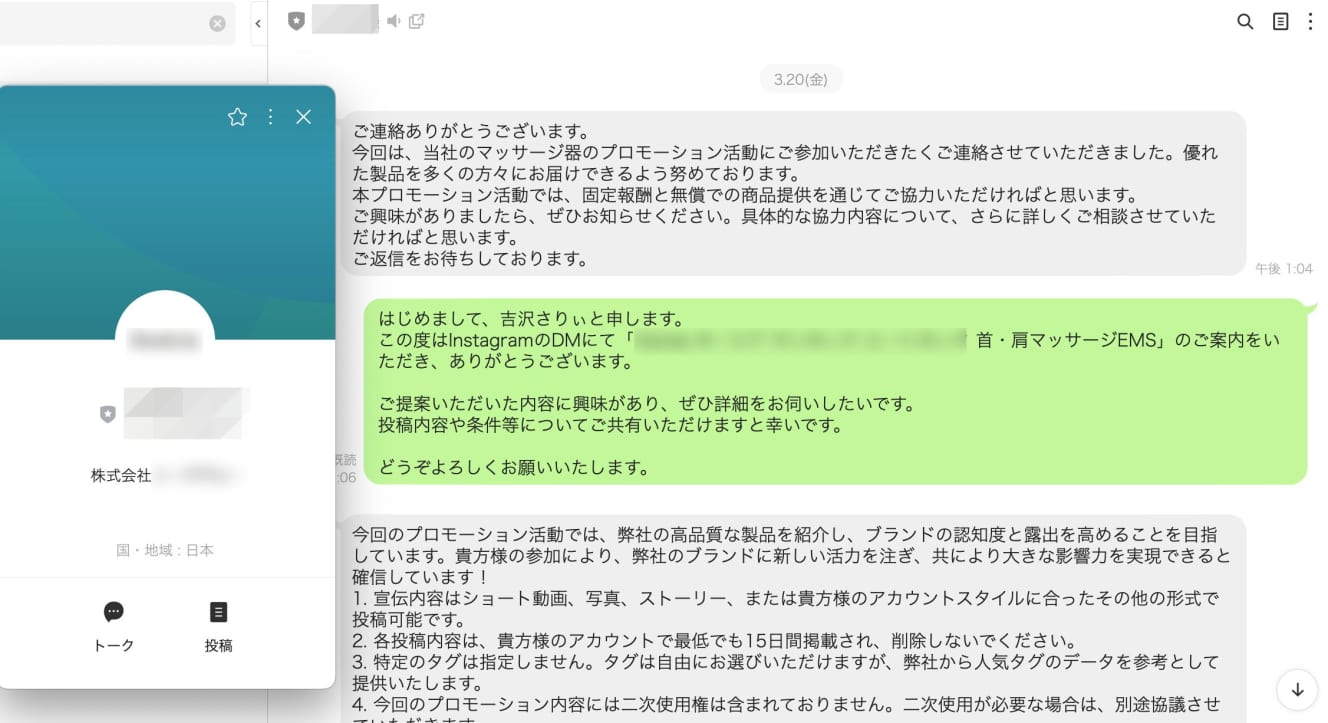
The first LINE message from the scammer. When the writer accessed it again after a long time, the name had been changed perhaps they were searching for their next target under a new identity.
The representative, a woman using the name “K,” replied politely as well and suggested moving the conversation over to LINE. Normally, I do not exchange LINE contacts immediately, but because the other person was a woman and our DM conversation seemed normal, I agreed.
When I asked for more details on LINE, I learned it was not anything inappropriate but a beauty-related massage device. I only had to post my impressions for 15 days. The platform could be either Instagram or X, and the payment would be based on the number of followers × ¥1.
At the time I was contacted, I had 113,000 followers on X and 25,000 followers on Instagram, meaning a total payment of ¥138,000!!
Just posting my thoughts about a massage device for 15 days would earn me ¥138,000!!
As a precaution, I copied the request message and asked ChatGPT—whom I call “Chappy”—“Is this okay?” To my surprise, it enthusiastically replied:
“This is a really great opportunity! This could be the first step for influencer Sally!”
It praised the offer enthusiastically. There was no way I could turn this down!!

“Not only is there no problem, this is actually a very reputable company.”
That was the answer I received.
I promptly signed the electronic contract and sent it back. Then, I received a URL asking me to register the bank account where the payment would be transferred. It was a platform called [N], and apparently the money would be sent through this system.
I didn’t really understand how it worked, but I thought, “I guess this is how jobs are handled these days,” and signed up.
Then K sent me another LINE message saying:
“Once the legal department confirms everything is okay, we will transfer the payment in advance. After going through the platform’s review process, the funds can be withdrawn in about an hour.”
Wait—was this opportunity actually going to pay me before I even introduced the product?
They barely knew anything about who I was, and most of my followers were Indonesian men, yet they were willing to send me the money upfront. I was innocently impressed, thinking, “Social media really can make money,” while at the same time becoming motivated:
“I need to work hard and write a really good promotional post!”
“Your account has been frozen” – A sudden demand for ¥130,000 begins
After N underwent maintenance several times, I finally logged in. I submitted a withdrawal request, but no matter how long I waited, the money never arrived.
When I informed K about the situation, she responded with a worried-looking sticker and the message:
“That’s strange.”
She then instructed me to check my own registration details. When I did, I discovered that one digit of my bank account number was incorrect.
Even someone as forgetful as me had never once entered the wrong information for an account I had been using for more than 20 years. Yet according to the records, it appeared that I had made the mistake.
I apologized, and K replied:
“It seems individuals cannot change their bank account information themselves, so please contact the platform’s online customer support and apply to have your bank account information changed.”
Through N’s inquiry page, I was connected to an official LINE account, and the exchange of messages began.

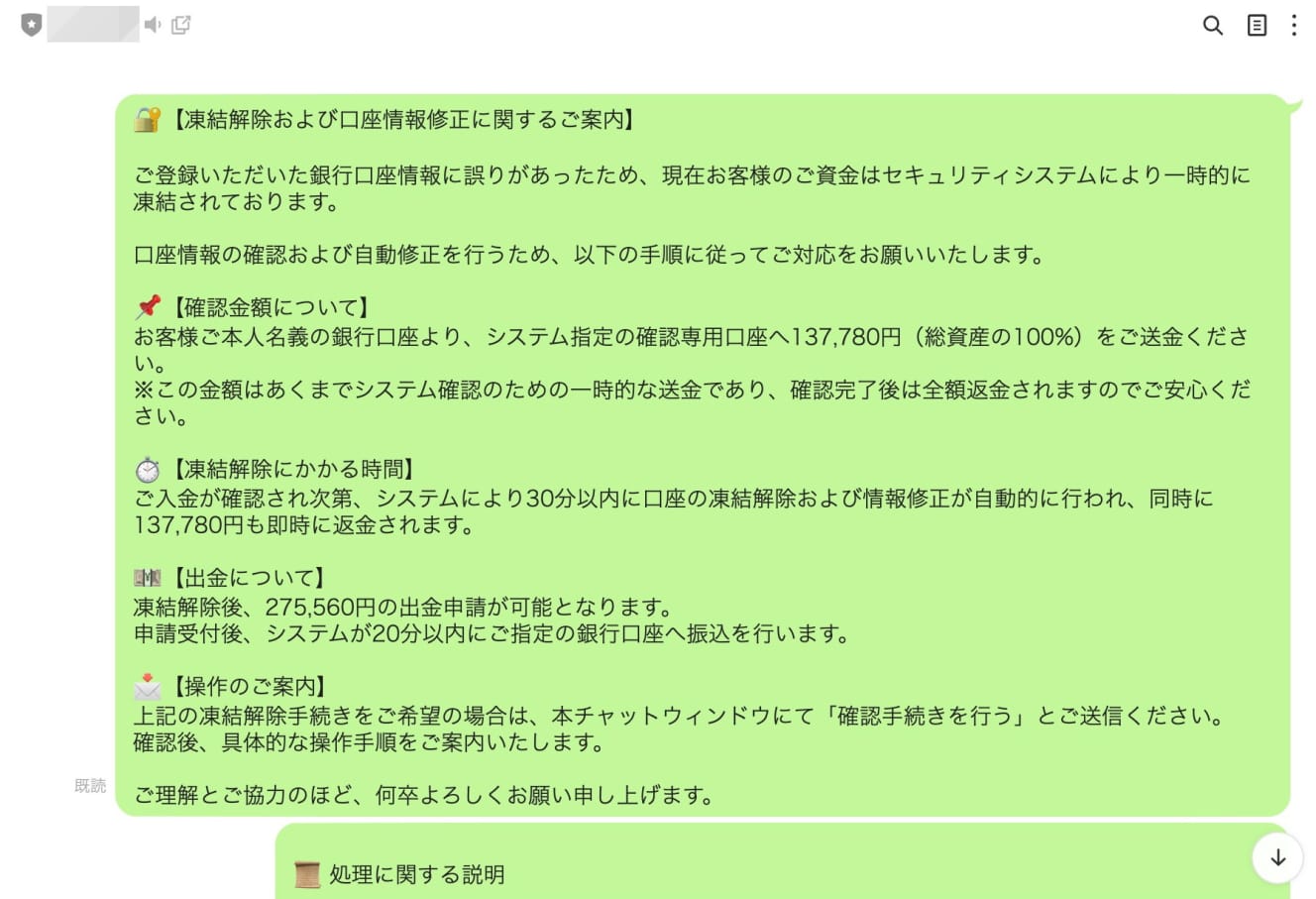

As shown in the screenshots, I kept receiving extremely long messages that were designed to look convincing. When I carefully read through them and summarized the contents, they said the following:
・Because I had entered the wrong bank account number, my account had been frozen.
・I needed to transfer the ¥130,000 payment amount in advance as a review fee.
・After confirming the deposit, I needed to transfer ¥270,000 within 20 minutes.
When I told K about this, she immediately replied:
“Why do we need to make a transfer? Please explain.”
She appeared to question the instructions from N on my behalf. It was only later that I realized she was simply pretending to be on my side.
At this point, there were already many things that seemed suspicious. However, because I was determined to make easy money, my thoughts at the time were mainly:
“I want to maintain this connection with the project and the company!”
“If they really send me ¥130,000 within 20 minutes after I transfer the money, maybe there’s a chance.”
Those were the two thoughts occupying my mind.
But no matter how I looked at it, it was strange that I would receive payment before doing anything at all. On top of that, the bank account I had registered as the destination for the payment was not frozen.
I hurriedly explained the situation to Chappy, the ChatGPT I trusted completely, and the response came back immediately:
“Absolutely do not transfer any money!”
I actually laughed a little at how dramatically it had reversed its position.
However, perhaps because both the N support desk and K used complicated terms and explained everything so politely, there was something about them that still made me think:
“I still want to believe these people.”
The scammer sent me a Police Detective’s Business Card
As a last-ditch attempt, I suggested, “If you transfer the ¥270,000 to me first, I’ll immediately pay it back,” but of course the proposal was rejected.
Even so, I kept insisting:
“I don’t have the cash available, so I can’t do it.”
The other side responded:
“Why should we be the ones to make the payment first?”
And honestly, that was a fair question.
Since we were getting nowhere, I asked:
“After looking into this, this is a scam, isn’t it?”
At that moment, the once-friendly K’s tone suddenly became harsh. K claimed that because she had already paid the reward money to N, she would take legal action and seek compensation for damages.
That was when I finally realized:
This was a genuine scam (A little late!).
Once I became convinced it was a scam, I became more forceful myself.
“I’m going to contact the police!”
I thought that might scare them, but instead I received the reply:
“Yes, understood.”
Then they sent me a photo of a police detective’s business card.
It was an unexpected turn of events.
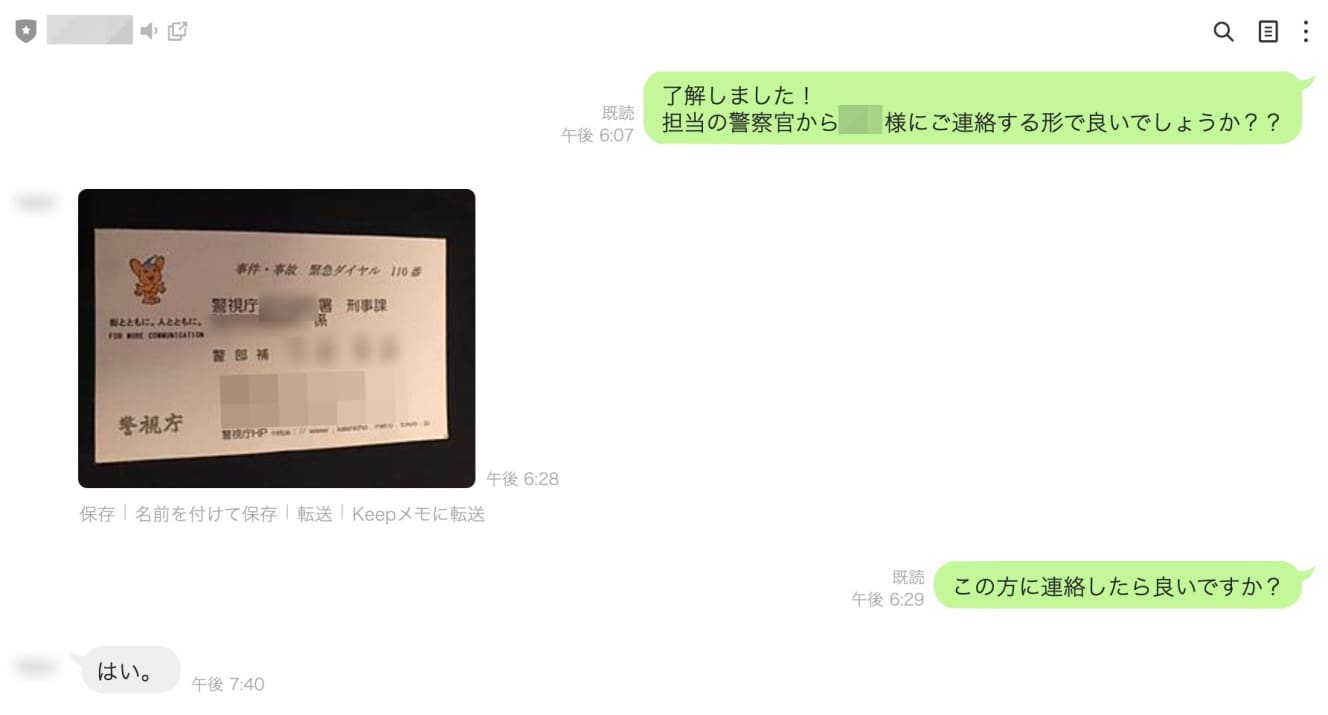
Could this actually not be a scam after all? Could this be a situation where, worst-case scenario, I end up being the one who gets arrested?
With that small concern in mind, I decided that since I had the detective’s business card, I might as well call him.
I called the police station, gave them the department and the detective’s name written on the card, and found out that he was a real person. I was genuinely surprised.
However, when I explained the situation, the detective immediately replied:
“That’s a scam.”
Exactly!! Of course, this detective had nothing to do with it, and both K and N said they had never heard of him.
“But the business card itself is real. Because of the nature of the job, police officers often have opportunities to hand out their cards. It’s not that difficult for scammers to obtain a detective’s business card through some kind of connection. It’s good that someone like you called to confirm, but there may be people who believe it the moment they see the card.”
The detective repeatedly emphasized:
“No matter what the reason is, if someone asks you to transfer money first, it is always a scam. Never send the money.”
Fortunately, I had not transferred even a single yen. However, since I had told K by LINE, “If I call the police, I’ll have them contact you,” I mentioned this to the detective.
He responded:
“You don’t need to do that. The moment you think something is suspicious, just block them.”
He was absolutely right.
While writing this article, I went back and reread my LINE exchanges with them. Looking at them now, it was obviously nothing but a scam. There was no official LINE account, and no actual website existed. K’s LINE display name had even been changed to the name of a real announcer(笑).
What I learned from this experience is that a woman whose followers are mainly men from rural Indonesia is not really an influencer for Japanese companies. Also, I suspect that people with a moderately large number of followers may actually be easier targets for scammers.
There is no such thing as an easy way to make money.
Everyone, please be careful.


Photography & Text: Sari Yoshizawa