She Feared Investing at First—Now This Homemaker Has Built a $4 Million Fortune in 8 Years


A 56-year-old housewife with no previous stock investment experience
The U.S. stock market is experiencing an unprecedented AI boom. On June 12, SpaceX, the rocket-launch and AI development company led by Elon Musk (55), made its debut on the Nasdaq market. The stock closed at $160.95, far above its IPO price of $135, giving the company a market capitalization of $2.1 trillion (approximately ¥340 trillion).
Thanks to the gains from the IPO, Musk became the world’s first trillionaire (with assets of $1 trillion, or more than ¥160 trillion), making him the richest person in the world.
In the future, massive IPOs are also expected from Anthropic, known for its generative AI Claude, and OpenAI, the company behind ChatGPT. The U.S. market is attracting attention from investors around the world, and even more global capital is expected to flow into it.
“Musk is sometimes mocked as crazy, but he has continued to create innovations one after another through companies such as Tesla and SpaceX. Now, he talks about how humanoid robots called ‘Optimus’ will enter homes and take care of household chores. He can see things that ordinary people cannot.
It is only natural that the businesses created by such a genius will grow and increase in value. I may buy more Tesla and SpaceX shares, but I will not sell them. I will continue holding these stocks because I believe in Musk’s vision and want to support his ventures.”
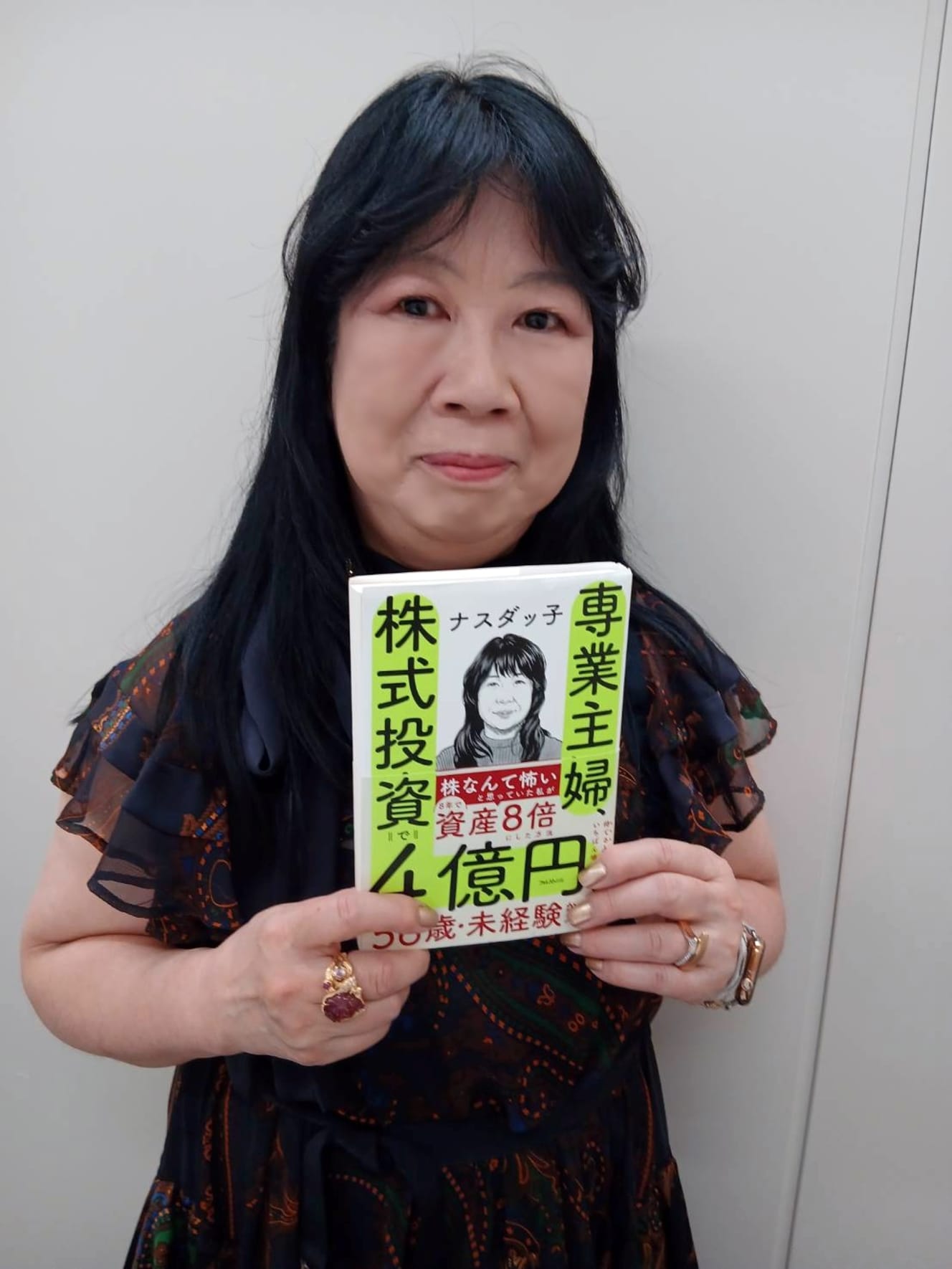
These are the words of Nasukko (65), author of “A Full-Time Housewife Earns 400 Million Yen Through Stock Investing: Starting at 56 with No Experience” (Forest Publishing).
She is a housewife investor who began investing in U.S. stocks at the age of 56 and grew her assets from ¥60 million to eight times that amount—¥400 million—in just eight years.
After graduating from junior college, she worked at a publishing company for three years before marrying a newspaper reporter who was eight years older than her at the age of 26. She supported her family by waking up at 5:30 every morning to prepare lunches.
For 30 years, she lived the life of an ordinary housewife. What sparked her interest in investing was her husband’s decision to retire at age 63 without extending his retirement.
“I’ll never panic-sell again.”
“I had accumulated ¥60 million in assets through 30 years of mutual funds, personal pensions, and other investments. Although I had already cleared the so-called ‘¥20 million retirement savings problem,’ there was still a situation where we would have no income for one year until pension payments began.
When my husband was a newspaper reporter, he was prohibited by his company from buying and selling individual stocks. They had strict ethical rules—if a family member living in the same household bought stocks, he could even be fired. After my husband retired in 2017, I started investing in U.S. stocks, but at the time I had no experience with stock investing at all. I didn’t know the basics, so I had no choice but to invest in things I was familiar with.
Amazon completely changed the way I shopped, and I couldn’t imagine returning to a life without Amazon. I decided that ‘Amazon had become part of the infrastructure of daily life and was unlikely to decline in the future.’ Although the stock price had already risen significantly, I invested ¥5 million in a lump sum.”
—Nasukko (continued below)
The core of Nasukko’s investment strategy is simple: Identify growing markets and companies, hold them for a long time, and believe in them and do not sell even during recessions.
Her current assets exceed ¥500 million, and her portfolio consists of companies such as Tesla, as well as major semiconductor firms including Nvidia and Micron Technology.
“People call it beginner’s luck, but within six months of starting, my ¥60 million grew to ¥90 million—a 1.5-fold increase. I was having the time of my life.
However, during the Christmas market crash of 2018, technology stocks fell across the board. Unable to withstand the decline, I panic-sold my Nvidia shares. I still regret that decision today. After that mistake, I swore that I would never panic-sell again.
Looking back, even the Lehman Brothers shock recovered within three years. Even companies with strong earnings can experience temporary sharp declines when events such as pandemics or wars occur. The key is not to panic when that happens. If you endure, stock prices will eventually recover. In fact, I buy more when prices fall.
By deciding from the beginning that a 30% decline is within expectations when purchasing, the chances of being emotionally shaken become much lower.”
From $12 to over $200
The company that turned Nasukko into a millionaire investor was Nvidia. For gamers who want to enjoy advanced 3D games, Nvidia’s graphics processing unit (GPU), GeForce, is an essential product.
While visiting Akihabara to buy games and electronics, or attending high-tech industry exhibitions as a hobby, she noticed that Nvidia products were being widely used. Intel was rapidly losing its dominance in PC semiconductors, and the term “AI” was gradually becoming more common. A major shift in the industry had already begun.
“At the time, Nvidia was still a company that ordinary people would ask, ‘What kind of company is that?’ Even when Toyota and Nvidia announced a partnership in 2017, the news was presented as ‘Toyota has teamed up with some mysterious company.’
Most people did not understand how impressive Nvidia was. Even those who knew about it viewed the company simply as one of the component manufacturers providing GPUs (graphics processing units) for gaming. The stock price was also affordable.”
When Nvidia first went public in 1999, its stock price was $12. Although it fell to around $6 shortly before the COVID-19 pandemic, Nvidia products became indispensable for major cloud services such as Google Cloud and Microsoft Azure, causing the stock price to skyrocket. It has since become a spectacularly successful stock, trading around $200 today.
“Nvidia Forever”
This phrase has become popular among investors.
It is a play on the chorus of Miki Douzan’s hit song “Lifetime Respect.” The phrase represents investors’ belief in Nvidia’s growth as a leader in AI and their commitment to holding the stock for the long term.
“People often ask me, ‘What is the next Nvidia?’ Until recently, I would answer, ‘Tesla.’
Musk is a visionary entrepreneur who will continue creating inventions that change the world. Nvidia itself is also still a company with tremendous future potential. Self-driving cars have not yet become commonplace, and AI and robotics still have a long way to evolve.
The challenges to achieving these goals are enormous, but there are also plans for SpaceX and Nvidia to collaborate on building data centers in space. Other planets would not have land constraints, solar energy would be endlessly available, and in the cold environment of space there would be no need for traditional cooling systems.
Nvidia has become a company that attracts some of the world’s brightest minds, so it will likely create innovations that surprise us. Eventually, people will say, ‘Was there really a time when you could buy Nvidia for $200?’”
After growing her assets to ¥500 million, Nasukko launched her own business in Aoyama, opening a showroom and salon. She also opened a snack bar on Friday nights in a building in Ginza, where she finds joy in conversations with many different people.
“Thanks to investing, I was able to make the things I wanted to do a reality. I no longer have to worry about money in retirement. From now on, I want to give back.”
Creating world-changing innovations may not be something ordinary people can do. But anyone can own shares in companies created by geniuses. Like Nasukko, perhaps there is a certain pleasure in watching the world transform while holding a stake in that change.


Reporting, Text, and Photos: Daisuke Iwasaki