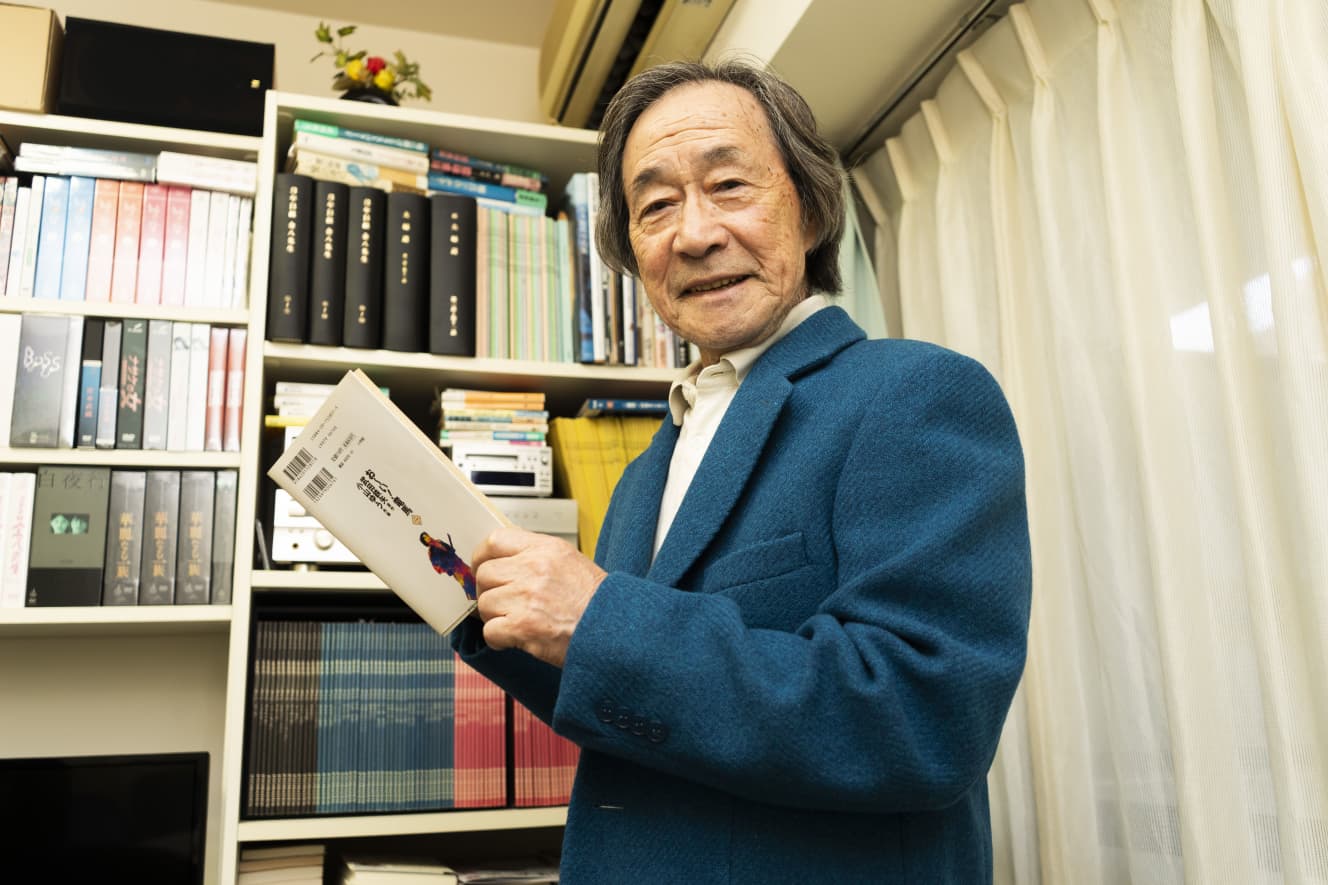
When asked about the secret to staying young, actor Tetsuya Takeda (77)—who has reached the milestone of his 77th birthday—gave a direct answer.
On May 20 this year, he released his book “Hanasake Jīsan: Jinsei Kōhan no Kyōkasho” (A Textbook for the Second Half of Life), published by Futabasha. In the book, Takeda offers his own unique perspectives on issues faced by people of his generation, including marital troubles, feelings of loneliness, forgetfulness, and worries about the future.
“The vulgarity and indecent desires that exist within ourselves actually come from surprisingly deep places. I think they are like a kind of signal transmitted from the very depths of life itself.
The same goes for bodily waste. Sometimes when you look at it, you can clearly see that it has the shape of your intestines. It’s called ‘ben’ (waste), but in a way it’s literally a message from within and something you can rely on.
The desire for erotic things may also be a message coming from inside the body.
Ignoring those messages may mean treating your own life carelessly. So, everyone should watch adult videos or look at photo books to their heart’s content and properly receive the messages your body is sending you!”
Takeda became a household name with the folk group Kaientai, and as an actor he appeared in television classics such as Class 3B Kinpachi-sensei and the 101st Proposal. Having lived through the entertainment industry from the Showa era to the Reiwa era, Takeda now looks back on his life and shares his own philosophy on how to approach aging.
“In my 60s, I thought, ‘I’m not going to lose to young people. Don’t treat me like an old man.’
But after reaching my mid-70s, I started thinking strongly, ‘In my 60s, I was just being stubborn. I’m already an old man.’
When I meet staff members I work with or old friends from my hometown who lived through the same era with the same youthful energy, they remind me where I am in my own journey through life.”
Still, quietly growing old is not Takeda’s style. At the age of 65, he began a new challenge.
“Aikido. I had always wanted to learn something new. The reason is that I often play the role of a teacher, and I’m always the one teaching others.
But in reality, it’s much more enjoyable to be the person learning something new from someone else.
At the time, I was deeply absorbed in reading the works of literary scholar Tatsuru Uchida (75), who practiced aikido himself. So I decided to go to the dojo of the teacher Uchida studied under.
This dojo is very strict. There is no special course for elderly people. People of all ages and genders train together, and there are even days when I practice against junior high school students.
I repeatedly throw and get thrown by younger people.”
At the dojo, he also encountered an unexpected connection.
“During his lifetime, Ken Takakura (died at 83) used to train there. When I first started attending, someone at the dojo asked me, ‘Were you recommended by Ken-san?’
However, not long after I began training, Ken-san passed away. I felt there was a mysterious connection there.”
Takeda made his debut in 1972 as a member of the folk band Kaientai. Although he is a veteran entertainer with more than half a century in the industry, he says there is one belief that has remained unchanged from his younger days until now.