The Hidden Ingredients Behind Moriyasu Japan’s World Cup Charge
[Aiming for the Quarterfinals! World Cup Japan National Team Support Special] The player meeting led by “Coach” Nagatomo, Kiyo Ueda’s secret training that led to a dramatic goal, and the style of “Endurance Monster” Kaishu Sano…


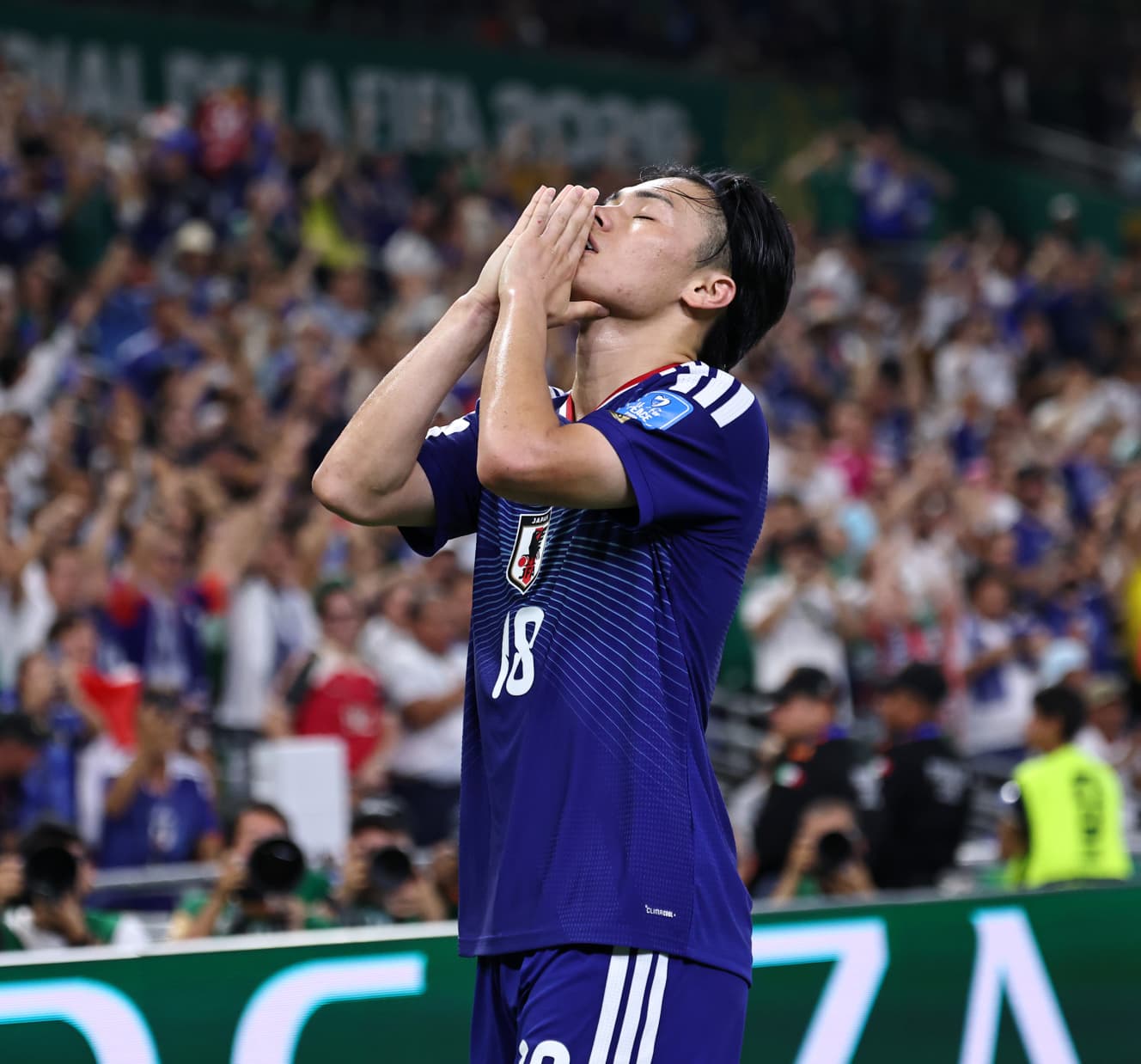
Three key figures
“Before the match against Tunisia, there was one player quietly staying on the pitch, repeatedly practicing his shooting. It was Ayase Ueda (27). From almost the exact same spot just outside the right side of the penalty area where he scored Japan’s second goal, he kept firing shots into the net with remarkable ease. He looked to be in tremendous form.”
Sports writer Yusuke Mimura, who covered Japan’s second group-stage match against Tunisia at the World Cup, recalled the ace striker’s preparations behind the emphatic victory.
There is hardly any need to revisit Japan’s 4-0 win. Even Keisuke Honda (40), serving as a commentator for Nippon TV, became so excited that his repeated catchphrase, “Ike ike dondon!” (“Keep pushing forward!”), spread across social media as fans throughout Japan celebrated the Samurai Blue’s outstanding performance.
Widely regarded as the strongest Japanese national team in history, Moriyasu’s side has continued to improve at a remarkable pace. According to Mimura, that progress can largely be attributed to three key players.
The first is the team’s ace, Ayase Ueda. He scored twice against Tunisia and was named Man of the Match, but it was the sheer power of his shooting that particularly impressed Mimura.
“Among reporters, it’s often said that ‘Ueda’s shots sound different.’ The moment he strikes the ball, you hear a deep ‘thud.’ That’s proof he’s hitting the ball with tremendous weight.
Apparently he’d been working on a new type of shot during closed training sessions. After the Tunisia match, when I asked him about it, he simply said, ‘I’ve felt good the whole time.’ He wouldn’t tell me exactly what he’d been practicing.=, but perhaps that long-range strike was the result.”
For longtime Japanese football fans, the phrase lack of finishing ability has long been a painful memory. It is unlikely to be heard during this tournament.
The team’s surge, however, has been driven by more than just improved goalscoring.
Providing a defensive shield in midfield while also contributing to the attack is Kaishu Sano (25), who assisted Ueda’s second goal and has played every minute of Japan’s first two matches. This season he ranked third in distance coveredand second in duels won in Germany’s Bundesliga, earning a reputation as a physical marvel. Yet his training philosophy is surprisingly unconventional.
“He doesn’t do weight training. His philosophy is to maximize the body’s natural power by maintaining its full range of motion, so he avoids putting on unnecessary muscle. He mainly works on stretching and strengthening the iliopsoas, which connects the upper and lower body, and exercises for the shoulder blades, which link the arms and shoulders. By improving flexibility, he reduces unnecessary energy expenditure.
Even during this tournament, you often see him spending long periods alone in the training room doing nothing more than simple stretching exercises,” said a source within the Japan Football Association.
The locker-room rallying cry
The final piece behind Japan’s surge is its mentality. Playing a crucial role is the team’s oldest player at this tournament, Yuto Nagatomo (39). When he was selected, many questioned whether he should even be on the squad, and in fact he had logged zero minutes through the first two matches. Off the pitch, however, he has become indispensable in instilling a winner’s mentality throughout the team. Sports journalist Yoshiko Ryokai explained:
“Three days before the Tunisia match, Nagatomo took the initiative in organizing a players-only meeting. Drawing on his experience from the previous four World Cups he participated in, he reminded everyone that Japan had never won its second group-stage match, and used that fact to fire up the squad.
It was the team’s second players-only meeting of the tournament, and simply holding multiple meetings during a World Cup is unprecedented for Japan. Nagatomo probably sensed that the team’s strong performance against the Netherlands had led to some complacency, while Takefusa Kubo’s (25) injury had also created uncertainty, so he wanted to settle everyone down.”
Mimura described Nagatomo’s presence as being practically that of Manager Nagatomo.
“Inspired by the veteran’s speech, the players kept repeating the same phrase in the locker room before the Tunisia match: ‘Stay focused and play with intensity from start to finish.’ It had become something of a team mantra. The way he leads the players through his own experience is exactly what you’d expect from a second manager.
After the match, I joked to him, ‘You’re basically Manager Nagatomo now, aren’t you?’ He replied modestly, ‘I just said what I felt needed to be said. Maybe I’ve grown up a little.’ Deep down, I’m sure he wants to be playing himself, but instead he has put the team first and devoted himself to supporting everyone else. There’s no doubt that Nagatomo’s selflessness was a major factor behind Japan’s convincing victory.”
With improvements on both sides of the ball and a stronger mentality to match, Moriyasu Japan has become the complete package. Their rallying cry of “Full steam ahead!” (Ike ike dondon) won’t end until they break through the quarterfinal barrier and reach the summit of world football.
From the July 10, 2026 issue of “FRIDAY”
PHOTO: JMPA