The New NISA Boom Is Fueling a New Kind of Point-Hunting—Which Rewards Ecosystem Wins?


“Shareholder Perk Point-Hacking” in the New NISA Era
In May 2026, Mitsui Sumitomo Financial Group (SMFG) announced a new shareholder benefit program that awards V Points to shareholders who meet certain eligibility requirements.
With soaring prices and the ongoing New NISA investment boom, simply collecting points through everyday spending is no longer enough. A new trend is emerging: shareholder perk point-hacking—earning points by investing in stocks that offer shareholder benefits in addition to your daily shopping.
Traditional point-hacking is easy to get into, but it can also tempt people into making unnecessary purchases just to earn rewards. Shareholder perk point-hacking, however, simply requires buying eligible stocks using vehicles such as the New NISA Growth Investment Account. The biggest appeal is being able to enjoy tax-free benefits such as reward points and dividends while receiving perks with minimal effort.
As the once-unrivaled Rakuten ecosystem begins to lose its dominance, which of the five major points ecosystems—Docomo, au, SoftBank (PayPay), and the rapidly closing Mitsui Sumitomo (V Points)—now offers the best value? We take an in-depth look at the strongest points ecosystem and the must-have credit cards that could transform your everyday finances.
Is Rakuten’s One-Company Dominance Over? The Current State of Japan’s Five Major Points Ecosystems
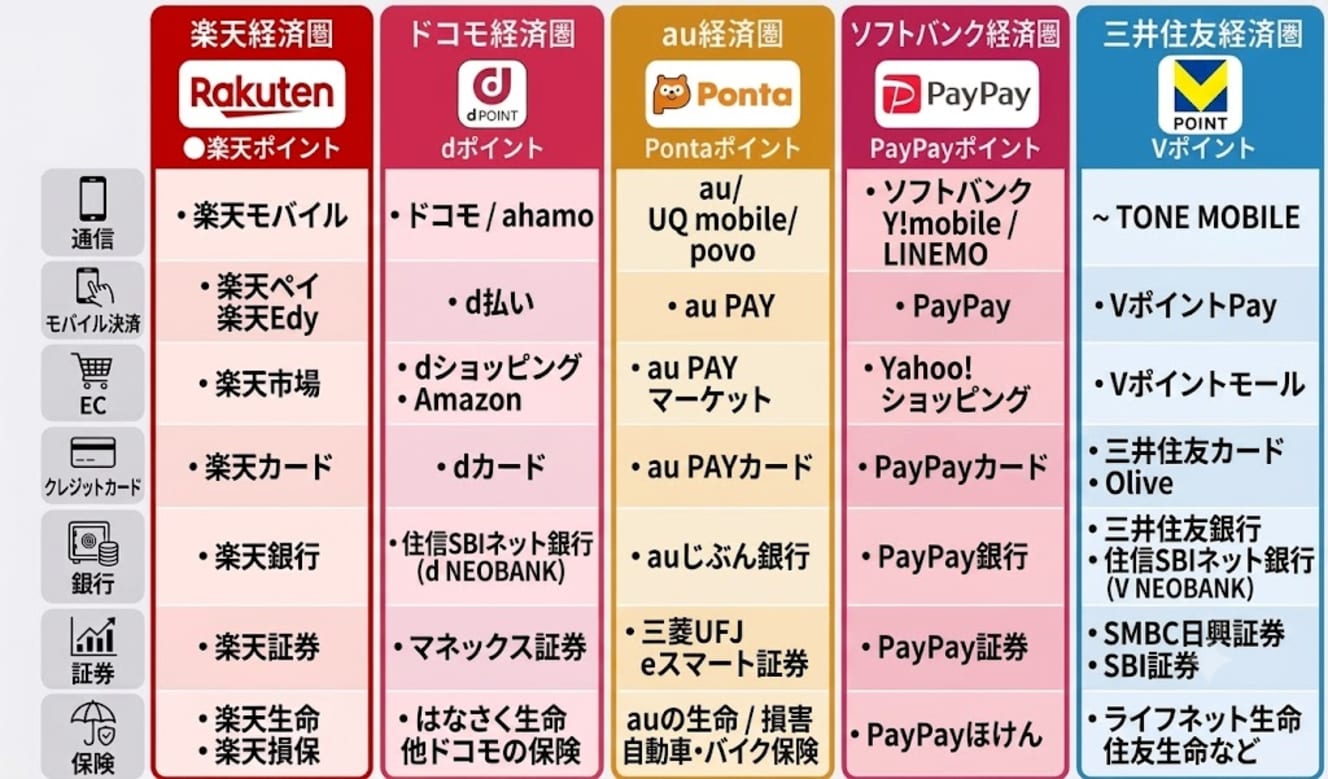
The five major points ecosystems—Rakuten (Rakuten Points), Docomo (d Points), au (Ponta Points), SoftBank (PayPay Points), and Mitsui Sumitomo (V Points)—each offer a broad range of services, from payment services (mobile payments and credit cards) to financial services (banking, securities, and insurance), telecommunications, and retail/services (e-commerce, reservation sites, etc.).
Because each ecosystem has different strengths, it’s best to choose your primary ecosystem based on the services you use most frequently, such as your mobile carrier, credit card, or bank.
◇ Rakuten Ecosystem (Rakuten Points) — Recommended for frequent online shoppers
This ecosystem is centered on Rakuten Group services such as Rakuten Ichiba (Rakuten Market) and Rakuten Card. Its biggest advantages are the breadth of its services and its high point-reward rates.
By using eligible Rakuten Group services such as Rakuten Card and Rakuten Mobile and meeting the required conditions under the SPU (Super Point Up Program), users can dramatically increase the point-reward rate on purchases made through Rakuten Ichiba.
◇ Docomo Ecosystem (d Points) — Recommended for Docomo users
This ecosystem revolves around Docomo Group services such as Docomo and d Card.
Paying your Docomo mobile phone bill with a d Card earns 1% to as much as 20% cashback, providing particularly generous rewards for Docomo subscribers.
At d Point partner stores such as Lawson, FamilyMart, and Matsumoto Kiyoshi, users can efficiently accumulate points by combining d Card, d Barai (d Payment), and the d Point Card.
In recent years, Docomo has also brought Monex Securities and Sumishin SBI Net Bank into its group, significantly strengthening what had previously been its weaker financial services.
◇ au Ecosystem (Ponta Points) — Recommended for au users and heavy subscription-service users
This ecosystem centers on KDDI Group services such as au and au PAY.
Linking telecommunications services with au PAY Card, au PAY, and au Jibun Bank increases the reward rate.
Benefits for au customers are particularly generous, including the exclusive Money Activity Plan (Manekatsu Plan) and rewards of up to 10% for paying au/UQ mobile service fees with an au PAY Gold Card.
There are also plans that provide up to 20% point rewards on monthly subscription fees when au/UQ mobile users sign up for eligible services such as Netflix and YouTube Premium, making this ecosystem especially attractive for heavy subscription users.
◇ PayPay (SoftBank) Ecosystem (PayPay Points) — Recommended for SoftBank/Y!mobile users and people who frequently make cashless payments in stores
This ecosystem is centered on SoftBank Group services such as PayPay, SoftBank, and Yahoo!.
PayPay is accepted at a wide variety of merchants, from convenience stores to independent local shops, making it particularly convenient for everyday cashless payments.
By linking services such as PayPay Card, PayPay Bank, and Yahoo! Shopping, users can boost their point-reward rates.
SoftBank and Y!mobile customers can also join LYP Premium—which normally costs ¥508 per month (tax included)—free of charge. Membership includes benefits such as higher Yahoo! Shopping reward rates, PayPay coupons usable at nearby stores, and free LINE stickers.
◇ Mitsui Sumitomo Ecosystem (V Points) — Recommended for frequent convenience store shoppers and people who want to earn points through investing and asset management
This ecosystem is centered on SMBC Group services such as Mitsui Sumitomo Card.
Its greatest strength lies in financial services, including SBI Securities, allowing users to accumulate points efficiently while building their investment portfolios.
In 2024, V Points merged with T Points, greatly expanding the number of participating stores and services where points can be earned and redeemed.
Using Mitsui Sumitomo Card or Olive (SMBC Group’s all-in-one card) for contactless payments or mobile ordering at participating convenience stores and restaurants earns 8% cashback. By meeting additional qualifying conditions—such as using eligible services—the reward rate can increase to as much as 20%.
In March 2026, V Points became mutually exchangeable with PayPay Points, making it much easier for users to take advantage of both ecosystems simultaneously.
The Five Major Ecosystems: Comparing the Essential Credit Cards
To earn points efficiently, using a credit card is essential. In particular, credit card mutual fund investing—making regular mutual fund purchases by credit card—has become a powerful way to accumulate points automatically every month.
◇ Rakuten Card (Rakuten Ecosystem)
The base reward rate is 1.0% across all Rakuten Cards (0.2% for public utility payments and taxes, 0.5% for insurance premiums and mobile phone bills).
Using a Rakuten Card qualifies users for an additional 2x multiplier (the standard rate plus bonus points) under Rakuten Ichiba’s SPU (Super Point Up Program). Other SPU bonuses include +0.3x for paying via direct debit from a Rakuten Bank account.
For credit card mutual fund investments through Rakuten Securities, the point reward rate ranges from 0.5% to 2.0%, with higher-tier cards earning higher reward rates.

◇ d Card (Docomo Ecosystem)
The base reward rate is 1.0% (0.5% for utility payments and similar charges).
Paying your Docomo mobile phone bill with a d Card earns 1% cashback with the standard card and up to 20% cashback with the d Card PLATINUM (however, ahamo users are not eligible for this benefit).
At participating d Card partner merchants, users can receive up to 6% in point rewards as well as discounts of up to 20%.
For credit card mutual fund investing through Monex Securities, the reward rate ranges from 0.2% to 3.1%, depending on the card tier and the monthly investment amount. Preferential rates are available for investments made through NISA accounts.

◇ au PAY Card (au Ecosystem)
The base reward rate is 1.0%, including for utility payments.
Rewards can be accumulated across a wide range of au-related services, including: Up to 10% cashback at au PAY Market; Jibun Plus, which offers up to 15 points per month for payments debited from an au Jibun Bank account, plus an additional 0.05% on deposit interest; Up to 2% cashback for using au Denki and au Gas; and an additional 1% for payments of various au insurance premiums.
The au PAY Gold Card (annual fee: ¥11,000, tax included) offers even greater benefits, including up to 10% cashbackon charges for au/UQ mobile, au Hikari, and other eligible services, as well as up to 5.5% cashback on automatic top-ups to au PAY (capped at 1,000 points per month).
For credit card mutual fund investing through Mitsubishi UFJ eSmart Securities, the reward rate ranges from 0.5% to 1.0%, and can increase to as much as 2.0% if certain conditions are met.

◇ PayPay Card (PayPay Ecosystem)
The base reward rate is 1.0% (0.5% for utility payments and similar charges).
Completing the PayPay Step requirements—making 30 or more payments of at least ¥200 each and spending a total of ¥100,000 or more during the qualifying period—earns an additional 0.5% in rewards.
Users can earn: Up to 5% cashback every day at Yahoo! Shopping and LOHACO (requires linking a LINE account); Up to 9% cashback on days ending in 5 (the 5th, 15th, and 25th of each month); and 1% (standard card) to as much as 10% (Gold Card) when paying charges for SoftBank, Y!mobile, SoftBank Hikari, or SoftBank Air services.
For credit card mutual fund investing through PayPay Securities, both the standard and Gold cards offer a 0.7%reward rate.
Gold Card holders also receive 6,000 bonus points after spending ¥1 million or more annually. Combined with the 5,000-point sign-up bonus, this effectively offsets the first year’s annual fee.

◇ Olive (Mitsui Sumitomo Ecosystem)
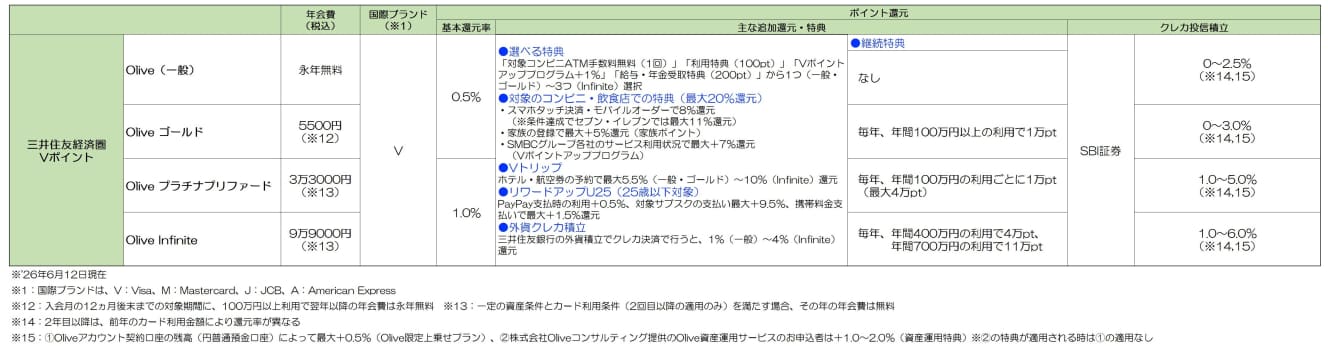
The base reward rate is 0.5% for the Standard and Gold cards, and 1.0% for the Platinum Preferred and Infinite cards (the same rates also apply to utility payments).
Rewards are particularly generous at participating convenience stores and restaurants. In addition to 8% cashback when using smartphone contactless payment or mobile ordering, cardholders can earn up to 20% cashback by meeting certain qualifying conditions.
Cardholders under the age of 25 are also eligible for Reward Up U25, which offers: an additional 0.5% when paying with PayPay; up to +9.5% on eligible subscription service payments; and up to +1.5% on mobile phone bill payments.
For credit card mutual fund investing through SBI Securities, the reward rate can reach as high as 6.0%, depending on factors such as the card tier, monthly card spending, and the amount of assets on deposit.
Gold-tier cards and above also offer attractive ongoing benefits. For example: Gold Card: 10,000 bonus points for annual spending of ¥1 million or more. Platinum Preferred: 10,000 bonus points for every ¥1 million spent annually, up to a maximum of 40,000 points.
In addition, Gold Card holders who spend ¥1 million or more during the eligible period ending 12 months after the month of enrollment will have the card’s annual fee waived permanently from the following year onward.
The Appeal—and Hidden Pitfalls—of Point-Based Shareholder Benefits
With the exception of Rakuten, the core publicly listed companies in each of the major points ecosystems offer their own reward points (or, in some cases, electronic money) as shareholder benefits. All of these shareholder benefit programs require continuous ownership for at least one year (two years in NTT’s case), making them incentives for long-term investing.
◇ NTT (9432) – d Points (Docomo Ecosystem)
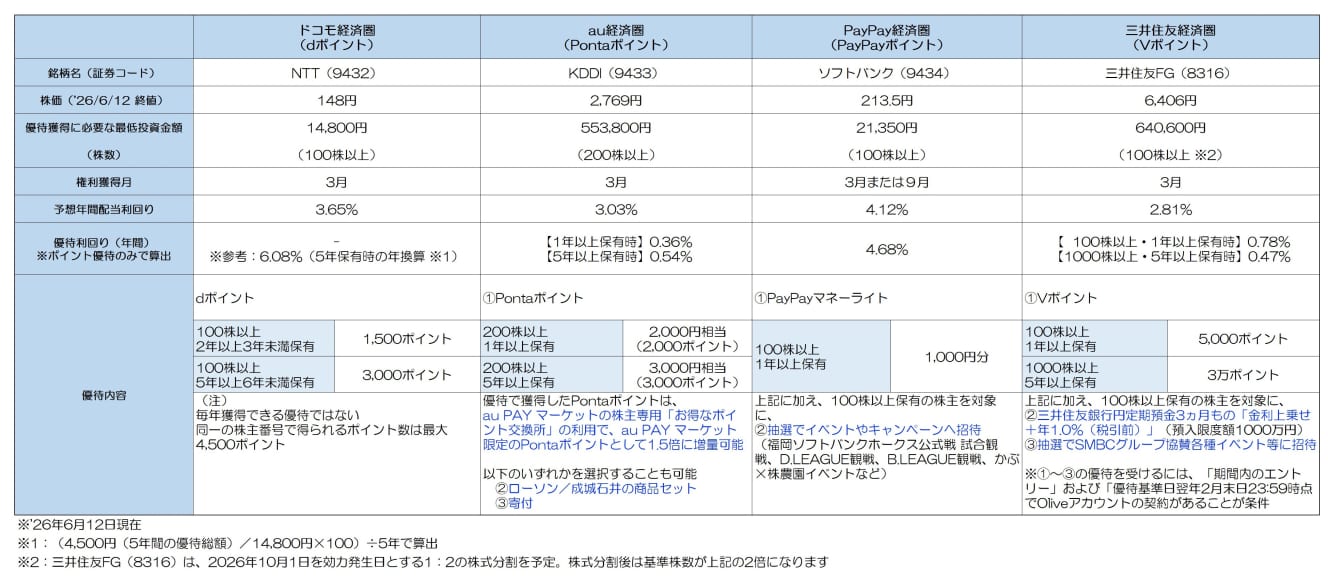
Shareholders who own 100 or more shares of NTT (9432) continuously for at least two years but less than three yearsreceive 1,500 d Points. Those who hold their shares for at least five years but less than six years receive 3,000 d Points.
Since the share price trades at around ¥150, the investment required to qualify for the shareholder benefit is approximately ¥15,000, making it relatively accessible.
However, investors should note that this is not a benefit that can be claimed every year through continuous ownership. Under the same shareholder registration number, the benefit is only awarded twice—once in the second year and again in the fifth year—for a maximum total of 4,500 points. After receiving the fifth-year benefit, shareholders will not be eligible again unless they change their shareholder registration number, such as by selling all of their shares and later repurchasing them.
The projected annual dividend is ¥5.40 per share, for an estimated dividend yield of 3.65%.
◇ KDDI (9433) – Ponta Points (au Ecosystem)
Shareholders who own 200 or more shares of KDDI (9433) continuously for at least one year receive 2,000 Ponta Points, while those who hold them for five years or more receive 3,000 Ponta Points.
The investment required to qualify is approximately ¥550,000. The shareholder benefit yield is 0.36% after one year of continuous ownership and 0.54% after five years.
Ponta Points received through the shareholder benefit can be exchanged through the shareholders-only exchange portalfor au PAY Market-exclusive Ponta Points worth 1.5 times their original value. Alternatively, shareholders may choose a Lawson/Seijo Ishii product assortment or make a charitable donation instead of receiving Ponta Points.
The projected annual dividend is ¥84 per share, representing a dividend yield of 3.03%.
◇ SoftBank (9434) – PayPay Money Lite (PayPay Ecosystem)
Shareholders who own 100 or more shares of SoftBank (9434) continuously for at least one year receive ¥1,000 worth of PayPay Money Lite.
The investment required to qualify is approximately ¥20,000, and the shareholder benefit yield is 4.68%.
Because PayPay Money Lite can be used as a PayPay balance for purchases and transfers, it is more versatile than PayPay Points, which cannot be transferred to other users.
The projected annual dividend is ¥8.80 per share, for an estimated dividend yield of 4.12%.
In addition to PayPay Money Lite, shareholders with 100 or more shares are also eligible for drawings to receive invitations to events and campaigns, including Fukuoka SoftBank Hawks official games.
◇ Mitsui Sumitomo Financial Group (8316) – V Points (Mitsui Sumitomo Ecosystem)
Shareholders who own 100 or more shares of Mitsui Sumitomo Financial Group (8316) continuously for at least one year receive 5,000 V Points. Those who own 1,000 or more shares continuously for five years or more receive 30,000 V Points.
Purchasing 100 shares requires an investment of approximately ¥640,000, and the shareholder benefit yield after one year of continuous ownership is 0.78%.
The projected annual dividend is ¥180 per share, representing a dividend yield of 2.81%.
Shareholders with 100 or more shares are also eligible for additional benefits, including a 1.0% annual (pre-tax) interest rate bonus on three-month yen time deposits at Sumitomo Mitsui Banking Corporation (up to ¥10 millionin deposits), as well as entry into prize drawings for invitations to SMBC Group-sponsored events.
To receive these additional benefits, shareholders must register during the designated application period and have an active Olive account as of the end of February in the year following the shareholder record date.
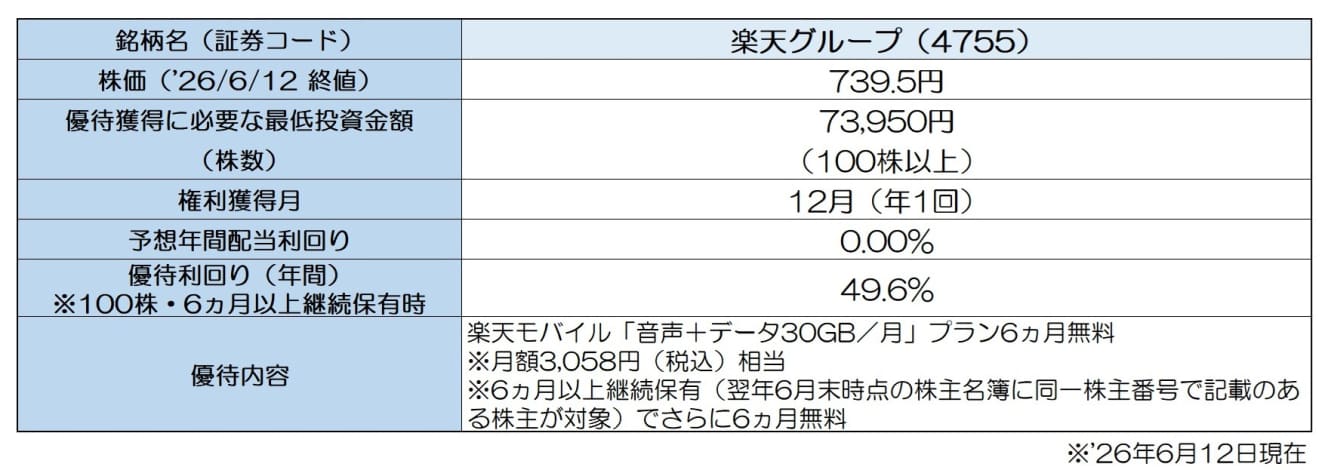
◇ Rakuten Group (4755) Offers Free Rakuten Mobile Service Instead of Point Rewards (Rakuten Ecosystem)
Reporting & Text: Hiroki Takekuni
Financial Planner / Representative, Rapport Consulting Office.After graduating from the Faculty of Engineering at Nagoya University, he worked at a securities firm and an insurance agency before going independent. Through financial consultations and writing and supervising articles, he supports people in thinking for themselves and taking action regarding their financial matters. He holds certifications as a Level 1 Financial Planning Specialist, CFP®, Real Estate Transaction Specialist, and Sauna & Spa Professional.
PHOTO: Afro