Japanese Knives in Global Demand Boom as Master Craftsmen Edge Toward Extinction


Foreign buyers go on a shopping spree! The mystery behind the popularity of Japanese kitchen knives
“Japanese kitchen knives,” which trace their origins back to the tradition of Japanese sword-making, are highly regarded not only in Japan but also by Michelin-starred chefs and other culinary professionals around the world for their sharpness. Increasing inbound tourism has also helped expand demand.
Kappabashi Tool Street, a specialty district for cooking utensils located between Ueno and Asakusa in Tokyo, used to rarely see foreign visitors. Recently, however, tourists carrying suitcases can be seen walking everywhere. Knife specialty stores are crowded with foreign customers inside.
Japanese knives booming amid weak yen and inbound tourism
The industry producing these kitchen knives is currently thriving. According to Tokyo Shoko Research (TSR), which analyzed 38 companies with five consecutive years of comparable financial results, total sales reached 16.733 billion yen (up 2.5% from the previous year), and profits reached 623 million yen (up 44.5%).
Regarding the sharp increase in profits despite only a modest rise in sales, Yuudai Kobayashi of TSR’s Information Department points out that a major factor is one company’s significant profit surge and return to profitability. In addition, for foreign buyers, the weak yen makes products cheaper, which likely boosts demand for higher-priced knives among inbound tourists.
He also notes that demand increased during the COVID-19 stay-at-home period, when people began reevaluating household goods, and that knives being offered as regional furusato tax gifts has also helped the industry. Kobayashi analyzes:
“Foreign tourists often visit retail shops, check how knives feel in hand, look at their design, and even try their cutting performance before purchasing. Sales channels are also expanding—such as selling in electronics stores in popular tourist areas, setting up shops in seafood markets, and encouraging purchases through cooking experiences.”
High-end Japanese knives selling extremely well at tens of thousands of yen
Among many small businesses in the knife industry, one major company actively expanding overseas is Kai Corporation (Chiyoda, Tokyo). On its online store, its flagship “Sekimagoroku” series ranges from several thousand yen to over 10,000 yen, while its premium “Shun” series typically costs 20,000–30,000 yen, with some items exceeding 70,000 yen.
The “Shun” series began overseas sales in the United States and Europe in 2000, and around 90% of its sales now come from overseas, mainly the U.S. It has also received high praise abroad, including winning the U.S. knife industry’s top award, “Kitchen Knife of the Year,” 12 times.
Sakai City in Osaka Prefecture is one of Japan’s six major cutlery production regions. A representative from the Sakai Traditional Crafts Museum commented:
“We display and sell products from over 20 companies, allowing customers to compare and choose. Since these are not cheap items, people can actually see, hold, and then decide on their purchase.”
During the COVID-19 pandemic, the number of foreign visitors dropped sharply, but efforts to promote information through social media helped revive the popularity of knives. Currently, knives priced around 20,000–30,000 yen are especially popular among foreign tourists.
A representative of the Sakai Tourism and Convention Association also expressed confidence:
“There is a global trend toward authentic, high-quality products. Visitors from overseas come specifically seeking high-quality knives.”
According to the association’s website, cutlery production includes both hand-forged “uchi-hamono” and machine-stamped products. Sakai specializes in hand-forged cutlery. These knives are crafted through fire, iron, and water, and the production process is divided into forging, sharpening (edge finishing), and handle attachment. A steel blade is layered onto heated soft iron at around 1,000°C, hammered and stretched to form the knife’s base shape. Such Sakai-made knives are trusted by professional chefs and are gaining attention from culinary experts worldwide.
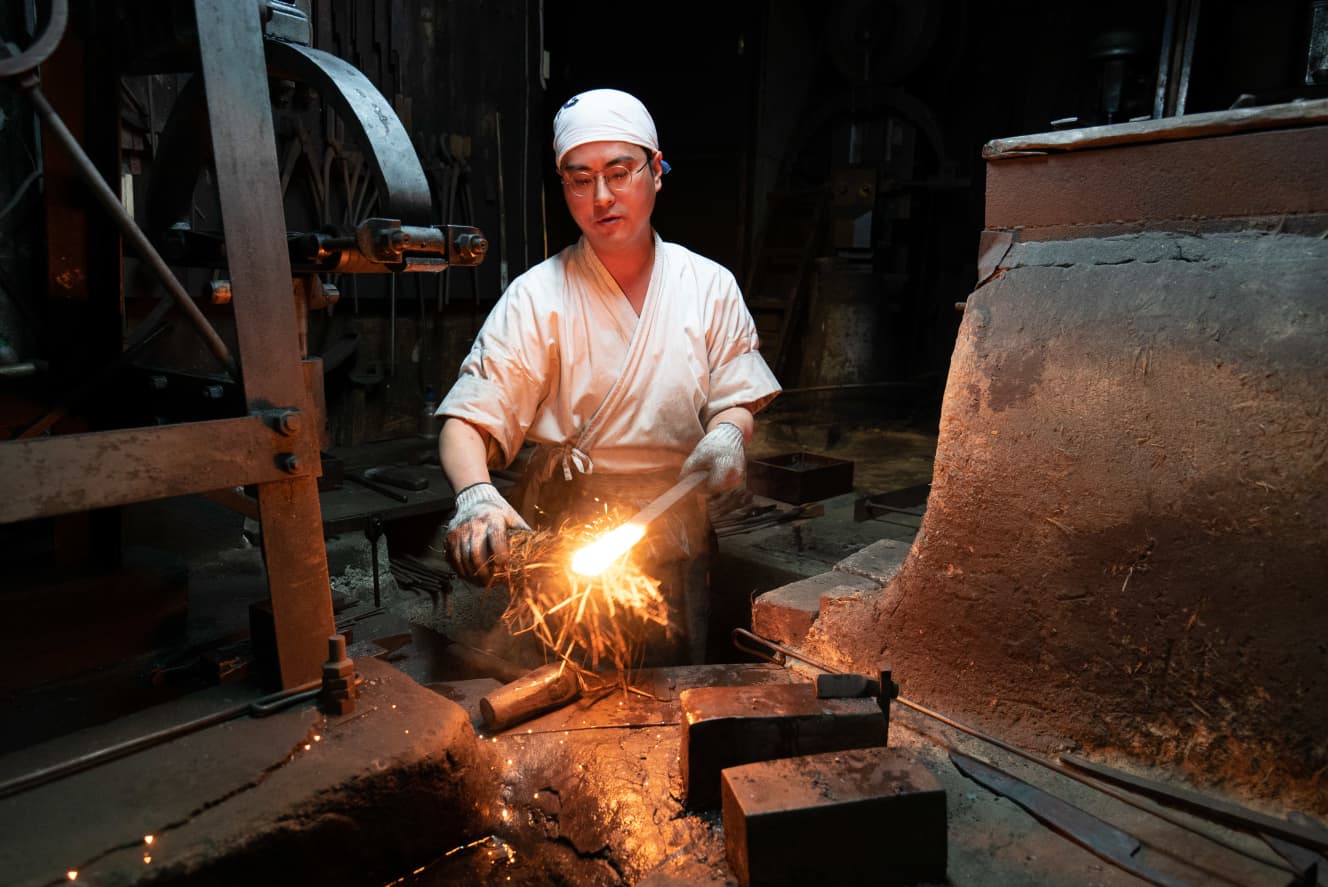
The overwhelming sharpness that captivates the world
One of Japan’s six major cutlery production regions is Seki City in Gifu Prefecture. Regarding the background behind why Japanese kitchen knives have gained global recognition, a representative of the Gifu Seki Cutlery Industry Association commented that “Japanese food culture being recognized as a UNESCO Intangible Cultural Heritage may have led to its tools, including kitchen knives, also being recognized.”
They further explained the difference in sharpness as follows:
“At some point, Japanese knives likely became known for their excellent sharpness. Overseas, cutting tends to feel more like chopping or hacking. Japanese knives, however, are constructed with a firm bonding of the blade steel, allowing them to cut even with a pulling motion.”
In fact, when preparing dishes such as sashimi, Japanese knives can cut ingredients cleanly with just a light pull.
Booming sales hide a lack of successors problem
However, behind the current boom in the knife industry, there are also underlying concerns. Mr. Kobayashi of TSR issues a warning as follows:
“There are many long-established, small-scale businesses, and as owners and craftsmen age, the lack of successors has become a major issue.”
In fact, among the 38 companies covered in TSR’s business performance analysis, 13 have fewer than five employees, and if the scope is expanded to fewer than ten employees, the number reaches 25. Regarding this aging workforce and shortage of successors, a representative of the Sakai Tourism and Convention Association also points out the difficulty of training new talent.
“It takes about 10 years for a craftsman to become fully skilled, but even after 10 years, there is no guarantee they will truly master the craft.”
A representative from the Sakai Traditional Crafts Museum also explains the current situation:
“There are quite a few practitioners who are still active even in their 80s. The number of businesses is on a declining trend.”
While it is often assumed that popular Japanese knives overseas simply mean they can be exported, it is not that simple. According to the same official, many of these businesses are extremely small, privately run operations with only a limited number of craftsmen, and there is no staff to handle tasks such as developing sales channels or dealing with customs procedures. Unless it is a large company, exporting is difficult in reality.
Collapse of the division-of-labor system? The crisis facing Japanese knives
Adding further pressure is the looming crisis of the division-of-labor system. According to the Sakai Tourism and Convention Association’s website, knife-making in Sakai is characterized by a system in which each stage of production is handled by different specialized craftsmen.
A representative of the Gifu Seki Cutlery Industry Association also describes the harsh reality in production regions:
“Seki City has many small-scale businesses operating under a division-of-labor system. As each business loses successors and shuts down, the remaining businesses end up being overloaded with work.”
As aging skilled craftsmen retire, the remaining workers are forced to take on the workload, and the industry risks a gradual decline. Barriers to investment in equipment are also extremely high.
“In a labor-shortage situation, how much salary can small businesses actually afford to pay? Even if demand for knives exists, expanding factories or investing in new machinery is risky, so they are left with no choice but to continue using their existing capacity.”
Mr. Kobayashi of TSR also highly evaluates the potential of Japanese knives:
“This is one of the things Japan can be proud of. It is an industry with still plenty of room for growth.”
According to data from the Ministry of Agriculture, Forestry and Fisheries, the number of Japanese restaurants overseas has grown from about 89,000 in 2015 to about 181,000 in 2025, indicating strong underlying demand.
On the other hand, Mr. Kobayashi also points out the challenge of retaining workers:
“Looking at metal processing companies, even when they hire young workers, many of them leave quickly. Ensuring retention is crucial.”
Beyond knives alone, Japan’s world-renowned traditional crafts face a dilemma: they are steadily declining due to aging and a lack of successors. Without paying greater attention to the field of traditional industries and passing down skills, these traditions may eventually disappear.
Reporting and Text: Hideki Asai PHOTOS: Kyodo News (1st photo), Afro (2nd photo)