“I Won’t Give In to Slander That I’m Being Manipulated!” A 15-Year-Old Reporter for the *Japan Junior High School Newspaper* Speaks Out on “Adults’ Deception and Discrimination Against Children”


An unusual move by a publisher
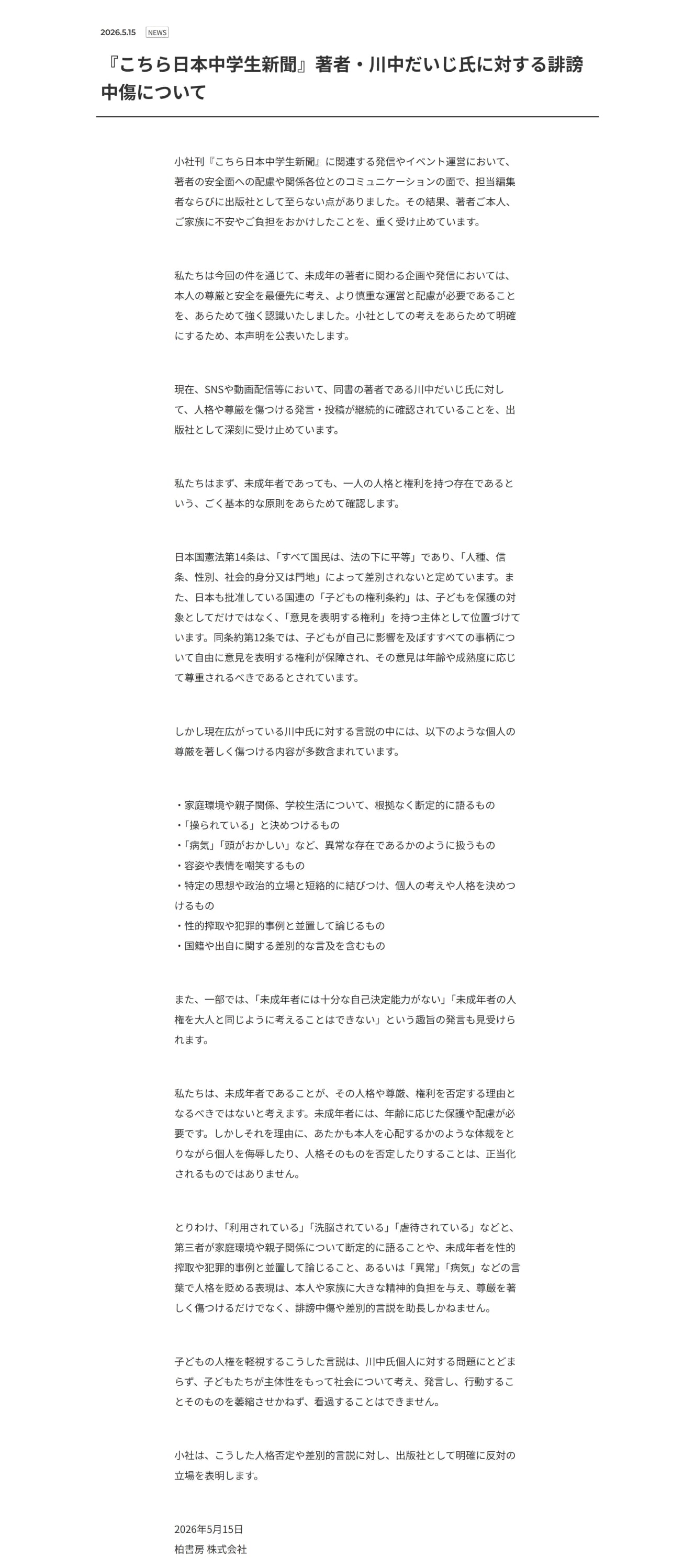
On May 15, 2026, Kashiwashobo posted a statement on its website.
“Regarding defamation against Daiji Kawanaka, the author of ‘This is the Japanese Middle School Newspaper’.”
The company published the book in March. The author is a serving journalist who founded the “Japan Middle School Newspaper” in 2023 and has covered topics such as the Osaka-Kansai Expo, IR casino projects, the Hyogo gubernatorial election, and the Moritomo Gakuen scandal—he had just graduated from junior high school this spring and is now a 15-year-old high school student.
The statement said it takes seriously the ongoing posts on social media and video platforms that damage Kawanaka’s personality and dignity, and listed specific categories of such content: claims without basis about his family environment or parent–child relationships, assertions that he is being manipulated, and more. It also pointed out views such as minors do not have sufficient capacity for self-determination and the human rights of minors cannot be treated the same as those of adults.
It then reaffirmed the principle that even minors are individuals with their own personality and rights, and concluded that such discourse is not merely a personal issue concerning Kawanaka, but could also discourage children from thinking about society with their own minds and from raising their voices. It is unusual for a publisher to go this far in defending an author, and the statement received widespread support.
Following this statement, we spoke with him again. The previous interview had been on March 31, the day before he entered high school. A little over two months had passed. What appeared on screen was not so much discussion of the slander itself, but the deeper issue behind it—discrimination against children and today’s discourse environment.
“Even 32 years after Japan ratified the Convention on the Rights of the Child, discrimination against children still doesn’t receive much attention. Gender discrimination has been increasingly recognized, but child discrimination has not,” Kawanaka said.
Starting from there, he places at the center of the issue the imposition of what children should be like.
“Many adults unconsciously try to fit children into a mold. I feel they are creating an image of children that is convenient for adults. This is not just a problem of social media, but a problem of Japanese society as a whole.”
When he posts about politics, comments appear saying he is being manipulated or brainwashed. Some even claim he is a tool of the Chinese Communist Party. It is a rather imaginative assumption, but he is unfazed and responds:
“People assume children are supposed to be obsessed with baseball or soccer. But I just happened to get into politics. It’s the same as children who get into baseball or soccer. Yet adults try to fit that into a box, saying ‘most children should be like this.’ Adults wouldn’t like it if they were constrained by assumptions or ideals either.”
The belief that children are not acting on their own will—that distrust is what he calls the mold. And that mold exists within families too.
“Sometimes parents force their children into club activities. They say, ‘Join either swimming club or track and field.’ Since it’s not the child’s own choice, they struggle, lose motivation, and get scolded by coaches. Even quitting requires parental permission.”
What begins as parental concern for the future gradually turns into you must be like this.
“This is also an imposition of parental concern, and I feel the child’s autonomy is not being respected.”
Even though visible forms of discrimination like corporal punishment have decreased, he says the substance remains, only in a different form.
“I think child discrimination has actually spread more than before.”

Adults’ concern is really a way of avoiding responsibility
The same distrust does not always appear in the form of outright attacks—it can also come disguised as concern.
“In the end, I’m the one who bears responsibility for myself, so when people present themselves as being concerned, I think it’s, in a sense, hypocritical.”
One example he cites is his experience surrounding a press conference held by Hyogo Prefecture Governor Saito.
“When I applied to attend one of the regular press conferences, I was told, ‘You might become the target of online abuse,’ and I was made to sign a consent form stating that I would take responsibility if anything happened. That was really a way for the organizers to avoid liability, yet they framed it as if they were simply worried about me.”
He says the difference between people who are genuinely concerned and those who are not is obvious.
“People who truly care about you will say something like, ‘There have been incidents like this recently, so please be careful,’ based on their own experiences. But people who impose their views say, ‘Because things like this can happen, you shouldn’t be doing this kind of activity.’ The difference is whether they’re taking away your freedom.”
Not only malicious slander, but also interventions made under the guise of good intentions can end up restricting children’s freedom.
The contradiction of condemning discrimination while excluding others
His concerns extend beyond discrimination against children.
“I feel there’s a growing tendency for people to reject those who think differently—to say, ‘They’re different, so they’re wrong.’ The idea that someone is automatically right simply because they share the same ideology is extremely dangerous.”
He continues:
“People say they’re against discrimination, but before they know it, they’ve adopted attitudes that resemble those of the very people doing the excluding.”
When you stand on the side condemning others, it’s difficult to recognize that you’re engaging in similar behavior yourself. In today’s social media environment, where differing opinions are casually dismissed, this observation from a 15-year-old strikes at the heart of the issue.
As a way to embrace differing viewpoints, he argues for introducing direct democracy.
“We need to acknowledge and respect differences in opinion. Even if the outcome isn’t what we wanted, we should sincerely accept it and learn from it. I think that’s what Japan needs right now. Believing that your own proposal is good while refusing to accept ideas from people who think differently is simply arrogance.”
He has proposed what he calls the “School Democratization Initiative,” which would introduce direct democracy into schools. Under the plan, students would be given the right to formally propose revisions to school rules, making it easier for them to participate and giving them firsthand experience as active citizens. He sees the national equivalent of this as a system of citizen-initiated legislation and referendums.
“Right now, penlight demonstrations are being held across Japan. If we had a system of direct democracy in place, people would have a new way to bring those voices into politics. Citizens could participate more directly in creating the country’s rules. Under a citizen initiative system, once a legally required number of signatures is collected and submitted to the Diet, the proposal would be put to a national referendum.”
He points to examples from abroad.
In Italy, voters were asked in a referendum whether divorce—which had already been legalized—should be banned again. About 60 percent voted against the proposal, so divorce remained legal. In Taiwan, a proposal to amend the Civil Code to explicitly recognize the rights of same-sex couples was rejected, but those rights were ultimately guaranteed through a separate special law proposed by the opposition.
“Those outcomes were the result of people treating each issue as their own, thinking seriously about it, and engaging with it.”

The public is not stupid
He draws on examples close to home in Osaka.
“When citizens gather to discuss the introduction of a national initiative system, you almost always hear comments like, ‘It’s dangerous to let people who haven’t studied the issue decide.’ I think this kind of thinking is what degrades democracy.
In reality, in the Osaka Metropolis plan referendums, both when Hashimoto was popular and when Yoshimura was popular, citizens studied the issue and thought it through—and rejected it twice. The public is not stupid. When presented with a single policy, people face it as stakeholders and think seriously about it.”
He argues that discrimination against children and the rigidity of today’s public discourse are connected at a deeper level. Mutual distrust among citizens resembles the condescension of children cannot understand. Overprotective, distrustful of others, shifting responsibility elsewhere, and preferring to remain mere observers—he suggests this attitude is directed equally at children and at citizens as political actors. When asked about this, he nods deeply.
“You’re absolutely right.”
There is also concrete evidence supporting concerns about discrimination against children in Japan. Since ratifying the Convention on the Rights of the Child in 1994, Japan has repeatedly received recommendations from the UN Committee on the Rights of the Child. These include concerns that an excessively competitive education system negatively affects children’s mental and physical well-being, and that children’s right to express opinions on matters affecting them is not being properly respected—both fundamental principles of the convention.
“I think many adults don’t even know that Japan has received recommendations from the UN,” he says.
He also sees signs of change reaching him. Young people who learned about the Convention through his book or activities have begun seeking advice. When a friend experienced unfair treatment from a supervising teacher, he told them, citing the Convention, “You can say something is wrong. You shouldn’t just endure it.”
“That is also one of children’s rights to express themselves.”
A 15-year-old’s rebuttal to adults who harass him
Why, then, is he able to remain unshaken? He answers immediately that he has never felt the urge to break down or take a break. The support at his core is his family.
At a launch event held on March 29 at the Nanagei Theatre (Nanagei Spilit), a small cinema in Osaka’s Jūsō district, his mother also appeared on stage. Journalist Imai Hajime moderated the talk. In the archived recording, his mother speaks about her son’s sense of resolve.
“Because we could discuss things as a family and they trusted me and let me take responsibility, I am able to do what I do now.”
Children’s political participation is often met with suspicion that they are being made to say things by their parents, but what he portrays is the opposite—a child treated as an independent subject and trusted as such.
He says that, in fact, he is not the one who gets hurt the most.
“I think I have stronger mental resilience than most people, so I don’t really get hurt myself. If anything, I think my parents are the ones who get hurt.”
Harassment can sometimes wound those around a person more deeply than the person themselves.
Even so, he does not back down.
“Why should the person being harassed have to withdraw? That would just play into the other side’s hands. I’m simply doing what I like, so I will continue to speak out. If anything, I sometimes worry that the words of those who are attacking me will eventually come back to them.”
He interprets the publisher Kashiwashobo’s statement mentioned at the beginning in this way:
“I think it was also a message asking people to respect children’s free will. The idea that it’s okay to do what you like, and that society will protect you—that kind of courage reaching all children would be wonderful.”
Rather than focusing on protection as a victim, he emphasizes protecting the space for children to think and speak freely. Even 32 years after ratification, the principles of the convention have yet to take root; the 15-year-old journalist illuminates this gap through his own experience.
“Children also need to know that they have rights.”
Beyond being tied down by schoolwork, he hopes for an environment where children can pursue what they like and ask why. That wish is not only for himself.
▼ Daiji Kawanaka — born in 2010 in Osaka City. A reporter for the “Japan Middle School Newspaper.” He became interested in politics in elementary school and launched the “Japan Middle School Newspaper” in 2023. Under the motto write what I want to write without worrying about anyone, he reports on elections, the Osaka-Kansai Expo, IR casino projects, the Moritomo Gakuen scandal, and more, distributing content via social media and YouTube. He has contributed to numerous magazines and web media. He serves as an interviewer for the program “Middle School Reporter Daiji’s Talk Club” on TV Osaka’s official YouTube channel “Osaka NEWS [TV Osaka News].” In March, he published the book “Kochira Nihon Chugakusei Shimbun” (Kashiwashobo).
Reporting and Text: Wakako Tanaka PHOTO: Courtesy of Daiji Kawanaka