[Playback ’06] “Reconstruction Photos” of the “Ikeda Elementary School Incident” Tragedy… The “Unexpected Face” the Perpetrator Revealed During the On-Site Investigation


We obtained documents from that time five years after the incident
What was *FRIDAY* reporting 10, 20, and 30 years ago? We look back on topics that were in the news at the time [Playback Friday].This time, we feature the June 23, 2006, issue , titled “Scoop Revealed: Five Years After the Ikeda Elementary School Incident—Reconstructed Photos of the ‘Scene of the Brutal Massacre of Eight Children’ by the Monster Takuma Mamoru, Revealed Through On-Site Investigation.”
It has been 25 years since the indiscriminate killing of children at Osaka Kyoiku University Affiliated Ikeda Elementary School (Ikeda City, Osaka Prefecture) on June 8, 1996.This article is an exclusive report that reconstructs the scene of the crime five years after the incident, based on photographic materials obtained by this magazine and the written testimony of former death row inmate Mamoru Takama (37 at the time).
This horrific incident, in which eight children were killed and 15 others suffered serious or minor injuries, stemmed from the irrational motive: “I thought if I killed a lot of elite, intellectual children, I would definitely be sentenced to death.” The details of the situation emerged from the materials—(descriptions within 《》 are quoted from past articles; titles are those at the time).
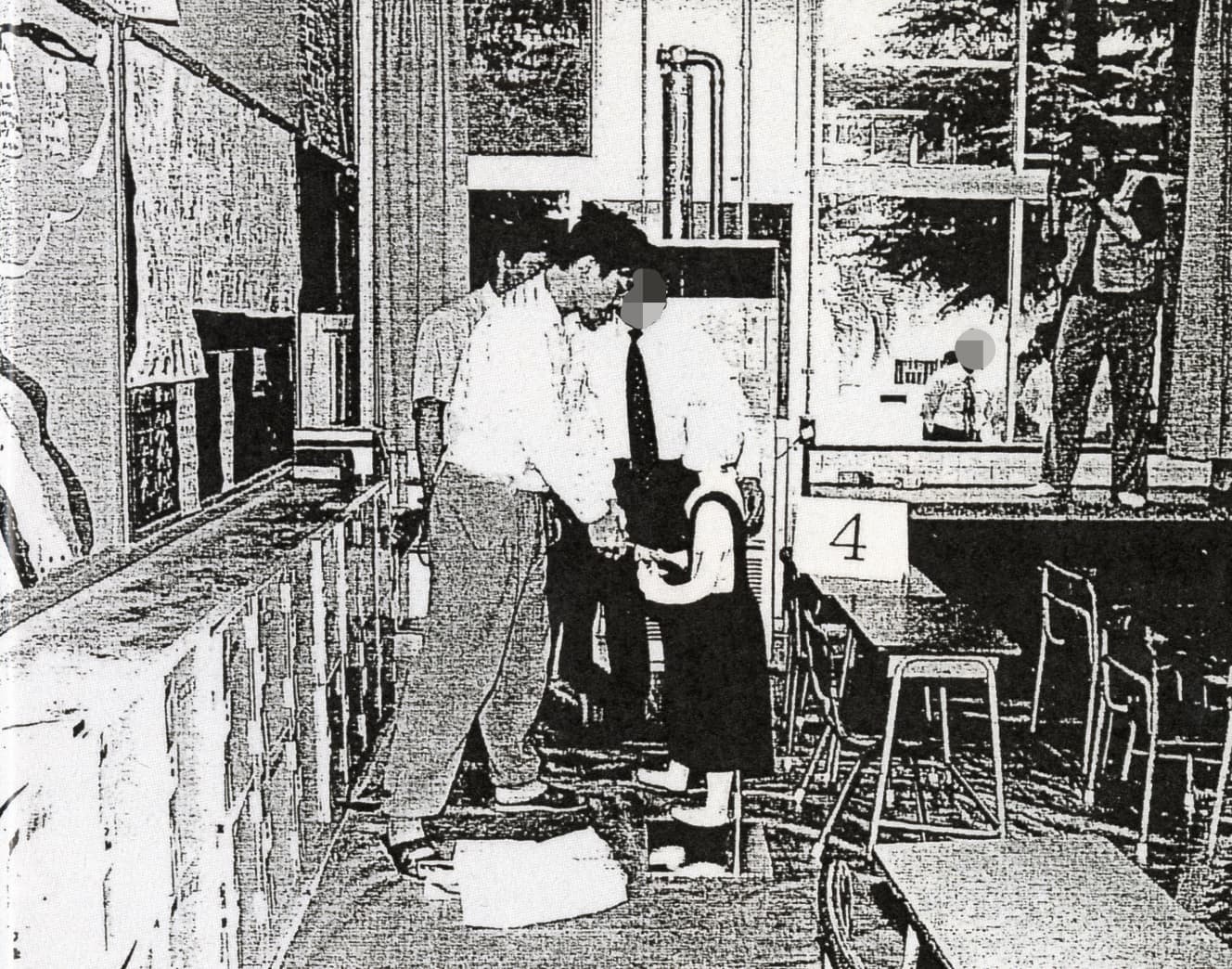
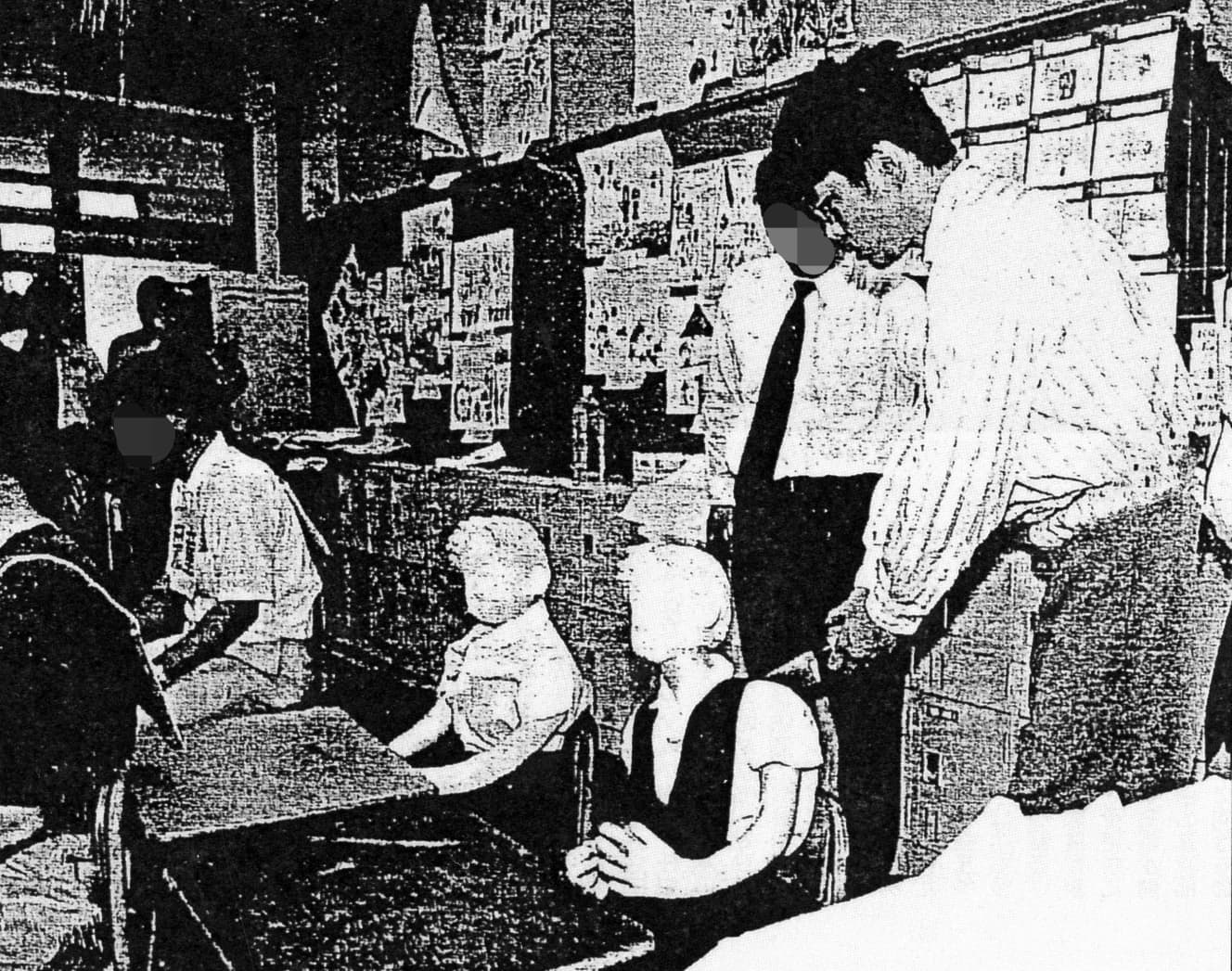
On July 2, 2001, about a month after the incident, Takama was seen at Ikeda Elementary School, the scene of the crime. He had come for an on-site investigation conducted that day. On this day, Takama was wearing a striped long-sleeved shirt.The crime scene had been preserved exactly as it was at the time of the incident, and traces of blood remained vividly visible. Faced with the scene of the tragedy, perhaps acutely aware of the gravity of the crime he had committed, Takuma reportedly clasped his hands in prayer before entering the first classroom.
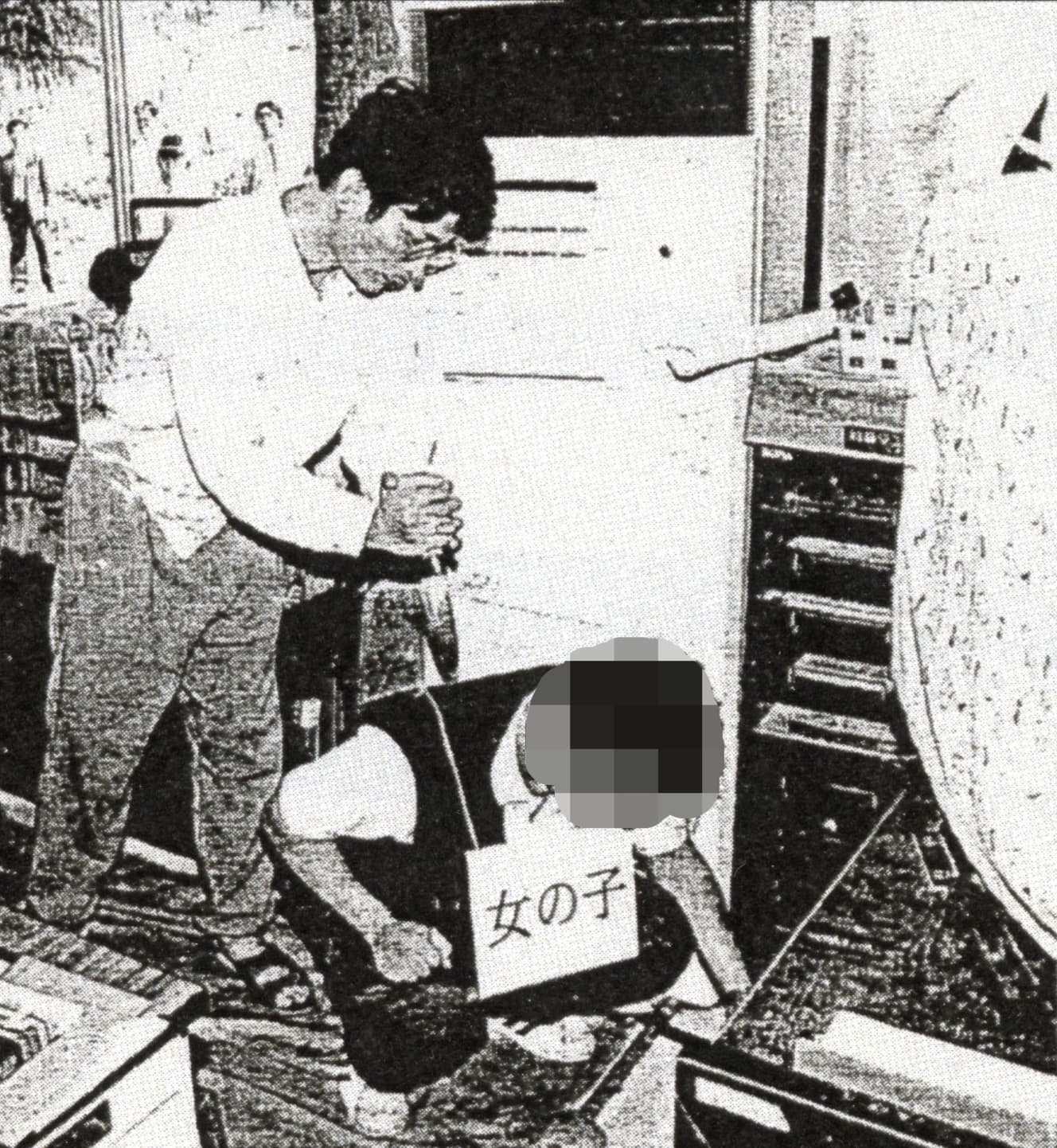
Then, using mannequins seated in chairs and investigators to represent the children, he took a kitchen knife in hand and reenacted each of his heinous acts.
On the day of the crime, Takama visited Ikeda Elementary School determined to “stab and kill as many elementary school students as possible.” He broke into the school building and set his sights on the first classroom he happened to come across. In the police statement published in articles at the time, Takama described the situation in his own words.
“My heart was pounding with intense anxiety. Although I had planned to stab and kill as many elementary school students as possible, when it came time to actually carry it out, I couldn’t completely hide the fear that was welling up somewhere inside me.
However, as if to suppress that fear, I kept telling myself, ‘I have no choice but to do this; I have no choice but to do this.’ Thinking about the crime I was about to commit, I shuddered. No sound reached my ears. I feel as though it was strangely silent.” (Quoted verbatim; same below)
It was a second-grade classroom. Takuma entered through the back entrance, took the chef’s knife out of the plastic bag, and held it in his right hand. When he looked ahead, he saw a girl within arm’s reach.
An unexpected action he displayed during the crime scene investigation
The girl noticed Takuma, but reportedly stood there dumbfounded without uttering a sound. Facing the girl head-on, Takuma stabbed her with a chef’s knife, aiming for the area around her abdomen.
“I held the knife in my right hand and supported it with my left, stabbing with both hands. I remember a sensation of the knife sliding smoothly into her abdomen.”
What followed was a scene of utter chaos, like a picture from hell. Takama reportedly swung the chef’s knife wildly, thinking only of taking the child’s life.
“The sound of the child screaming ‘Kyaa!’ still echoes in my ears. I don’t know if that was the scream when I stabbed her or the scream as she tried to flee.”
According to Takuma, he felt neither the sensation of the knife stopping inside the body nor any resistance when pulling it out. As he stated in his testimony, “I think the knife really just slid right into the child’s body,” Takuma continued to swing the knife ruthlessly, piling up a heap of casualties.
He stabbed children in the back as they fled in panic, and—perhaps driven by sheer terror—he mercilessly attacked even those who had crouched down in fear. He also stabbed a teacher who stood in his way, trying to stop him. What was Takama thinking at that moment? In his written statement, he said the following:
“〈I don’t think I had any rational thought whatsoever, such as ‘It would be pitiful to kill a child’ or ‘I must not kill a child.’ All I had in my head was killing children. That is how desperately I was trying to stab and kill them.〉”
What else can one call this but the act of a monster?
From the moment of his arrest through the trial and up to his execution, Takama never once apologized to the victims’ families. However, his demeanor seemed different during this on-site investigation. Before entering the classroom, he bowed and clasped his hands in prayer, and reportedly cooperated fully with the investigation. In his written statement, Takama described his state of mind at that time as follows:
“〈Actually, ever since I decided to go to the school, there was something on my mind. Before entering the first classroom I attacked, I had been thinking that I wanted to put my hands together in prayer to atone for the wrong I had done to the children I killed. (omitted) When I went to the scene and actually put my hands together, it made me feel more composed.〉”
Takama never apologized to the bereaved families until the very end, instead continuing to spew nothing but abusive language. What was the meaning of this subdued demeanor he displayed only on that day?
Without ever offering an “apology” until the very end…
As many people know, in the trial that began on December 27, 2001, Takama’s brazen behavior in the courtroom became a media sensation almost every time.
At the first hearing, while the prosecutor was reading the indictment, he asked, “Is it okay if I sit down?” and was reprimanded by the presiding judge, who told him, “You must listen while standing.” While he ranted at length about his dissatisfaction with his upbringing and his hatred for his father and mother, he offered absolutely no apology to the deceased children or their bereaved families.
In his final statement, ignoring the notes edited by his defense team, he said:
“I’m not scared of dying at all. If my life was going to be a hopeless, poverty-stricken existence anyway, this outcome might have been better,” “I still think I could have killed more if it had been at a kindergarten,” and “For women, slashing their faces does more damage than killing them,”
and other remarks, further infuriating the bereaved families. Then, at the sentencing hearing on August 28, 2003, he was removed from the courtroom for disorderly conduct and was not directly handed the death sentence. Furthermore, as he was being escorted out, he hurled insults at the bereaved families before leaving.
Takuma himself withdrew the defense team’s appeal, making the death sentence final at the first trial. The sentence was carried out on September 14, 2004, an unusually short time—about one year—after the verdict (he was 40 years old).The early execution is believed to have been due to several factors: the defendant’s lack of remorse and his desire for an early execution; the fact that he was arrested in the act and admitted his guilt, leaving no possibility of a wrongful conviction; and consideration for the strong desire for punishment expressed by the victims and their families.
Regarding Takama’s demeanor during the on-site investigation in July 2001, an official from the Osaka Prefectural Police told our magazine the following:
“He showed none of the brazen arrogance he later displayed in court; it was striking how meekly he cooperated with the investigation.In my opinion, Takama was likely reflecting on his crime during the on-site investigation. However, a twisted psychology—a desire not to show his remorse to others and to inflict suffering—stifled his expressions of remorse, and that remained unresolved until the very end, leading him to the gallows.”》