Record-Breaking Surge in Man-Eating Bear Incidents? Experts Sound the Alarm Over Unusual Bear Behavior


Fatal incidents occurring at a pace exceeding previous years
“Urban bears” are rapidly increasing, with some individuals believed to have hibernated within city areas
Man-eating bears are on the move again this year—and at what may be the worst pace on record.
Reports of bear sightings surged across the Tohoku region after April began. In April alone, Miyagi Prefecture recorded 138 sightings, 5.3 times more than the previous year, while Akita Prefecture received an astonishing 395 reports, up 4.6-fold year-on-year. Amid this spike, tragedy finally struck.
“On April 21, the body of a 55-year-old woman was found in the mountains of Shiwa Town, Iwate Prefecture. The body bore claw marks and what appeared to be animal bite wounds, with severe damage. Authorities later concluded that she had been killed in a bear attack. A senior police officer from the Iwate Prefectural Police’s Shiwa Station, who was searching the area, was also attacked by a bear and suffered injuries to his face and arms,” said a local newspaper reporter.
The map below summarizes bear-related incidents during fiscal 2025 (April 2025 to March 2026) and those recorded in April 2026. Last fiscal year saw the worst bear-related damage on record, with 238 victims and 13 fatalities. The first fatality did not occur until June. This year, however, two people had already died by May 14.
In recent years, particular concern has focused on so-called “urban bears,” bears that live around populated areas. Rather than staying deep in their natural mountain habitats, these bears boldly appear in regional cities, where they may attack people they encounter and, in the worst cases, kill them.
The increasing number of these dangerous animals is alarming enough, but Kazuhiko Yoneda, director of the Japan Asian Black Bear Research Institute, warns that “I’ve observed bears for over half a century, and this year’s urban bears are completely different from the urban bears we’ve known before.”
“This year, bears have already been sighted in urban areas such as Sendai in Miyagi Prefecture and Koriyama in Fukushima Prefecture since April. Rather than descending from the mountains, they most likely spent the winter around city outskirts. If they had traveled from the mountains, it would be difficult for bears measuring 1.5 meters in length and weighing around 120 kilograms to make the journey of several dozen kilometers into urban areas without being spotted.”
In other words, bears are no longer merely becoming accustomed to human settlements—they appear to be evolving to the point of hibernating near them.
“Bears are naturally timid animals that fear humans. But urban bears no longer show that fear. They brazenly come into residential yards in broad daylight to eat persimmons and other fruit,” Yoneda explains.
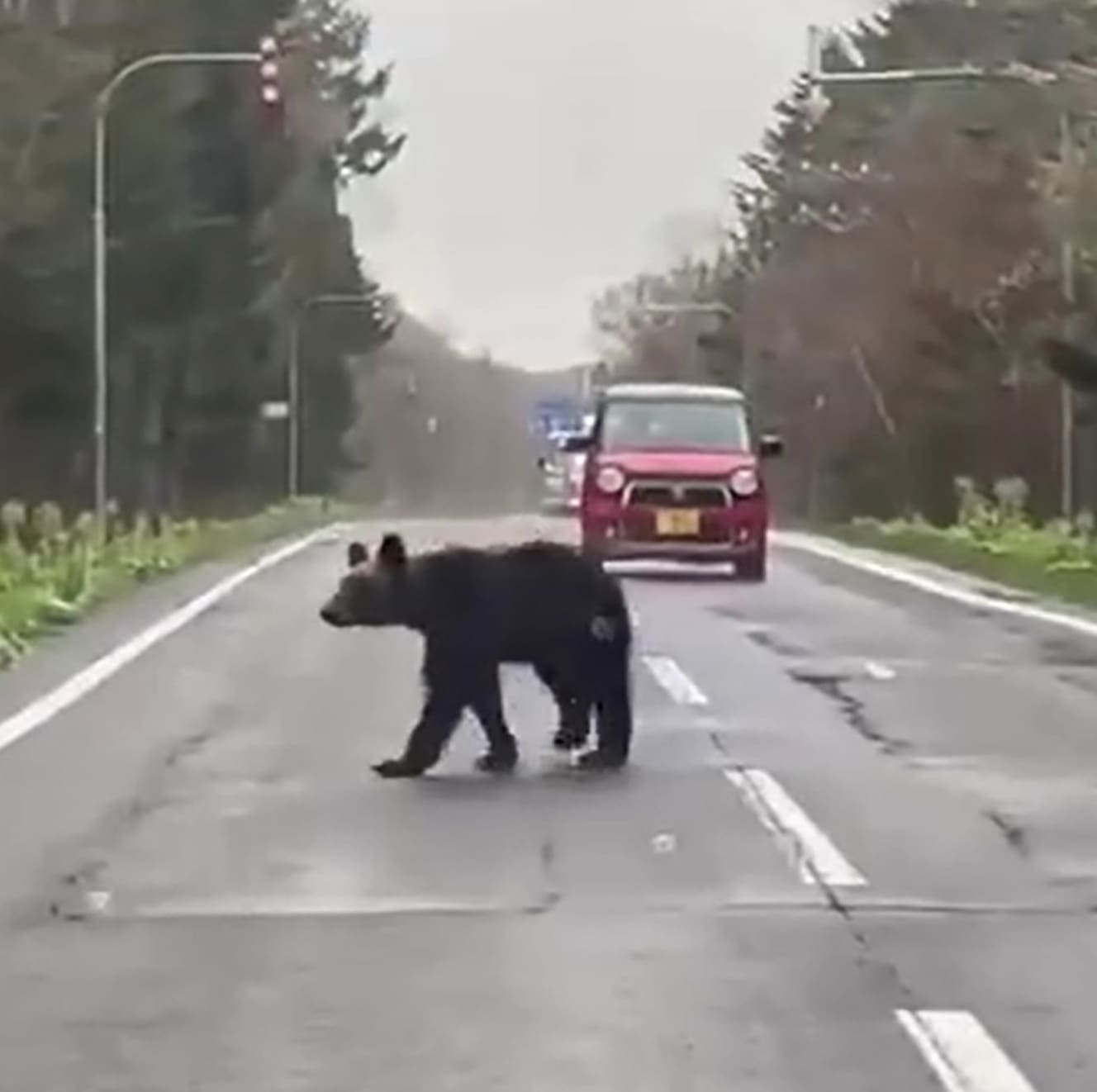
“FRIDAY” obtained video footage of an urban bear that appeared near Kombumori Station in Nemuro, Hokkaido, this May.
The footage shows the bear calmly lumbering across a two-lane road with cars passing by. Its leisurely gait conveys an air of confidence, suggesting an urban bear that has become accustomed not only to people but even to traffic.
Why have urban bears increased so dramatically? Professor Yoshikazu Sato of Rakuno Gakuen University, an expert on bear ecology, explains:
“Last year, acorns—the bears’ primary food source—were scarce, leaving them unable to find enough food in their natural mountain habitats. As they searched for persimmons and chestnuts growing near human settlements, they learned that there’s food here. They likely came to regard areas near people as part of their own living range. In mountain towns and villages, population decline and aging have reduced human activity, making those places less threatening to bears. That, too, has encouraged them to expand into human communities.”

A giant body that doesn’t look like it just emerged from hibernation
This year’s bears have another notable characteristic: despite having just come out of hibernation, they are unusually large.
“Normally, bears lose about 20 to 40 percent of their body weight during hibernation. They burn energy while sleeping, lose fat, and their skin becomes loose and saggy. However, among the bears sighted this year are individuals weighing well over 100 kilograms with taut, healthy-looking skin.
We believe this may be due to the unusually warm winter in Hokkaido and the Tohoku region, which reduced the amount of energy bears expended during hibernation. In other words, they are emerging from hibernation in relatively vigorous condition. That is likely why bears this year are more active than usual,” says Yoneda.
Indeed, reports of enormous bears have been emerging from across the country.
In April, a brown bear captured in the Nagashima district of Tomamae, Hokkaido, was estimated to be approximately 2.2 meters long and weigh 330 kilograms. The photograph below, taken on May 2 in Okoppe, Hokkaido, also shows a bear with a body size that seems impossible for one that has only recently emerged from hibernation.
The photographer, Tetsuya Kurosawa, has also noticed a clear change in this year’s bears.
“I think it weighed around 250 to 300 kilograms. I use fixed-point cameras, and one of them captured another bear weighing about 250 kilograms back in April. In a normal year, you’d see much smaller and thinner bears. This spring, however, I’ve had the impression that plump, well-fed bears have been active right from the start.”
Even more alarming, experts warn that bears which have grown larger and become accustomed to human settlements will become increasingly aggressive in the coming months. The reason: mating season. Yoneda explains:
“Bears enter their mating season in early summer. It begins around early May and will soon be in full swing. During this period, male bears expand their range in search of females. Males have a habit of finding females with cubs and killing the cubs to trigger the female’s return to estrus. As a result, mother bears become highly aggressive while protecting their young. This increases both the risk of people encountering bears and the risk of being attacked.”
How should people deal with bears that are both larger and no longer afraid of humans? An official from the Environmental Affairs Division of Shiwa Town, Iwate Prefecture—where a fatal bear attack recently occurred—offered the following advice:
“As a local government, we have systems in place to set traps in areas where bears are likely to appear and to arrange emergency hunts by local hunting associations when sightings are reported. Iwate Prefecture also provides a map application that pinpoints bear sightings. Anyone entering areas believed to be bear habitat or where bears have been spotted should always travel in groups and carry bear bells or other deterrents.”
Professor Sato also warns that communities themselves must take measures to keep bears away from human living areas.
“Don’t leave abandoned persimmon trees or agricultural crops that can serve as food for bears. Unneeded trees should be cut down, and harvested crops should be stored in barns rather than left outdoors. In recent years, some people have stopped reporting bear sightings. Whenever a bear appears, it must be reported so it can be driven away from residential areas. Once bears begin to recognize human settlements as part of their habitat, their behavior will only escalate. Before that happens, it’s essential to make them understand that human communities are not places where they belong.”
On May 19, a body missing its upper half was discovered in Okutama, Tokyo. Large animal tracks were reportedly found nearby.
Man-eating bears that have become both more aggressive and larger are appearing one after another and venturing into human settlements. What once seemed like a nightmare scenario is beginning to feel all too real.
From the June 5–12, 2026 combined issue of “FRIDAY.”
PHOTO: Tomamae Town Hunting Club Chairman Toyoyuki Hayashi (1st photo) TOYO-BROTHER (2nd photo) Tetsuya Kurosawa (3rd photo)