Why 90% of Osaka’s Waterworks Projects Run Late—and the Curious Explanations Given


Completion within the scheduled construction period has disappeared
The deterioration of Japan’s water supply infrastructure has become a serious problem.
According to multiple media reports, approximately 170,000 kilometers of water pipes in Japan have exceeded their legally designated service life of 40 years—a distance equivalent to circling the Earth about four times. In an earthquake-prone country like Japan, the risk of pipe ruptures is high, making the replacement of aging water mains an urgent priority.
However, bid-rigging scandals involving waterworks construction contracts have been uncovered across the country. A reporter from a national newspaper’s social affairs desk explains:
“Last year, in a waterworks tender conducted by the Iwaki City Water Bureau in Fukushima Prefecture, a contractor submitted a bid that matched the estimated price exactly, even though there had been an error in calculating that estimate. An engineering supervisor from the bureau’s construction division who leaked the design cost information was arrested for violating Japan’s Anti-Bid Rigging Act, and the president and director of the local company that won the contract using the leaked information were also arrested. Then, in May of this year, the head of the Onomichi City Waterworks Bureau in Hiroshima Prefecture was dismissed after allegedly leaking the estimated contract price for a waterworks project to a contractor.”
As scandals involving water bureaus continue to surface, the author received information suggesting that construction delays are occurring with unusual frequency on projects commissioned by the Osaka City Water Bureau.
A former employee of the bureau said:
“An increasing number of Osaka City Water Bureau projects are failing to meet their completion deadlines. Extensions of six months or even a year have become commonplace. Contractors that fail to finish on time should normally face penalties such as fines or suspension from future bidding, yet for some reason no punishment is imposed. Companies that miss deadlines continue winning contracts repeatedly. It’s an abnormal situation. Within the Osaka City Water Bureau, the phrase completion within the scheduled construction period has practically disappeared. I’d estimate that construction periods are extended on 60 to 70 percent of all projects.”
According to the former employee, the bureau normally does not permit construction period extensions except in cases involving natural disasters.
Shintaro Domura, chairman of the Global Environmental Issues Conference, expressed his frustration:
“Even when we request documents from the Osaka City Water Bureau, they are reluctant to disclose them. So instead, we filed a disclosure request with the Osaka Prefectural Police and obtained internal documents concerning construction period extensions.”
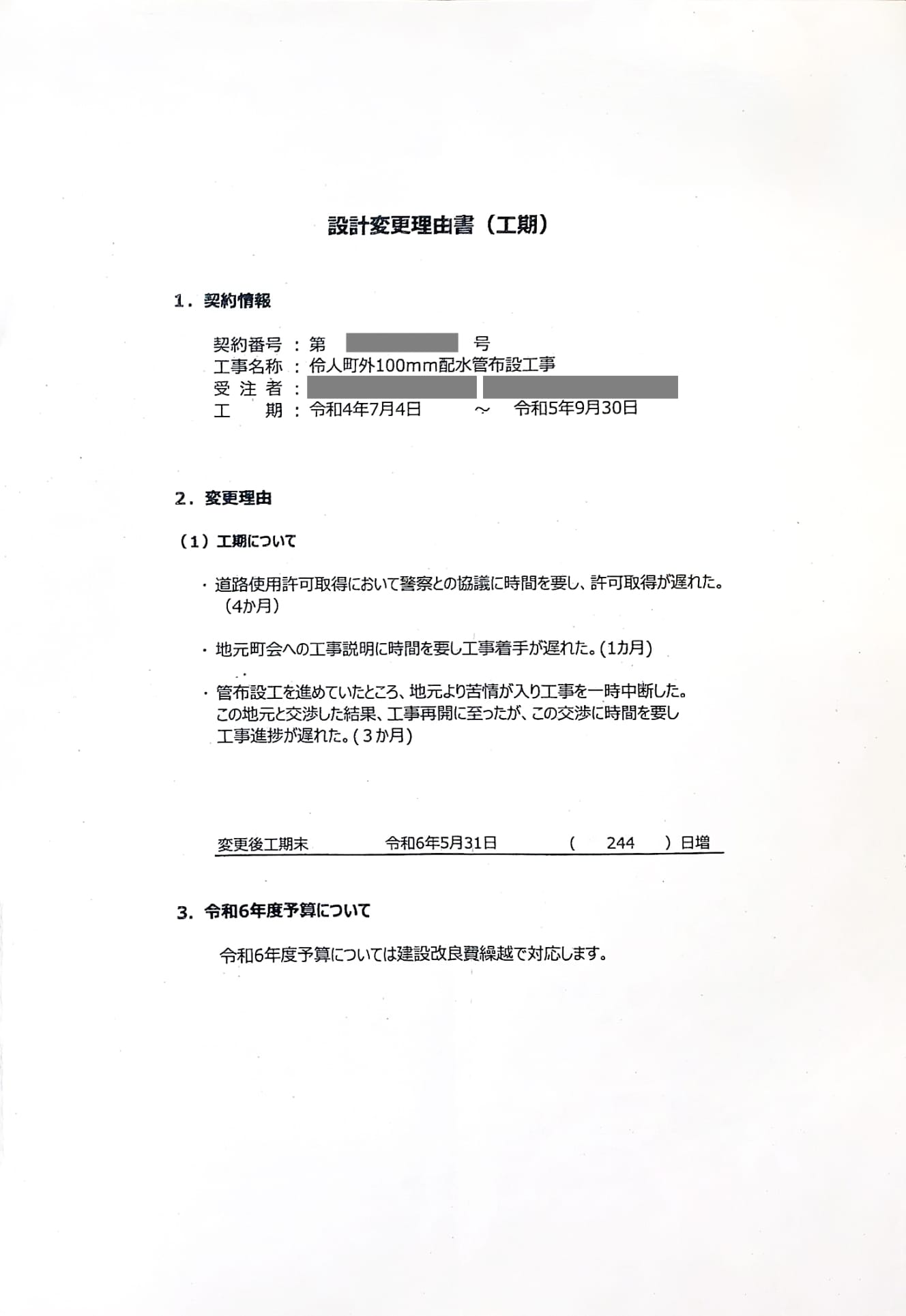
Among the documents Domura obtained was a “Design Change Justification Form” relating to a water distribution pipe installation project in Osaka’s Tennoji Ward (original construction period: July 4, 2022, to September 30, 2023). The document listed the contractor’s reasons for requesting an extension:
《It took time to consult with the police regarding the acquisition of the road use permit, delaying the issuance of the permit. (4 months)》
《It took time to explain the construction project to the local neighborhood association, delaying the commencement of the work. (1 month)》
《While pipeline installation work was underway, complaints were received from local residents, causing the construction to be temporarily suspended. Although negotiations with the local community eventually led to the resumption of the work, those negotiations took considerable time, delaying the progress of the project. (3 months)》
However, after independently verifying these claims, Domura says all of them proved to be false.
“I visited the Traffic Division of Tennoji Police Station and confirmed with the section chief whether consultations with the police had actually delayed the permit. They told me no such delay had occurred. I also met with the local neighborhood association chairman to verify whether residents had lodged complaints, and that claim was false as well. Armed with this evidence, I confronted Water Bureau officials, but they simply fell silent. They refused even to respond.”
The construction project ultimately ran 244 days longer than originally scheduled.
A contractor involved in Osaka City Water Bureau projects criticized what he described as unjustified extensions:
“Normally, once a contractor signs a contract with the Water Bureau, it immediately applies for a road occupancy permit from the local police station. Everyone knows approval takes about a month, so that’s already factored into the schedule. Occasionally local residents may raise objections, but in my experience those issues are usually resolved within a few days. I’ve never heard of residents opposing a project for several months.”
Why are construction deadline extensions so frequent?
Domura also obtained from the Osaka Prefectural Police documents detailing the consultation records between Water Bureau officials and officers from the local police station regarding the water pipeline installation project in Tennoji Ward. Those documents likewise contained no exchanges supporting the claim that consultations with the police took a long time.
“The reason construction deadlines are so frequently extended is that work is concentrated among certain contractors, leaving them with workloads beyond their capacity. When the city puts projects out to bid, the Contract and Property Management Division notifies contractors, but companies that already have projects nearing their deadlines are excluded from bidding. Therefore, before the bidding process begins, they extend the deadlines of existing projects to create the appearance that they have enough capacity to take on new work. It is deeply problematic that Water Bureau officials are fully aware of this reality yet tacitly allow it to continue,” said Domura.
Why, then, are construction deadline extensions occurring so frequently? How does the Osaka City Water Bureau respond to Domura’s assertion that the reasons listed in the “Design Change Justification Document” are false? When questioned, the bureau provided the following response:
“The supervising assistant and the contractor jointly conducted site inspections and consultations, taking into account excavation conditions and traffic conditions to prepare a traffic management plan (a diagram showing traffic restrictions and safety measures around the construction site required for the road use permit application). This plan was submitted to the local police station for preliminary review. However, the police instructed revisions regarding the construction occupancy area and detour routes, resulting in multiple rounds of revisions and repeated confirmations with the police until approval was obtained.
Although the formal road use permit application was submitted only after receiving confirmation from the local police that there were no further issues, and the permit itself was issued without significant delay thereafter, the preliminary review process and responses to revision requests also took time. Including this period, it took approximately four months to obtain the road use permit, as stated in the Design Change Justification Document. Therefore, the claim that ‘this reason is false’ is not factual.”
Regarding the repeated extensions of construction deadlines, the bureau acknowledged that approximately 90% of water pipeline construction projects contracted in fiscal years 2021 and 2022 had their deadlines extended, effectively admitting that nearly all such projects experienced delays. It further explained:
“The contract stipulates that when the contractor is unable to complete the work within the contract period due to reasons beyond its control, the contractor may request an extension of the construction period by submitting written documentation specifying those reasons to the contracting authority. Since all deadline extensions in fiscal years 2021 and 2022 were implemented in accordance with this provision, no penalties were imposed.”
As for the allegation that contracts are disproportionately awarded to certain companies, the bureau denied the claim, stating, “Contract awards are not concentrated among specific contractors.”
Nevertheless, there is no denying that construction deadlines have been extended for a large number of city-commissioned projects. Shouldn’t the Osaka City Water Bureau be held accountable for explaining this issue to the public?
Interview, text, and photographs: Kei Kato