Japan Innovation Party Campaign Announcer Claims Salary Deductions and Unexpected Police Search



“I was even subjected to a house search!” An election campaign “uguisu-jo” speaks out
A house search was conducted at the home of a woman identified as A, who lives in Takarazuka City, Hyogo Prefecture, on February 22 this year. Detectives from the Amagasaki South Police Station who visited suspected that A, who works as a campaign car announcer—known as an “uguisu-jo”—had illegally received compensation exceeding the legal maximum.
However, A had no recollection of any wrongdoing. For her, who has nearly 30 years of experience as an uguisu-jo, it was her first such trouble. On the same day, police officers also visited the home of another uguisu-jo, B, who lives in Neyagawa City, Osaka Prefecture.
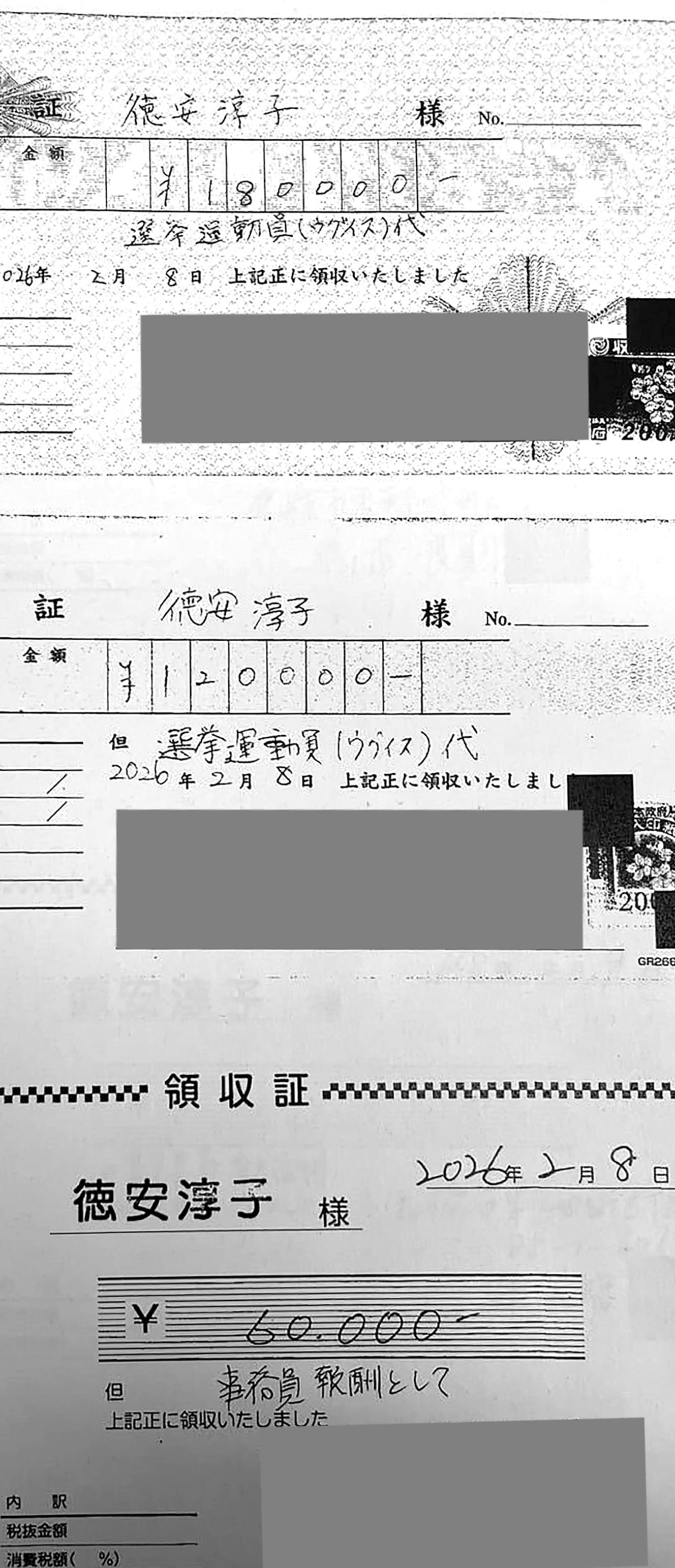
A month later, on March 24, a man in his 40s who had been a secretary to former House of Representatives member Junko Tokuyasu (64) of Nippon Ishin no Kai was summarily indicted for paying compensation to campaign staff that exceeded the legal limit.
In this case, a woman who coordinated the uguisu-jo staff was also summarily indicted for receiving illegal payments (bribery). The charge was violation of the Public Offices Election Act.
The uguisu-jo who worked for Tokuyasu’s campaign included the aforementioned A and B. The two expressed anger to “FRIDAY” reporters, saying they had been made to unknowingly participate in wrongdoing involving “uguisu-jo.”
“On the morning of February 22, police came to my house, and I was taken to Amagasaki South Police Station for voluntary questioning. There, the investigator intimidated me, saying, ‘Tell the truth. How much did you really get? You must have received more than the legal amount!’
The legal payment for an uguisu-jo is set at 20,000 yen per day, and I only received 140,000 yen for seven days of work. No matter how many times I explained this, the detective would not accept it. They also said they had been monitoring our movements during the election period and knew where we ate, how often we went to the bank, and even our routes home. And then, that very night, they carried out a house search,” (A said).
The uguisu-jo were furious after house searches and the seizure of their smartphones!
There was a reason why the detectives refused to believe them. In Tokuyasu’s campaign finance report, A’s compensation had been recorded as 240,000 yen. B, who had also been questioned on the same day, discovered that her compensation— which should have been 80,000 yen (for four days of work)—had been reported as 120,000 yen. According to both women, they had never received receipts reflecting those amounts. At that point, a suspicion arose:
“Had our compensation been inflated on paper, with someone pocketing the difference?”
Their suspicions proved correct. After police examined bank deposit records and other evidence, both women were cleared of wrongdoing. However, investigators also discovered that in the September 2025 Settsu City Council election in Osaka Prefecture, another campaign affiliated with the Ishin no Kai faction had reported a 70,000-yen payment for uguisu services under A’s name, despite there having been no actual work performed.
A also said that detectives appeared suspicious of possible irregularities in the November 2024 Hyogo Prefectural Assembly by-election, in which she had worked as an uguisu-jo.
“Not only was my house searched, but the police also examined my family’s bank accounts and confiscated my smartphone. Even after they concluded I wasn’t a suspect, it still took two weeks before I got my phone back.” (A)
Unable to shake the words spoken by detectives during questioning, A reviewed the campaign finance report of the candidate for whom she had worked in that Hyogo by-election. She discovered that although she had worked five days, the report listed compensation for nine days.
“We had been sent to various election campaigns at the request of the woman who was later summarily indicted in the Tokuyasu case. We were paid in cash, so we had no way of knowing what amounts were being officially reported,” said B.
A and B each demanded that the politicians involved correct their campaign finance reports and provide explanations. They also requested responses from the Hyogo Ishin no Kai and Osaka Ishin no Kai party headquarters. However, according to the two women, the only response they received was that the matter would be investigated, with no concrete explanation and no corrections made to the reports.
“Without our knowledge, we were made to participate in violations of the Public Offices Election Act, and we even had to endure police interrogations. I still haven’t forgotten that ordeal. Didn’t the politicians and candidates know who had actually worked as uguisu-jo? The Tokuyasu case became a criminal matter, and the candidate in the Settsu City election lost. But Candidate C in the Hyogo prefectural by-election is still in office. Simply saying, ‘I didn’t know,’ shouldn’t be enough,” said A.
Finally, B spoke with visible disappointment.
“I’ve become completely fed up with irresponsible politicians and political parties. I’m retiring from being an uguisu-jo.”
Did Hyogo Prefectural Assembly member C know about the alleged wrongdoing involving the uguisu-jo? And how does the member intend to respond going forward? When asked through a written questionnaire, the following response was provided:
“Regarding the number of days worked by campaign vehicle staff during the 2024 prefectural by-election, we received an inquiry from an individual who had served in that role, suggesting there might be a discrepancy between the actual number of working days and the number listed in the campaign finance report.
We promptly reviewed the relevant documents from that time and confirmed the facts internally; however, we were unable to verify any discrepancy with the number of days recorded in the report.
At present, we are unable to determine whether any revisions to the finance report are necessary. We will continue to consult with legal counsel and respond appropriately.”
When asked whether it had been aware of the alleged misconduct, the Hyogo Ishin no Kai, to which the assembly member belongs, replied:
“We are not aware of any facts indicating that campaign vehicle staff in Mr. C’s camp were paid compensation exceeding the legal maximum.”
Both parties denied any wrongdoing. Nevertheless, A and B maintain that a portion of their compensation was skimmed off through inflated reporting. The question remains: Can these allegations simply be left unresolved?
From the May 29, 2026 issue of “FRIDAY.”


PHOTO: Jiji Press (4th photo)