The Sohei Kamiya Speech Controversy That Brought UTokyo’s May Festival Events to a Halt


The backlash that existed beforehand
The University of Tokyo’s “May Festival,” which was scheduled to take place on May 16–17 at the Hongo and Yayoi campuses, announced on the afternoon of May 16 that all events for that day would be canceled.
A speech by Sanseito leader Sohei Kamiya had been scheduled for that day, but after a bomb threat was received on the morning of May 16, the May Festival Executive Committee decided around 1 p.m. to cancel the event. Then, at 2 p.m., citing security checks, organizers canceled all other events as well.
The lecture had been organized by the conservative student group Ugo no Shu. Scheduled to speak that afternoon in Room 25 of the Faculty of Law and Letters Building No. 1 on the Hongo campus were Sanseito leader Sohei Kamiya, Sanseito Upper House member Kiyoka Shioiri, and Ugo no Shu representative Tai Yamada.
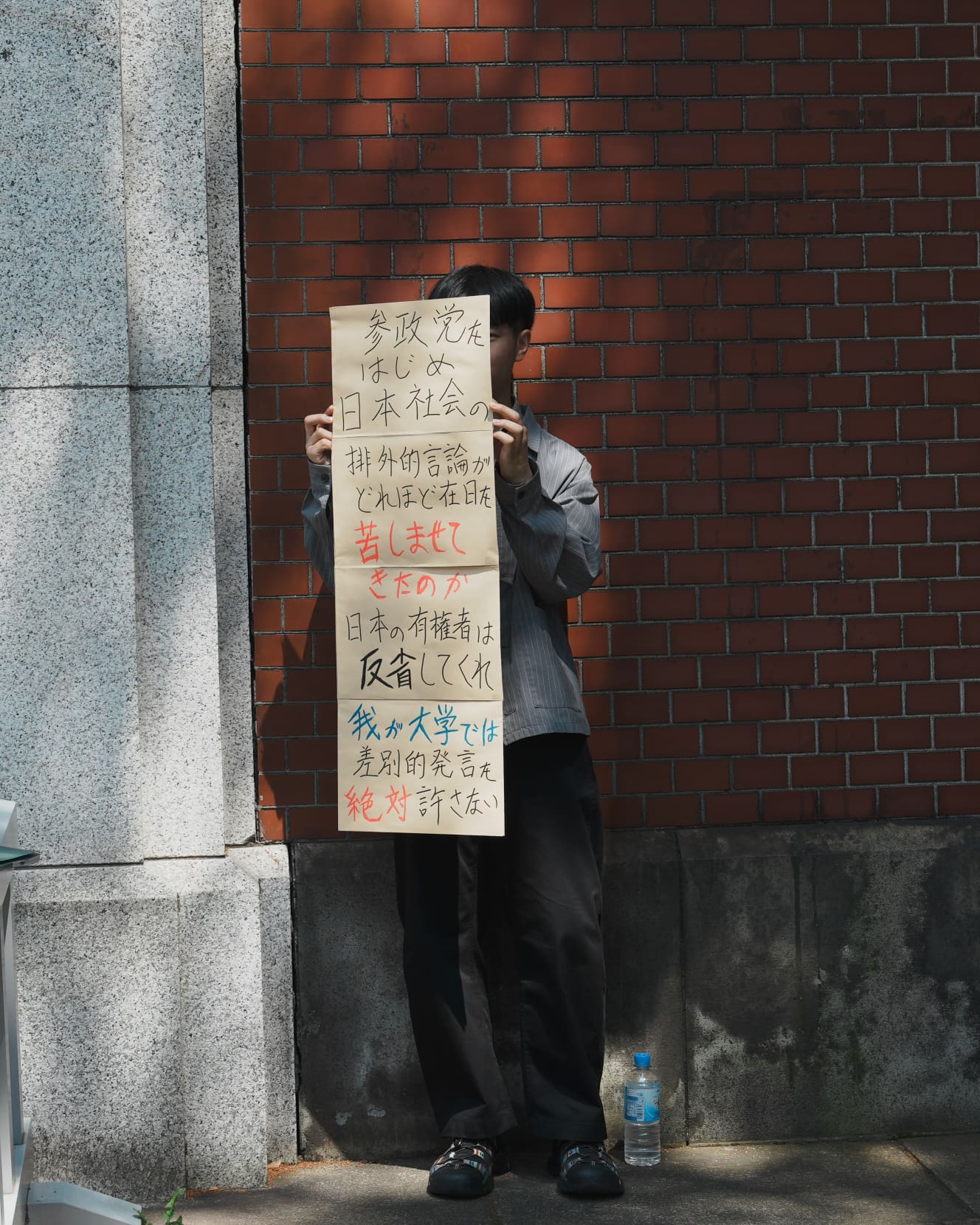
Opposition to the event had emerged as soon as it was announced. A group of students launched a protest campaign, arguing that the university should uphold the principle stated in the University of Tokyo Charter of maintaining a space for intellectual inquiry free from discrimination. They demanded that Kamiya sign a written pledge retracting what they described as discriminatory and false statements he had made in the past before being allowed to speak.
When I visited the festival on the morning of May 16, the campus was already crowded. In addition to students, there were local residents and high school students in uniform among the visitors. Kamiya had been scheduled to take the stage at noon. However, even after the appointed time, there was no sign that the event would begin.
As the clock approached 1 p.m., I headed to the university’s main gate. There, more and more protesters were gathering—some staging a sit-in, others carrying placards and marching around the campus.
The opposition to Kamiya’s appearance extended beyond students. Protest groups opposed to Sanseito itself appeared to have joined in as well.
Many people carried signs bearing slogans such as “Why is Kamiya at the University of Tokyo?” and “Down with patriarchy,” along with placards displaying protest statements. Demonstrators were present not only at the main gate but also outside Faculty Building No. 1, where Kamiya had been scheduled to speak.
Students perplexed by the sudden cancellation of the event
Around Faculty of Law and Letters Building No. 1, crowds gathered seeking admission tickets or demanding explanations from festival organizers about why Kamiya’s lecture had not begun, creating a tense atmosphere far removed from the usual festive mood of the May Festival.
Those who had come to hear Kamiya appeared to be predominantly older rather than younger attendees. Voices arguing could also be heard from inside the building. Since festival officials were instructing people not to enter, I spoke with a 74-year-old man who had come to attend the lecture and asked what had happened inside.
“At first, between about 11 a.m. and noon, only a handful of University of Tokyo students were inside the building, staging a sit-in protest. Then 15 to 20 people connected to Sanseito showed up, and arguments broke out between them and the students. The Sanseito supporters were very vocal, while the students spoke relatively little. Outside protest groups also made their way into the building and sat on the stairways, so the situation became quite chaotic. It was amid that confusion that the executive committee announced the cancellation of Kamiya’s lecture at 1 p.m.”
Then, around 2 p.m., an announcement came from the May Festival Executive Committee:
“Due to safety concerns, all events are canceled.”
Students began dismantling their booths while asking, “What’s going on?” and “Why?” Many appeared anxious and unable to grasp what was happening. One student staffing a booth spoke with visible frustration.
“We were just informed by the executive committee that our event had to be canceled. We don’t really know what happened, but we assume it’s related to Kamiya. There were many groups protesting Sanseito in front of the gate, so perhaps they did something.”
The situation became so heated that the phrase “Find Ugo” (referring to the student group Ugo no Shu) was reportedly circulating in student group chats.
Many ordinary students who had been looking forward to the festival expressed anger over the disruption.
“Some people are graduating from their clubs through this May Festival. A lot of students are disappointed by the cancellation. I spent months preparing for my project, and having it canceled on the very day of the event leaves me feeling devastated. Booths are generally funded by students themselves, so losing all afternoon sales means many groups will end up in the red. We can accept the financial loss, but we can’t accept having our memories of the school festival ruined,” another student said.
Some students were even discussing the possibility of filing a class-action lawsuit seeking damages.
A counter group took advantage of the situation!
But is it appropriate in the first place to invite a figure like Sohei Kamiya—someone who has a deeply entrenched base of critics—to a university festival?
The University of Tokyo’s May Festival regulations, known as the “Five Principles and Two Supplementary Provisions,” stipulate five principles, including no risk of accidents, activities must be student-led, and no promotion of specific religions or political parties. The supplementary provisions additionally require that events “not violate public order and morals” and prohibit activities that serve as advertising for companies or other organizations. According to an alumnus who guided me around the festival, however, political figures can still be invited despite these principles.
“It is possible to invite politicians to the May Festival and other university events. In fact, student-organized programs have frequently featured politicians in the past. Rather, the problem lies with the executive committee’s failure to anticipate that something like this could happen. More recently, during protests over the university’s tuition increase, the executive committee assigned several students to direct foot traffic and prevent confusion. The fact that similar measures were not implemented for a large-scale event like the May Festival suggests inadequate preparation.”
However, the alumnus argued that neither Ugo no Shu—the student group that organized the lecture after completing the required campus procedures—nor the May Festival Executive Committee that approved it should bear primary responsibility for the controversy.
“From the students’ perspective, this is not about a left-versus-right political dispute. It appears that outside counter-protest groups with no connection to the university took advantage of a May Festival event to pursue their own agenda. And the direct cause of the cancellation was the bomb threat. Whether it was a prank or not, I firmly oppose any attempt to suppress speech through criminal intimidation and threats of violence,” the alumnus said.
On the evening of May 16, the May Festival Executive Committee announced that the festival would proceed on May 17 after implementing enhanced overnight security measures and conducting bag inspections at entrances to ensure safety.
Although security checks caused delays for visitors entering on May 17, the day reportedly proceeded without incident.
On May 16, Kamiya posted on X:
“It appears that audience members were prevented from entering the venue today, so the lecture was canceled. I remained on standby, but there was nothing that could be done.”
The May Festival is a university event sustained by the goodwill of students and the members of the public who attend. The hopes of students who spent months preparing their projects—and of those responsible for running the festival—that it would conclude safely should never be trampled by violence.
We welcome your information and tip-offs to “FRIDAY Digital”. Please send your information to the following information form or to the official X.
Information Form: https://friday.kodansha.co.jp/tips
Official X: https://x.com/FRIDAY_twit
 The iconic Yasuda Auditorium basked in picture-perfect sunshine on May 16.


Interview, text, and photos: Blank Green