The Dream of Instant Translation? PockeTalk’s CEO Says It’s Finally Here
Part 2] 42 languages instantly become Japanese! The newest translator will be on sale soon!


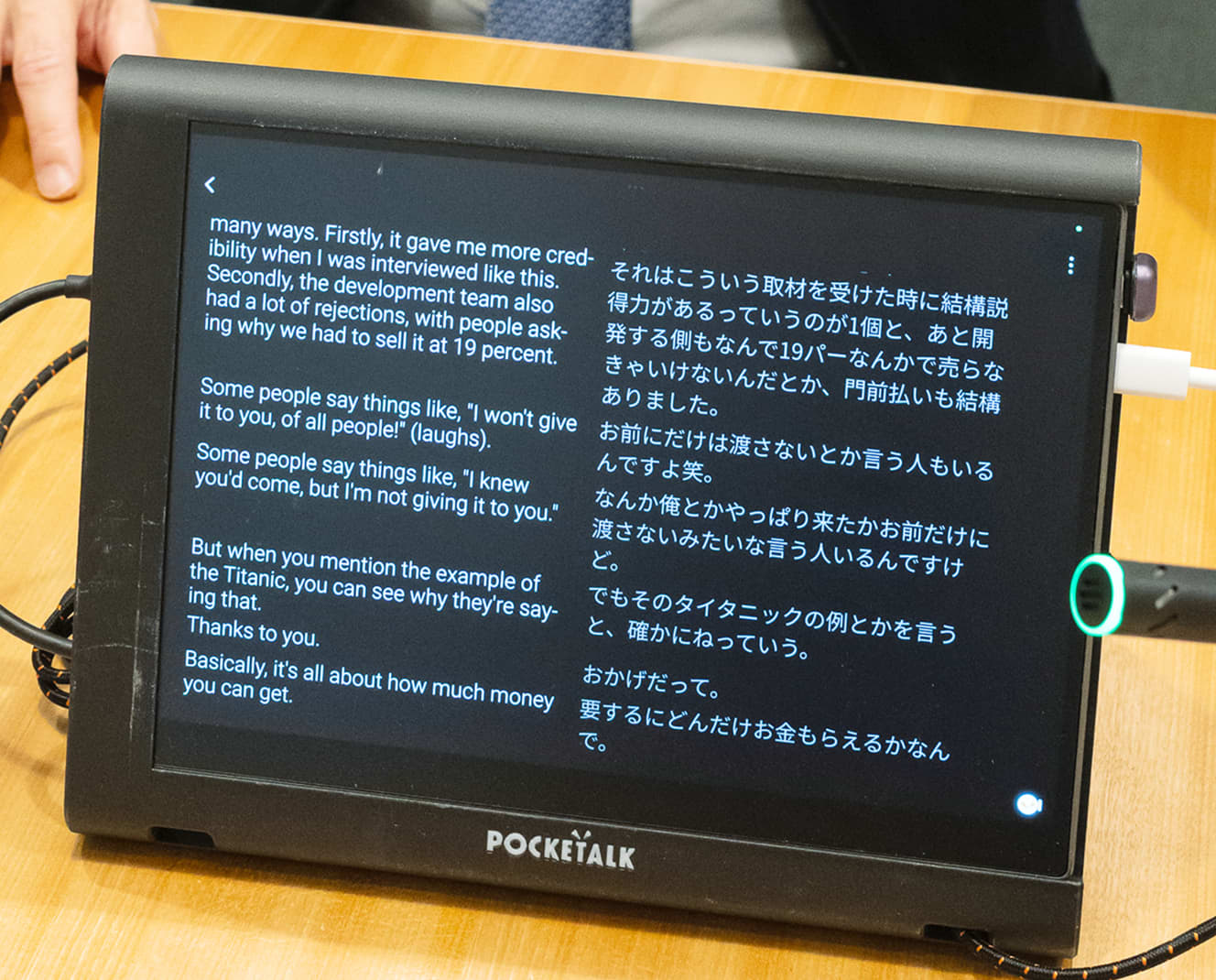
Scheduled for release sometime this year, the Pocketalk X is a stationary AI simultaneous interpretation device developed based on Pocketalk-Sentio, software that can understand a speaker by translating 42 spoken languages into voice and text in 77 languages in real time. Demonstration tests have already been conducted at airport counters and other locations, where Japanese people and foreigners who cannot speak Japanese at all were reportedly able to communicate without any problems.
“I struggled with learning English. And no matter how much I studied, I could never become like a native speaker. I started to think that it was simply too difficult for Japanese people in the first place. It felt like we needed something almost magical.”
Sales increased sevenfold
This was exactly the translation device he had envisioned. In fact, he had tried to pursue the idea in the sixth year after founding Sourcenext, but gave up because it seemed impossible. The turning point came four years after moving to Silicon Valley, in 2016.
At the time, he had launched a service that converted smartphone voicemail messages into text, and he was astonished by its accuracy. The technology had advanced dramatically.
“The most important thing for a translation device is first converting the user’s spoken Japanese into accurate text. Up until then, the biggest issue had been the poor recognition of Japanese speech.”
Things moved quickly from there. Within a year, the first Pocketalk device was launched.
“For the translation engines, we selected the best one available for each language. There was no need to use engines from the same company.”
This resulted in remarkable translation accuracy. They focused heavily on microphone performance so words could be captured properly, eliminated complicated contracts, and made it possible to use the device immediately after purchase.
After repeatedly gathering user feedback, they released a second-generation model the following year with a larger screen and improved usability. Later, a third-generation model with a camera function was introduced.
Then, in 2020, just as Pocketalk alone had reached sales of 9 billion yen, COVID-19 struck. Travel demand vanished, and 70% of sales disappeared.
However, an unexpected source of demand emerged.
“In fact, about 20% of people in the United States couldn’t speak English sufficiently in the first place.”
As the devices began being used in hospitals treating COVID-19 patients, orders poured in. Warehouse workers also needed them. Thanks to corporate demand, sales grew to an astonishing seven times their pre-pandemic level.
“Honestly, we never predicted that.”
There had long been interest from investors wanting to invest specifically in the Pocketalk business. However, Pocketalk accounted for too large a share of Sourcenext’s sales, and spinning it off would have required shareholder approval.
During the pandemic, though, Pocketalk’s share of total sales declined, eliminating that obstacle. Matsuda decided to separate the business.
In 2022, he established a new company, which later raised 10 billion yen in funding. That funding helped develop products such as Pocketalk Subtitles, the Pocketalk smartphone app, and the real-time interpretation software Pocketalk-Sentio.
As mentioned earlier, whatever language is being spoken appears smoothly on the screen. Moreover, the accuracy is remarkably high. It is now even used at international conferences.
The market spans the entire world. Already, half of the company’s sales come from overseas, something Matsuda says is rare for a Japanese startup.
“Moving to Silicon Valley was beneficial in this regard too. There’s an atmosphere here that makes you feel even extraordinary things are possible. And there are real examples of it all around you.”
While taking a walk with his children, he once even had a conversation with one of Google’s founders, Larry Page.
“He smiled like an angel and shook my hand.”
Matsuda says that experience taught him something important.
“I realized that perfectly ordinary, decent people can achieve extraordinary success.”
His hobby is baseball. He plays pitcher in amateur leagues and once threw a complete game with nine strikeouts while in his forties. In recent years, he has even appeared at professional baseball ceremonial first pitches, reaching 110 km/h.
“Whenever I return to Japan, I still make sure to stand on the sales floor. I always learn a lot. One customer once spent nearly an hour complaining, but when I handed over my business card at the end, they were shocked. The key is making sure people don’t realize you’re the president,” he says with a laugh. “Otherwise, you can’t hear their honest opinions.”
The day when Japanese people finally shed their English-language inferiority complex may not be far away. (Honorifics omitted in the original article.)
From the May 15-22, 2026 issue of “FRIDAY.”
Interview and text: Toru Uesaka PHOTO: Hiroyuki Komatsu