The Definitive 90s Idol Song Top 10—Experts Agree on a Clear Number One
Special Research Project Part 2


While the 1980s saw the emergence of glittering national idols such as Seiko Matsuda (64) and Akina Nakamori (60), the 1990s came to be called the winter era of idols. Popular music programs like “The Night Hit Studio” (Fuji TV) and “The Best Ten” (TBS) were discontinued one after another, and opportunities for idols to shine were lost. However, even in such an era, superstars who captivated audiences of all ages emerged, producing a string of million-selling hits that rivaled those of the 1980s.
For this feature, FRIDAY invited idol critic Akio Nakamori and Fumitake Takakura, along with radio personality Naoki Yoshida, who is well-versed in idol songs, to hold a roundtable discussion on 1990s idol songs. After intense debate, they selected a definitive top 10 of exquisite classics.
[Read Part 1 here] “Let’s talk about 1990s idol songs! Akio Nakamori × Naoki Yoshida × Fumitake Takakura debate the best songs”
Fukakyon and Aiko collaboration
Yoshida: You can’t leave out Yumiko Takahashi (52), who was called the last true orthodox idol of the 20th century. As a solo idol, she combined an adorable image with strong singing ability—much like 1980s idols such as Seiko Matsuda.
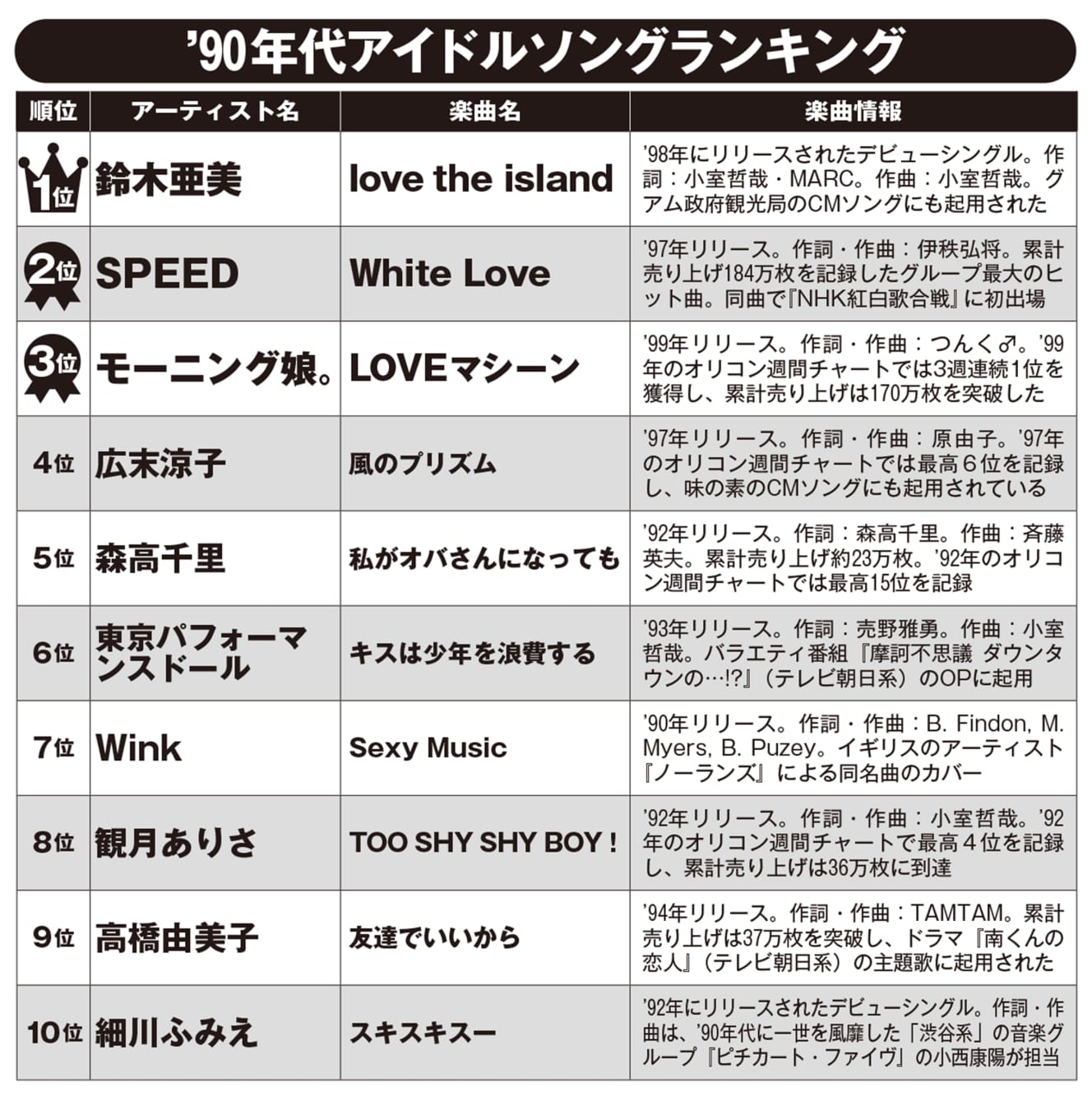
Nakamori: Her 1994 release “Tomodachi de Ii kara” is a masterpiece. As the title suggests, it is about unrequited love, and it sold over 370,000 copies. The drama “Minami-kun no Koibito” (TV Asahi), for which it was the theme song, also boosted its popularity.
Yoshida: Although Wink debuted in 1988, we should also talk about them as a group that broke through in the 1990s.
Nakamori: Their signature song is the Japan Record Award-winning “Samishii Nettaigyo,” but that was released in 1989.
Takakura: “Sexy Music,” released in 1990, was a cover of the British group The Nolans’ song of the same name. The Japanese lyrics were written by Nekko Oikawa, who also wrote “Samishii Nettaigyo.” It was the last Wink song to reach No. 1 on the Oricon weekly chart.
Yoshida: As mentioned earlier, another feature of the 1990s was idols who first gained attention as actresses and later released music. Kyoko Fukada (43) is one example.
Nakamori: Fukakyon doesn’t really feel like a singer, does she?
Yoshida: Actually, she released her debut single “Saigo no Kajitsu” in 1999. That song is a remake of “Ashita” by singer-songwriter Aiko (50).
The rise of the Komuro Family
The rise of the Komuro Family
Takakura: Arisa Mizuki (49) also made her acting debut before her CD debut.
Nakamori: She debuted as a singer in 1991 with “Densetsu no Shoujo.” It became a topic of conversation because it was used in a carbonated drink commercial she herself appeared in, but she is still more strongly associated with her acting career in the public eye.
Takakura: Her 1992 song “TOO SHY SHY BOY!”, which was also used in a commercial, became her biggest hit, selling over 360,000 copies. The lyrics, composition, and production were all handled by Tetsuya Komuro. Its catchy, upbeat sound and lyrics attracted many young listeners.
Nakamori: From the mid-to-late 1990s, acts like Tomomi Kahara and Namie Amuro—often referred to as the “Komuro Family” or “Komuro system”—emerged, producing a string of mega-hits selling over one or two million copies. However, they are somewhat different from traditional idols, aren’t they?
Yoshida: Yes. It might be more accurate to say they were artists with idol-like popularity. The 1990s was an era where people with idol-like qualities debuted without necessarily carrying the idol label.
Nakamori: Fumie Hosokawa (54), who became hugely popular as a gravure idol, also released several songs.
Takakura: Her 1992 debut song “Suki Suki Suu” is a good track with electronic sounds in the background and the repeated phrase “suki suki su.” It wasn’t a major commercial success, but it had a strangely addictive quality.

The ultimate idol song is
Nakamori: We still have a lot more to talk about, but it’s time to decide the rankings.
Takakura: I want to put Suzuki Ami’s “Love the island” at No. 1. In the late 1990s, when there were few orthodox solo idols, Ami—“Ami-Go”—suddenly appeared as a star. I think her commemorative debut song is an extremely important track in the overall idol scene.
Nakamori: I don’t disagree. However, the 1990s was also the era when the current style of large female idol groups was established. So I’d like to place SPEED and Morning Musume at No. 2 and No. 3.
Yoshida: In that case, those would be “White Love” and “LOVE Machine,” their biggest hit songs.
Nakamori: We should also include Hirosue in the top ranks.
Takakura: Then let’s place her around No. 4. I’d choose “Kaze no Prism,” rather than her signature song “Maji de Koi Suru 5 Byou Mae,” because it better matches her image.
Based on this roundtable discussion among the three idol experts, the editorial team compiled the following 1990s Idol Song Ranking: Top 10.
All of these are timeless classics that are still sung at karaoke today. After the winter era, idol songs entered a rich new spring.
From the May 15 and 22, 2026 issue of “FRIDAY”
PHOTO: Kyodo News Agency (Kanzuki)