Looming starvation! Only 28 Polar Bears in Japan… Polar Bears Disappearing from Zoos, Alarming Future “Humans Can’t Even Survive”.


Looming “starvation” due to sea ice loss…
A male polar bear cub born last December at the Oga Aquarium GAO in Akita Prefecture has been on display to the public since April, thrilling visitors. A naming ceremony was held on April 25, and the cub’s name was decided to be Momota.
The number of polar bears in captivity in Japan has continued to decline since peaking at 67 in 1995. Polar bears are difficult to breed in captivity, and Japanese zoos and aquariums have an aging population. Currently (as of April), there are 28 polar bears in captivity in 16 facilities throughout Japan. Experts fear that they may not be seen in zoos in the future.
Polar bears are rare animals that were listed as endangered by the International Union for Conservation of Nature (IUCN) in 2006. Even if zoos and aquariums consider introducing polar bears from their habitat, the Arctic wild polar bear itself is in danger of extinction.
The biggest threat to polar bears is the decrease in sea ice due to global warming. The Arctic is warming faster than anywhere else on Earth, and the area of sea ice on which they depend for their livelihood is rapidly shrinking.
Professor Emeritus Toshio Tsubota of Hokkaido University, a leading researcher on bear ecology, cites the decrease in sea ice due to global warming as the biggest factor in the polar bear’s threatened extinction.
How does the decrease in sea ice affect the survival of polar bears?
Sea ice is an essential habitat for polar bears as it is where they hunt seals. This platform is decreasing due to global warming.
There are eight species of bears in the world, and the polar bear is the only one that is a complete carnivore. It, too, relies on seals for most of its food. If the sea ice, which is a treasure trove of food, were to disappear, they would not be able to survive,” said Professor Emeritus Tsubota.
According to Professor Tsubota, polar bears hunt seals from November to May, when the Arctic Ocean is covered with ice. During this period, they eat seals and accumulate body fat. Since they cannot hunt during the five months after the sea ice melts, they are said to be able to survive on their accumulated body fat.
Unlike other bears, polar bears do not hibernate. On the contrary, they are inactive during the summer months, lowering their metabolism to prevent energy loss. Physiologically, their bodies go into a state of hibernation. The period of hibernation is about five months; they can live for about 150 days without any problems, but it is said that after six months, some polar bears will probably starve to death.
Recently, however, they have exceeded the five-month mark, and I think they are approaching the six-month mark. This is because the sea ice is melting earlier and the period when there is no sea ice, which means polar bears cannot hunt, has been extended by three to four weeks. With a shorter period of satiation, body fat stores will decrease and body fat will no longer be available to cover the period of fasting.”
Has the shortening of the seal hunt period caused any change in the polar bear’s diet?
There are reports of polar bears eating reindeer in some areas. However, seals are still the easiest animal for them to hunt. It is unlikely that all polar bears would eat reindeer.”


Emaciated mother bears and declining birthrates
Dr. Tsubota specializes in wildlife medicine and has played a particularly important role in research on bear reproductive physiology.
Even though bears mate during the mating season from spring to summer, the fertilized eggs stop developing without implanting in the uterus, and implantation occurs just as the animals go into hibernation. This is called “delayed implantation,” and it was Dr. Tsubota who revealed that brown bears in Hokkaido also have delayed implantation.
Polar bears also have delayed implantation.
In the case of polar bears, mating season is from April to May, and calving season is from November to January. The period between mating and birth is seven to eight months, but the fetus develops for two months, so they also have delayed implantation.
Polar bears do not hibernate, but only pregnant females do. Around October, they retreat to dens they have dug on ice or land and give birth to their young in them.
Polar bears mate around April, when seal hunting is over, so the females give birth in a state of continuous fasting throughout the summer and winter when there is no food. After giving birth to their young, they continue to raise their young in their dens, feeding them high-fat, high-protein milk. Parents and cubs come out of their dens into the open when the cubs reach a certain size. So the cubs are fasted for eight months out of the year at the most.
For eight months, the mother bears must give birth and raise their cubs …… without eating or drinking, putting their very lives on the line.
It is a matter of evolution that this way of life has taken root.
However, as the natural environment changes, it becomes increasingly difficult for bears to survive in their natural habitat.
In fact, their reproductive rate is declining, their mortality rate is increasing, and their numbers are decreasing. Polar bears give birth to one or two cubs per pregnancy, but in recent years there has been a considerable increase in the number of single cubs. I think the number of cubs is also decreasing.
Are polar bears also facing a declining birthrate?
In the past, there used to be a lot of fat, plump females that looked well nourished, but recently there have been a lot of skinny females. Nowadays there are many thin females. This naturally leads to poor milk production, and the cubs die. That is the main reason for the low birth rate.
Countdown to Extinction
In April 2011, Dr. Tsubota went to Canada, located in the Arctic Circle, to check on changes in the environment surrounding polar bears, and participated in an ecological survey in Hudson Bay. At the end of last year, he published a book titled “All About Polar Bears I Want to Tell Without Bears” (co-authored with Ms. Yoshiko Torii, an animal expert at Sapporo Maruyama Zoo, published by Jitsugyo no Nihonsha), which describes the current situation of the polar bears in their habitat. In the book, Torii states, “(Polar bears) are the most important animal in the world.
Polar bears are animals with sophisticated biological systems that have been adapted to the unique environment of the Arctic, so it is difficult for them to adapt well to rapid environmental changes such as global warming.
Polar bears are thought to have branched off from brown bears about a hundred thousand years ago. They have evolved over a long period of time, so it is unlikely that they will be able to adapt to environmental changes that have been altered by humans in a very short period of time, such as global warming. Polar bear researchers say, ‘At the moment, they are heading toward extinction.
Does Dr. Tsubota share this view?
Even now, the Arctic ice is melting and decreasing. Even now, the Arctic ice is melting rapidly, and if it continues in this state alone, it will probably become extinct. If global warming progresses further, the extinction will be accelerated.
That is why we must use human wisdom to stop global warming. That is why I try to appeal to the public as much as possible.
In “All About Polar Bears: What We Want to Tell the World Without Bears,” there is an interview with Andrew E. DeRocher, a polar bear researcher and friend of Dr. Tsubota, who also mentions what should be done to avoid polar bear extinction.
He, too, says we have to stop global warming anyway. To do so, the government and large corporations, as well as each individual, must take small actions in their daily lives, even if they are trivial things, such as using as little electricity as possible, for example. He said that this would lead to saving the polar bears.”
In its latest report (the Sixth Assessment Report), the Intergovernmental Panel on Climate Change (IPCC), which includes experts and scientists from around the world, asserts that there is “no doubt” that global warming is being caused by human activities. Humans have a responsibility to stop global warming.
If polar bears can’t live in an environment where humans can’t survive, perhaps humans can’t either. ” The decline of polar bears is an important message about the critical situation of the Earth. I think it is sounding a warning bell.
We humans need to listen to the alarm bells and change our own lives. If we don’t, I think we will end up in a situation that is truly irreversible.”
▼Toshio Tsubota is a professor emeritus at Hokkaido University, an invited faculty member of the Graduate School of Veterinary Medicine, Hokkaido University, and a researcher at the Department of Archives, Hokkaido University Museum. D. from the Graduate School of Veterinary Medicine, Hokkaido University. Professor at the Faculty of Agriculture, Gifu University in 2001, Professor at the Graduate School of Veterinary Medicine, Hokkaido University in 2007, and in his current position since 2014. Co-author of “Together with Bears: The Future of Polar Bears, Brown Bears, and Black Bears” (University of Tokyo Press), supervisor and translator of “Let’s Learn with Illustrations! Arctic Animals: Polar Bears” (Maruzen Publishing Co., Ltd.).

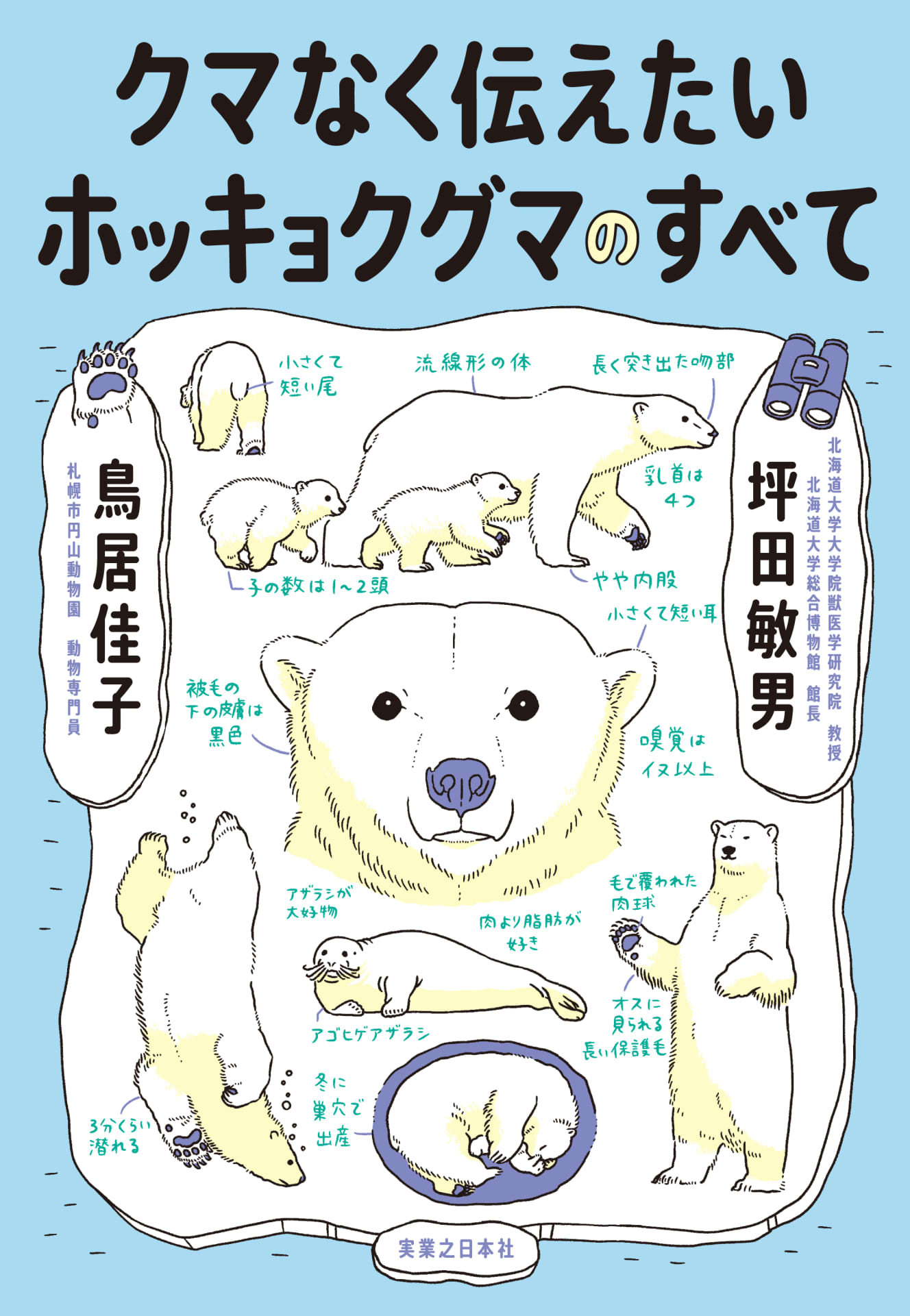
Click here to purchase “All About Polar Bears: What You Want to Tell Us About Them Without Bears”.
Interview and text by: Sayuri Saito PHOTO: Afro (1st and 3rd pictures)