Government Data Reveals Cheapest Rent Rankings Across Major Cities and Rural Areas


Recent price increases have hit people’s lives hard, with rising crude oil prices caused by the Iran war dealing a final blow. Many people feel they have already reached the limits of saving money and lament that there is nothing left to cut from food and daily living expenses.
Under such circumstances, the last remaining option is to reduce housing costs. However, moving to a cheaper rental area generally means relocating to rural regions. Unless one can work remotely or has professional qualifications, it also becomes necessary to consider changing jobs or even starting a business in the new location.
Pushing the limits: the harsh reality of housing costs in the Greater Tokyo area
While job changes or starting a business may sound daunting, it is worth first looking at the extremely severe housing situation in the Tokyo metropolitan area. According to Miki Hirata, who is in charge of public relations planning at the Japan Organization for Migration and Regional Revitalization, it is very difficult to find family-sized properties (over 70 square meters) even within Tokyo’s 23 wards.
“I was told by real estate agents that there simply aren’t enough properties. Some listings are found online and are immediately decided without even viewing them,” she said.
“I also heard cases where people who ran restaurants in Tokyo had to suspend operations during COVID-19 and tried to reopen afterward, but could not afford the high rent,” she added.
Housing prices in the Tokyo metropolitan area have skyrocketed to extreme levels. Data from March shows that the average price of newly built condominiums in Tokyo’s 23 wards reached 15.023 million yen, according to the Real Estate Economic Institute. The average price of used condominiums (converted to a 70-square-meter basis), according to Tokyo Kantei, also reached 12.425 million yen—far beyond the reach of ordinary workers.
Due to soaring rents, compact housing is gaining attention in the metropolitan area. The Ministry of Land, Infrastructure, Transport and Tourism has long set a standard of 25 square meters per single resident as the basis for a healthy and culturally adequate living environment. However, that ideal no longer reflects reality. Recently, rental units of around 10 square meters have become popular, especially among people in their 20s and 30s.
One-third of central Tokyo? Cities with ultra-cheap rent
Should one endure a cramped room and continue working in the capital area, or move to rural regions and significantly reduce housing costs? In rural areas, locally produced fresh food can be obtained at reasonable prices, and there is also the possibility of living a relaxed life with family in a rich natural environment.
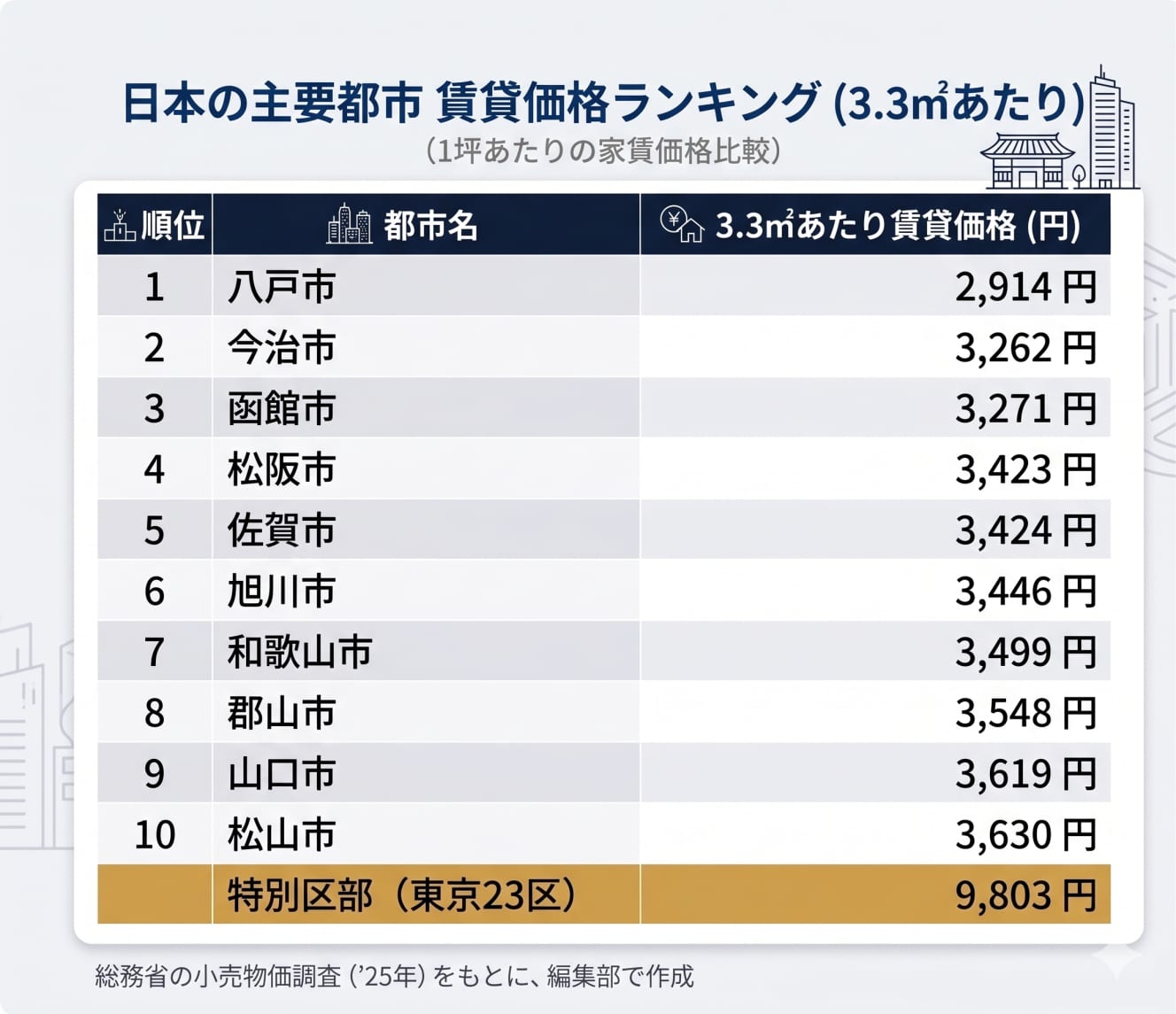
So how much is rent in major cities across Japan? Based on the 2025 Ministry of Internal Affairs and Communications “Retail Price Survey,” cities with prefectural capitals and populations over 150,000 were ranked by private-sector rent per 3.3 square meters (tatami equivalent). The survey covers about 28,000 households nationwide, and the figures are considered standard rental levels in each area.
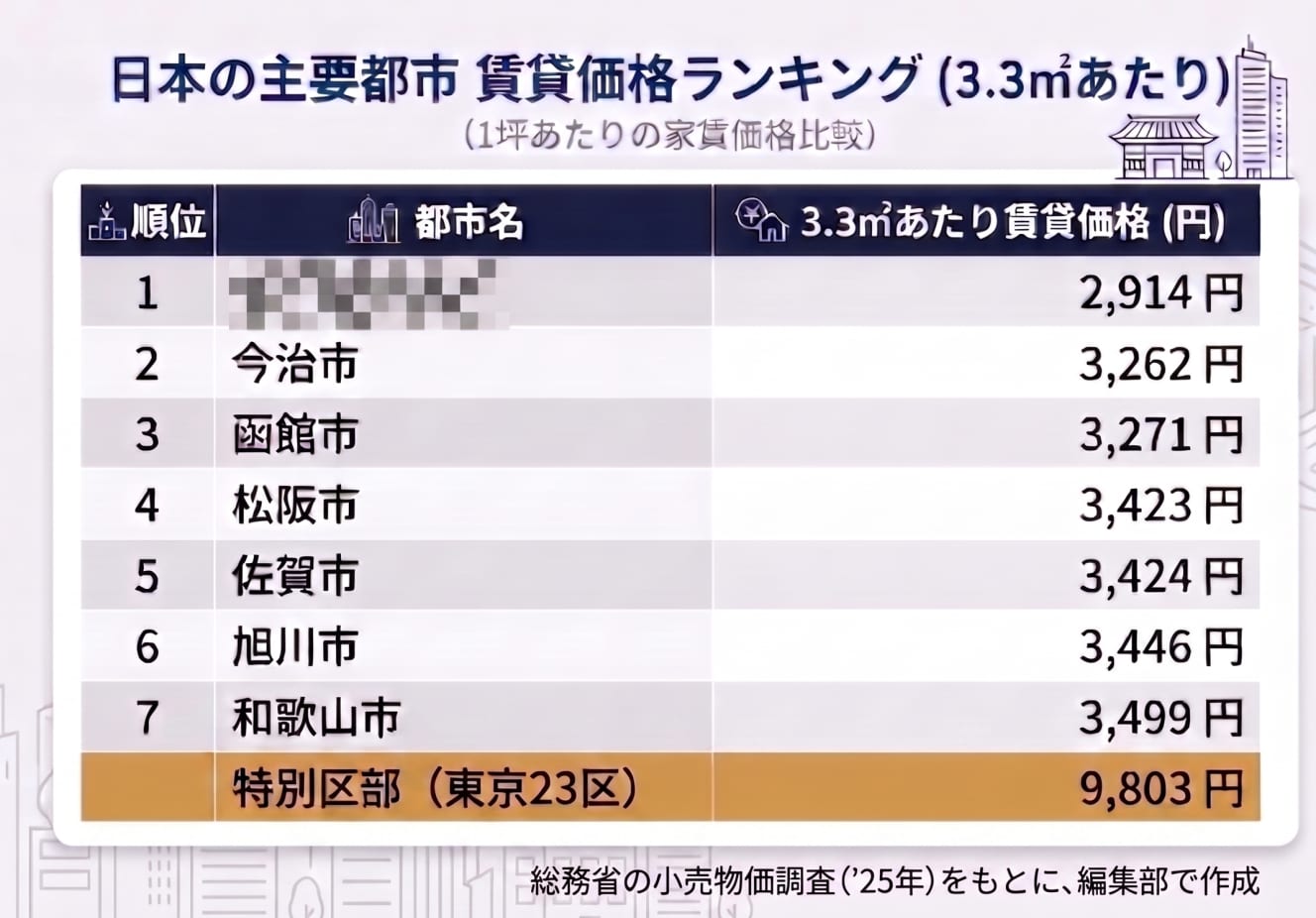
The highest rent in this ranking was unsurprisingly Tokyo’s special wards at 9,803 yen. The cheapest cities ranked as follows:
Hachinohe City: 2,914 yen
Imabari City: 3,262 yen
Hakodate City: 3,271 yen
Matsusaka City: 3,423 yen
Saga City: 3,424 yen
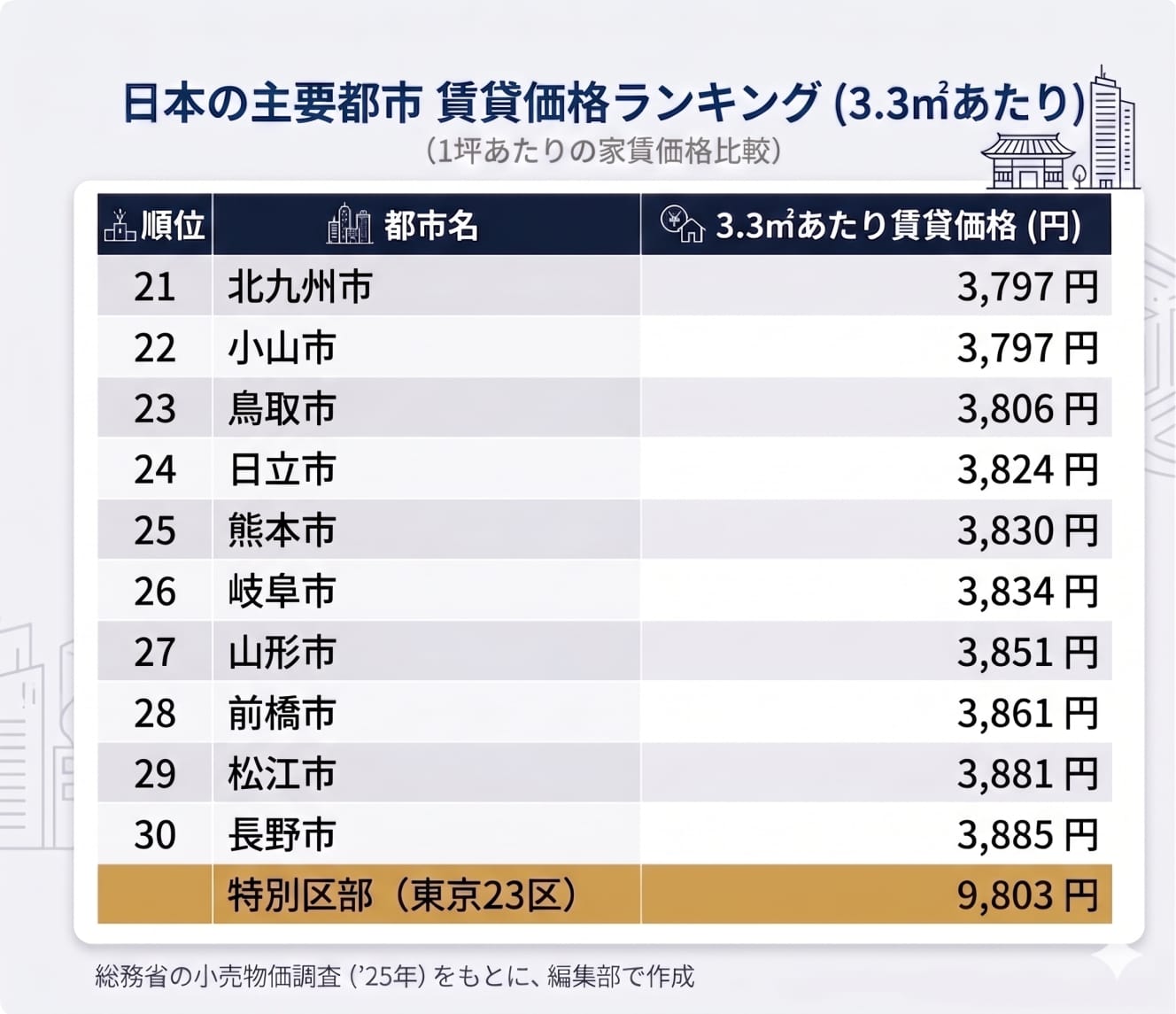
These cities are spread across Japan from north to south, at roughly one-third the level of central Tokyo. Expanding the criteria further, cities with private-sector rent below 3,500 yen also include Asahikawa and Wakayama. Expanding to under 4,000 yen includes 34 cities such as Mito, making it easier to choose potential relocation destinations based on regional characteristics and climate.
The reality of moving to rural areas: cars are essential, snow, and more
Interest in exploring different regions and researching local conditions in detail can be an effective approach, but life in rural areas is not necessarily all positive. Although rent is cheaper, that does not always mean that overall living costs will be lower.
The “Hometown Return & Migration Exchange Promotion Organization” publishes a brochure titled “HOW TO Migration,” which points out that while food and education costs may be lower, in some regions gasoline expenses can actually be higher than in urban areas, and income levels may decrease. Assuming that moving to the countryside will greatly improve household finances can be dangerous.
Regarding Hachinohe City, which ranked as the cheapest in the municipal rent rankings, Ms. Hirata offers the following caution:
“Prefectures like Aomori are cold in winter, so it’s best to visit in person. Heating costs such as kerosene for stoves also add up.”
In areas with heavy snowfall, snow removal work is also essential, and utility costs such as water and gas may be higher than in urban areas. It is also not uncommon for these regions to require each household to own a car.
“In addition to neighborhood association fees, there are places where residents are required to participate in cleaning roads and public facilities. It’s better to research this in advance.”
How to succeed in moving successfully
On the other hand, there is also attractive information for people considering relocation.
“In areas actively trying to attract migrants, some municipalities provide housing. For example, detached houses may be available for around 50,000 yen in rent. Recently, about 80% of relocation consultations come from people seeking jobs in regional cities rather than rural farming villages, as it is easier to find employment there.”
The “Hometown Return Support Center,” operated by the same organization, reports that far more people are seeking jobs locally rather than working remotely. Recently, some people even visit the center after asking AI for advice and being told that a certain region is not suitable for them.
As advice for successful relocation, Ms. Hirata says:
“Do your research in advance and visit the area. It involves your life, and if you have children, you also need to understand the education system.
Even in regional cities, you need to make an effort to integrate—such as greeting local residents. Don’t bring an overly urban attitude. It helps to find people you can rely on. Try not to see inconvenience as a burden, but as something you can enjoy.”
Amid endless price increases and soaring housing costs in the capital region, considering rural relocation as one possible option may open up new life paths.



Interview and text by: Hideki Asai