Anna Nakagawa’s FRIDAYReport] “How to build a strong mental attitude” learned from fencer Misaki Emura
We want to meet, hear, and learn from that top runner [Part 2, Part 1


A blonde Olympic medalist of a different color appears on the scene!
Despite being ranked No. 1 in the world last season, her mentality was shaky.
What is the “way to adjust your mind” that she saw beyond the peak of her career?

The second guest is Misaki Emura (pictured right)!
To be in a good mood
Nakagawa: The first time I saw Ms. Emura was at the team formation ceremony for the Paris Olympics. She was the flag bearer at that time, wasn’t she? Her eye-catching blond hair and dignified appearance made her look like a model. On the other hand, when I met you in the studio of “Sunday Sports” after winning the medal, you had a very cute, crooked smile. I was struck by the gap.
Emura: People who have never talked to me before are quite intimidated by my appearance alone (laughs). They probably only have an image of the tense atmosphere during the games.
Nakagawa: Following the bronze medal in the team competition at the Paris Olympics, I was ranked No. 1 in the world last season. He is still traveling around the world every time he competes. In the midst of all this, I heard from you on YouTube that there was a time after the Olympics when you could not maintain your motivation.
Emura: Even now, my motivation is not stable. It is true that I still find myself going into competitions not feeling fresh. Strangely enough, it is at times like that that I am able to win first place in competitions. However, there is no way I can reproduce such a victory, so there is no way I can go to the next Olympics with this kind of tension. I am at the stage of trial and error so that I can control it myself.
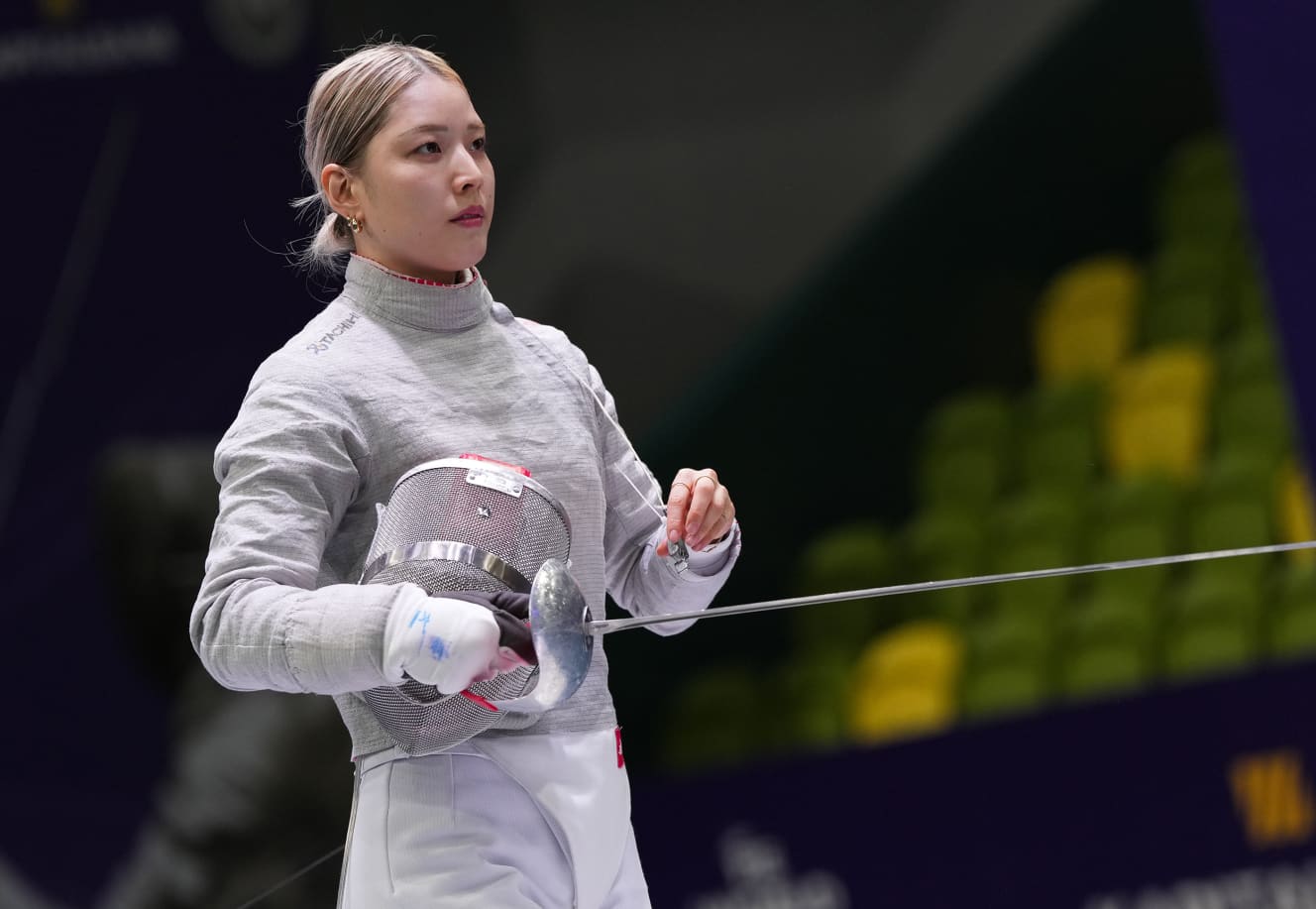
Nakagawa: She is now 27 years old and in her maturity stage as an athlete. Does that mean there are difficulties in that area?
Emura I think I feel this way because I have accumulated so much in my career. Now, of course, I want results, but I also want to know if I am doing the fencing I want to do, the quality of my performance, and above all, if I am enjoying myself. I want to compete with those things in mind. I originally started fencing because I liked it. I wanted to be strong, and I had a rival I wanted to beat, so I worked hard for a long time. But now that I no longer have a rival, my goals have changed. My mind is also turned to how I can pursue the kind of fencing I want to do.
Nakagawa I was surprised to hear before this interview that you sometimes arrange your own flights for overseas expeditions.
Emura That’s right. Sometimes I have the association take care of the procedures, but it is usually cheaper if I do the research myself. It is not unusual for me to do it myself. Basically, most athletes bear their own travel expenses. Fencing associations are not large.
Nakagawa I see! For example, do you sometimes choose to take a difficult connecting flight in favor of a budget-conscious flight rather than a less tiring direct flight?
Emura Yes, I do. I fly economy, and direct flights are rare. To be honest, I am fortunate to have sponsors, but it is difficult for student athletes.
The Importance of “Off Schedule
Nakagawa: It must be a challenge just to keep in good condition. In addition to physical conditioning, mental stability must also be important.
Emura: Mentally, I used to be a perfectionist by nature, and I used to get frustrated all the time. Before big competitions, I even felt like the people around me were my enemies.
Nakagawa: I know it’s a bit forward of me to say this, as I am not an athlete or anything, but I totally understand. When you are sensitive, even well-meaning words uttered by those around you may seem a bit reserved, don’t you think?
Emura That’s right. Then who will take the responsibility if I follow your advice and fail to get results? I sometimes wonder. Before the games, my personality had definitely deteriorated.
Nakagawa Is that something that can be improved? I am still not at all …….
Emura I am still searching for ways to improve, but I have become more conscious of how to be in a good mood on the day of the match. I have noticed that this directly affects my performance in the match. I value being in a good mood both in the short term and in the long term.
Nakagawa: Do you set aside a day off?
Emura That’s right. In the past, I did not have any off days. Even if I did, I had to go for a run or do something to relax.
Nakagawa: That is exactly what I am doing now. I just became a freelancer, so I am relieved to have a solid work schedule.
Emura I was also so determined not to have any regrets about competing that I practiced every day, which is amazing when I think back on it now. But then I reached the limit of my fencing-soaked days. It was in 2010, after the Tokyo Olympics. My body began to be affected, and there were days when I could not practice due to nausea and diarrhea.
Nakagawa: Looking back, do you think that it was a mental condition?
Emura I think it definitely was. After that, I took a two-week vacation. I had never taken such a long break since I started fencing. I wanted to refresh everything at that time, so I decided to go with this blonde hair. I thought, “Let’s do it! (laughs). (Laughs). That was the first time I learned the importance of taking a break and switching things up.
Nakagawa: That boldness has led to the results you have achieved so far. What do you usually do on your days off?
Emura: I make plans to take time off. For example, if someone invites me out, I apologize because it is my day off.
Nakagawa That’s a wonderful idea.
Emura I don’t set a specific time to get up in the morning, and I don’t even set an alarm. I don’t even set an alarm. I create days when I am not busy with anything, and I try to keep a good balance.
Nakagawa Anna’s FRIDAYReport Vol. 2, Part 2] Misaki Emura, “Top Player” of women’s fencing sabre
Misaki Emura was born in Oita Prefecture. After graduating from the Faculty of Law at Chuo University in 2009, she became Japan’s first professional fencing player.’ She won a bronze medal in the team competition at the 2012 Paris Olympics and was the first Japanese female fencer in the history of women’s sabre to be ranked No. 1 in the International Fencing Federation rankings for the 2024-2025 season.
Nakagawa: Born in Tokyo, Nakagawa spent her childhood in Finland and Puerto Rico. Spent her childhood in Finland and Puerto Rico. Joined NHK as an announcer in 2004 and worked as a local anchor for “Sunday Sports” and the Paris Olympics.” After leaving NHK in the spring of 2013, he joined the entertainment agency Horipro, where he worked as a freelance announcer and TV personality.


From the May 1-8, 2026 issue of FRIDAY
PHOTO: Hitomi Tanaka Stylist: Miku Ogawa Hair & Make-up: Sayoko Saki Costume Cooperation: e.m.