BTS Tokyo Dome Return Draws 110,000 Fans as Related Stocks Drop 15%


“Hello everyone, it’s been a while! We really missed you!”
At Tokyo Dome on April 17–18, during their first full-group Japan concert in about seven years, titled “BTS WORLD TOUR ‘ARIRANG’ IN JAPAN”, the members expressed their joy. The 110,000 fans who filled the venue let out thunderous cheers that seemed to erase the years of their absence in an instant. The performance of hit songs like “Butter” and “Dynamite” brought the excitement to its peak.
However, behind this glamorous live concert, a cold wind was blowing through the Korean stock market――a gap between on-site and streamed performances.
The temperature difference between the live venue and streaming
HYBE, the agency of BTS and a long-standing king of the K-pop industry, saw its stock price plunge by more than 15% in a single day right after the group’s first reunion concert following all members’ military discharge, held on March 21 at Gwanghwamun Square in Seoul. As aerial images showing empty spaces in the square spread on social media, a wave of pessimistic sentiment regarding the end of BTS mania swept through the Korea Exchange (KRX).
This trend did not stop in April. On April 14, the stock closed at 245,500 won, down about 40% from its February peak. The market remained skeptical. The reason investors rushed to sell was something very concrete.
According to police announcements, around 40,000 people attended, and even the agency’s estimate was about 100,000—far below the expected figure of 260,000.
However, it would be premature to interpret this lower turnout as a simple decline in popularity. Behind it lie two factors: painful memories in Korean society and a digital strategy. A representative from a major record company explained the situation:
“This drop in attendance is not really due to waning popularity, but rather severe physical constraints. The site was heavily influenced by the tragedy of the Itaewon crowd crush in Seoul in October 2022, which claimed over 150 lives. Authorities were on extremely high alert. Police and local governments feared crowd congestion in specific areas and deployed as many as 15,000 security personnel. Strict controls such as metal detectors, one-way pedestrian flow, and even trains skipping nearby stations made it extremely difficult just to get there. In addition, the government issued advance alerts, and the media also fueled fears of chaos, effectively running a don’t come campaign.
Meanwhile, the live Netflix broadcast to about 190 countries was a major success. Rather than attending in person under strict restrictions, fans simply chose to enjoy it from home, resulting in a massive shift toward 18.4 million concurrent viewers.”
Fan base changes and a new winning strategy
However, BTS is not necessarily safe just because of these concurrent viewing figures. During their absence, the power structure of K-pop has been dramatically reshaped. Within HYBE, younger and more energetic successor groups such as NewJeans and Stray Kids from JYP have risen to prominence. In addition, BLACKPINK, which has made a full comeback under YG, and IVE, which boasts overwhelming brand power, have intensified competition for market share across agencies to an unprecedented degree.
In particular, the fact that interest among younger fans—especially those in their teens to early 20s—is being dispersed among these new-generation groups also highlights the aspect that BTS is being confronted with the age limit of an idol group.
“However, when looking at the current state of ARMY (the name of BTS’s fandom), the fanbase that once centered on teenagers has now completely shifted to people in their 30s to 50s, transforming into adults with strong purchasing power. ARMY members deliberately avoid on-site chaos, enjoy digital content, and are willing to spend large amounts on expensive tickets. BTS is no longer a disposable idol, but an icon that influences all generations,” the source says.
BTS is currently holding a world tour of 85 shows across 34 markets (as of April 22). Future performances are planned across North America, Europe, South America, Asia, and Oceania, with additional concerts in Japan and the Middle East also being considered.
“Even with that level of popularity, investors remain cold. Regarding the scale of this world tour, the market had expected that, given their past momentum, a mega-tour exceeding 100 shows would be possible, so there are voices pointing out that it feels underwhelming. Adding further pressure is rising crude oil prices due to escalating tensions in the Middle East. Transporting massive equipment and personnel across five continents has caused operating costs to surge due to inflation. Even if they can draw crowds, there are concerns about whether profits will remain. It is precisely these profitability concerns—despite the historic sales of the album ‘ARIRANG’—that are pushing down the stock price,” says a representative from a major record company.
Are they obsolete, or are they the kings of a new era? The answer will be determined by the profits generated by this tour and the global wave of enthusiasm.
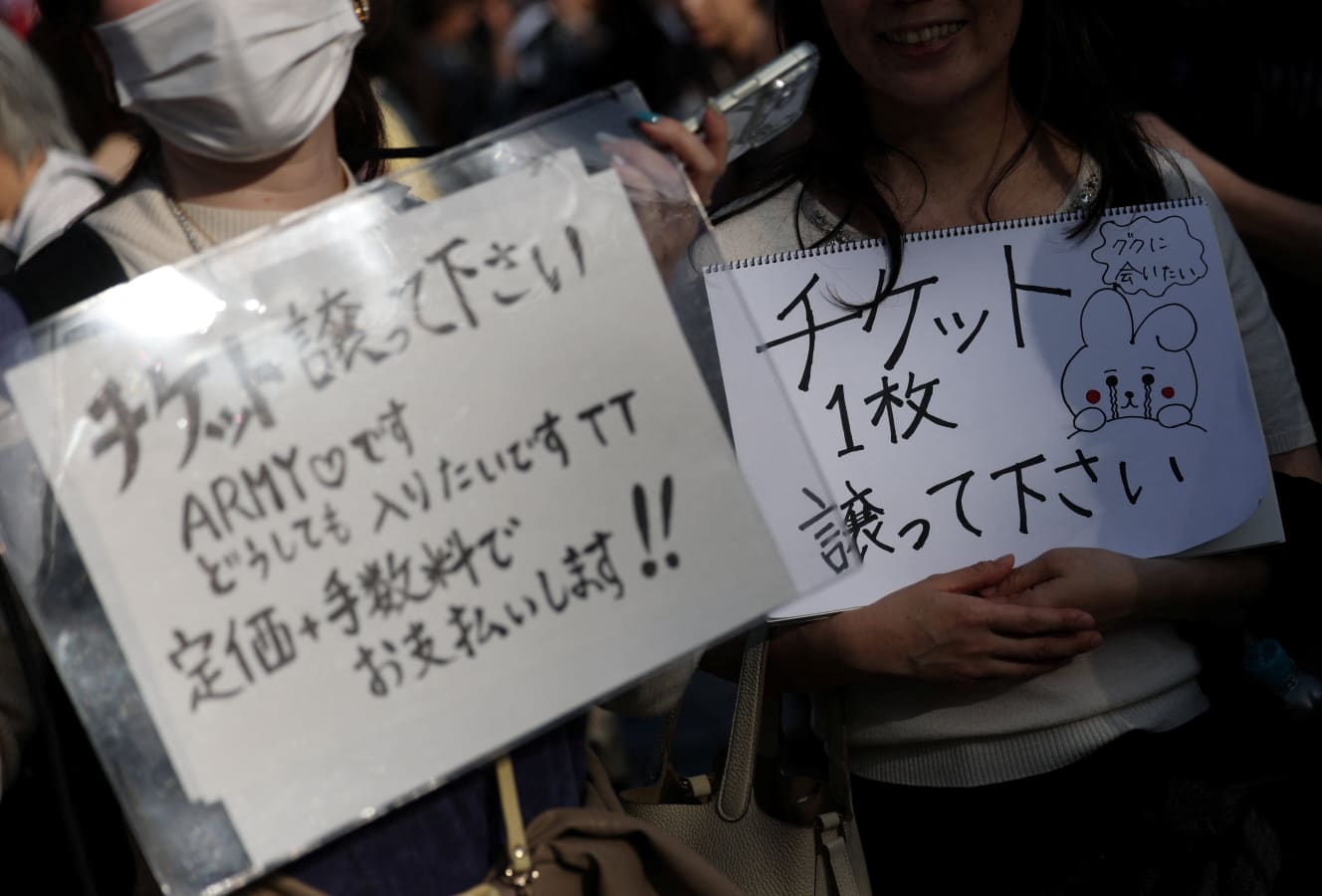

PHOTO: Afro